
In Conversation with Elia Nurvista on Palm Oil, Plantation Logic, and the Hauntings of Commodity Landscapes
When ARTITUTE first received the press materials for Nafasan Bumi ~ An Endless Harvest, we were immediately drawn in by the language surrounding Elia Nurvista’s practice: food, politics, plantations, and the systems that quietly shape what we consume.
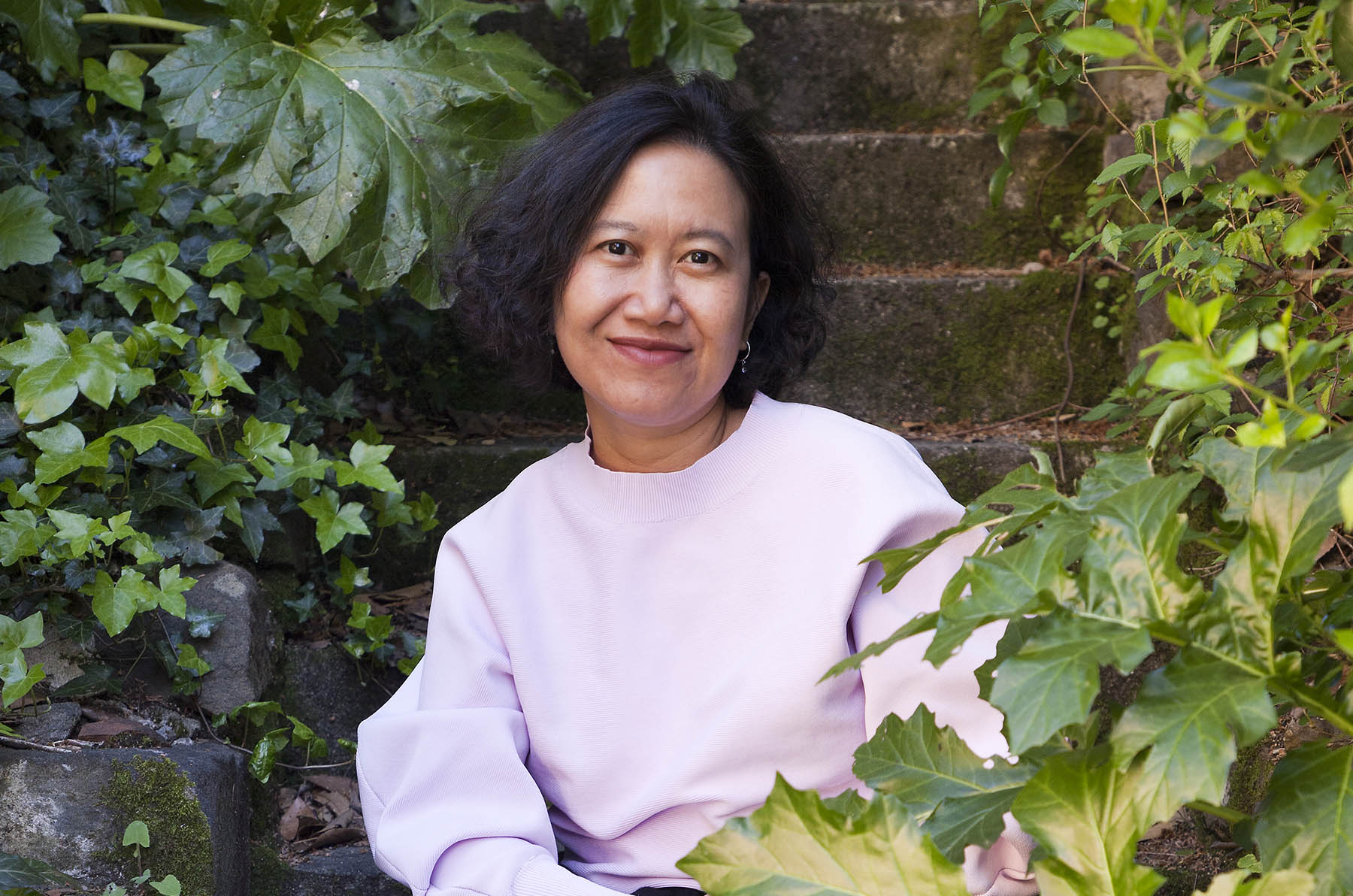
Elia’s work has long examined how everyday ingredients carry the weight of history. From sugar to palm oil, her projects reveal how something as ordinary as cooking oil can be inseparable from colonial legacies, ecological devastation, and the lives of workers who remain unseen.
Presented as a duo exhibition with Indonesian artist-technologist Bagus Pandega, Nafasan Bumi brings together two raw materials deeply embedded in global supply chains: palm oil and nickel.
On 15 January, ARTITUTE met Elia at Singapore Art Museum for an exclusive interview, followed by a private tour of the exhibition.
What emerged was not only a story about palm oil, but about the plantation as a structure that continues to repeat itself, endlessly.
Beginning with Palm Oil: Research Since 2020
Elia shared that her research into palm oil began around 2020, growing out of her earlier investigations into sugar plantations.
“Before palm oil, I was working with sugar and sugar plantation,” she explained. “What remains is the plantation logic and scheme that now operates in other commodities.”
Palm oil, she notes, has become one of the largest drivers of deforestation in Indonesia today. Yet its presence in daily life is almost invisible.
“It becomes directly 100 or 1000 products that we find in the supermarket,” she said. “And we use it daily.”
For Elia, this disconnection is precisely what makes palm oil such a powerful subject. A commodity planned in policy rooms and traded globally, yet consumed without trace.
She became especially interested in how shifting European energy policies, including plans to reduce fossil fuels, created demand for alternative resources like palm oil, accelerating plantation expansion in Southeast Asia.
“It was planned in one place,” she reflected, “but then all the process goes as a global commodity, somehow lost the track.”
Zooming Out, Then Zooming In
Elia described a turning point in her research.
After first seeing palm oil as a global system, she felt compelled to return to the plant itself.
“I want to zoom in, into the plants itself as an object,” she said.
During her research with Singapore Art Museum, she visited plantation landscapes more closely, including a trip to Johor Bahru, Malaysia, while grounding her wider inquiry in the histories and realities of Indonesia’s plantation economy.
Palm oil is not only an abstract global commodity. It is also a living organism, a physical structure, a landscape that reshapes communities.
Plantation Labour and Colonial Continuities
One of the most striking parts of Elia’s interview was her discussion of labour.
She spoke about one of the earliest palm oil plantations in Sumatra, established during Dutch colonial rule, where migrant workers were brought in from China, Tamil communities, and Java, because migrant labour was easier to control.
This system continues in modern plantations, where companies often avoid employing local communities, preferring workers from elsewhere, people without land, people with fewer protections.
Indigenous communities, she added, are among those most affected by expansion through deforestation and land concessions.
“It’s not only ecological cost,” she said, “but also social cost.”
Material Curiosity: Discovering Red Palm Oil
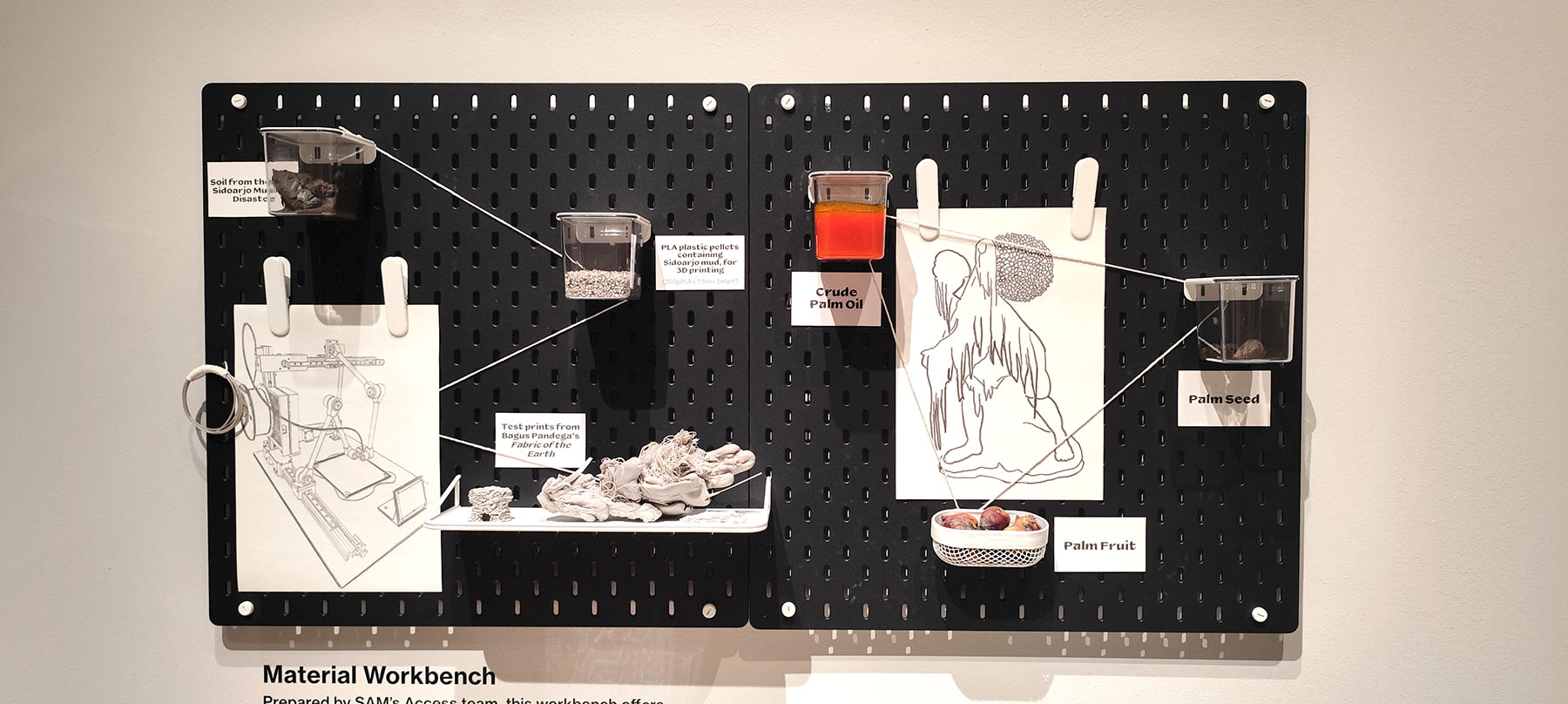
Elia’s research also began with moments of unexpected discovery. She spoke about encountering unrefined palm oil for the first time, a vivid red oil that emerges at the earliest stage of pressing.
“I didn’t know that the first product would be this red,” she admitted, almost questioning herself. Like many, she had only ever associated palm oil with the familiar pale cooking oil found in everyday kitchens.
It was only later that she realised this red palm oil is used widely in African cuisines, forming the fragrant base of soups and dishes that carry an entirely different sensory relationship to the commodity.
That moment of surprise became a turning point. Her curiosity led her to begin working directly with the material, transforming its colour into visual language. Visitors can encounter traces of this exploration in the exhibition’s learning room, where a stamp activity draws from the forms she created with palm oil itself.
From there, Elia continued looking deeper into plantation by-products, including palm fronds, often discarded as waste, yet repurposed by women in plantation communities into woven crafts and baskets.
“What is considered as waste has no longer value in plantation economy,” she said.
She was equally moved by the gendered invisibility of this labour, where women often work alongside husbands in plantations yet remain unregistered and unseen.
Bodies in Penumbra: Sculpture, Exhaustion, and Dissolving Forms
The material weight of these realities is felt throughout the gallery.
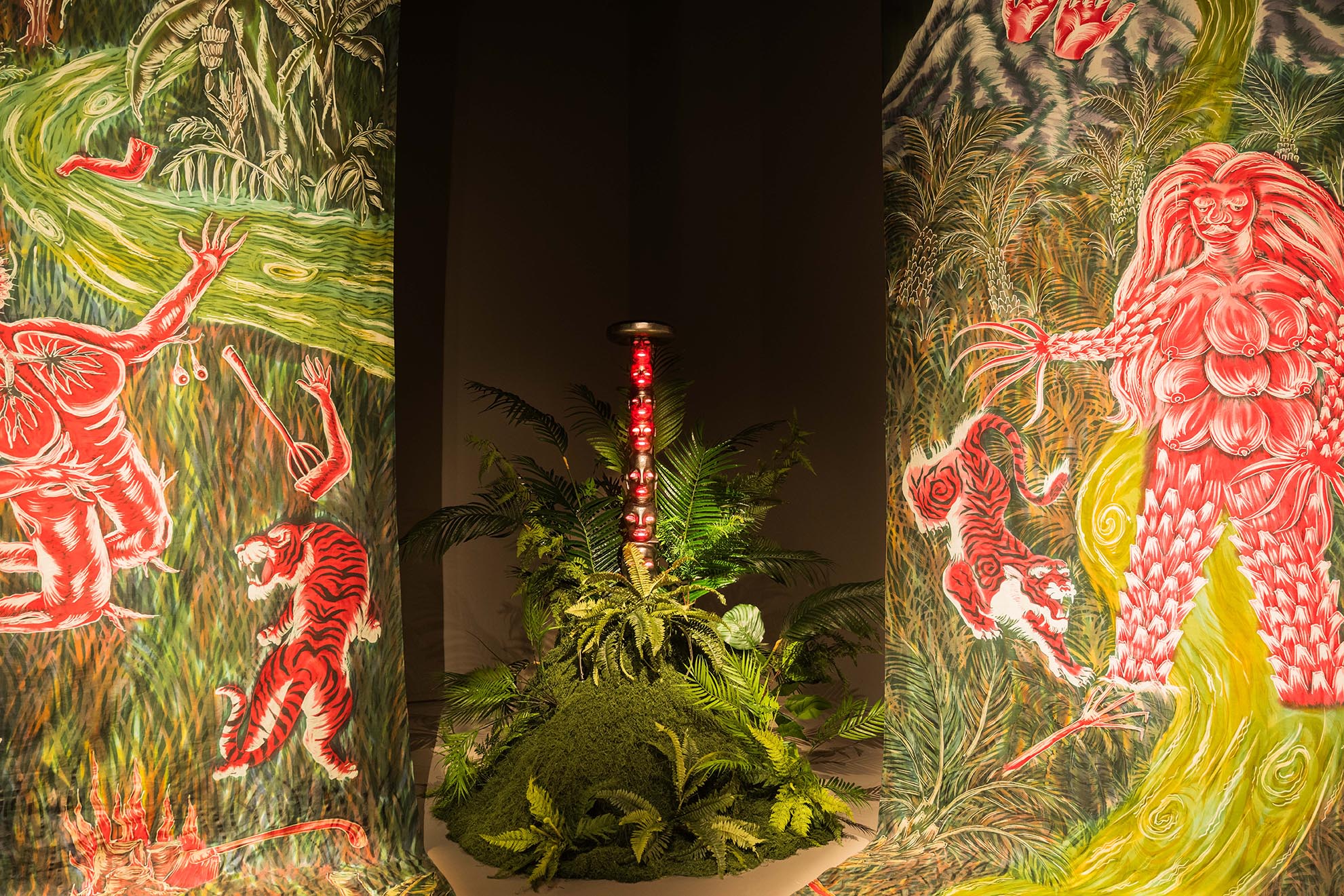
Between two large batik textiles stands Cyborg (2026), a sculptural figure that feels almost like a totem at the centre of the room. Constructed from 3D-printed filament, resin, aluminium, water hose and LED light, Cyborg becomes a personification of plantation power.
Elia describes Cyborg as a central character in her film Plantation Tragedy (2026), set in a world where oil palms are imagined as going on strike.
In the film, Cyborg reports figures and conditions, its voice moving between confession and calculation. Capital, technology and emotion collapse into one language, where even grief and guilt are processed as data.
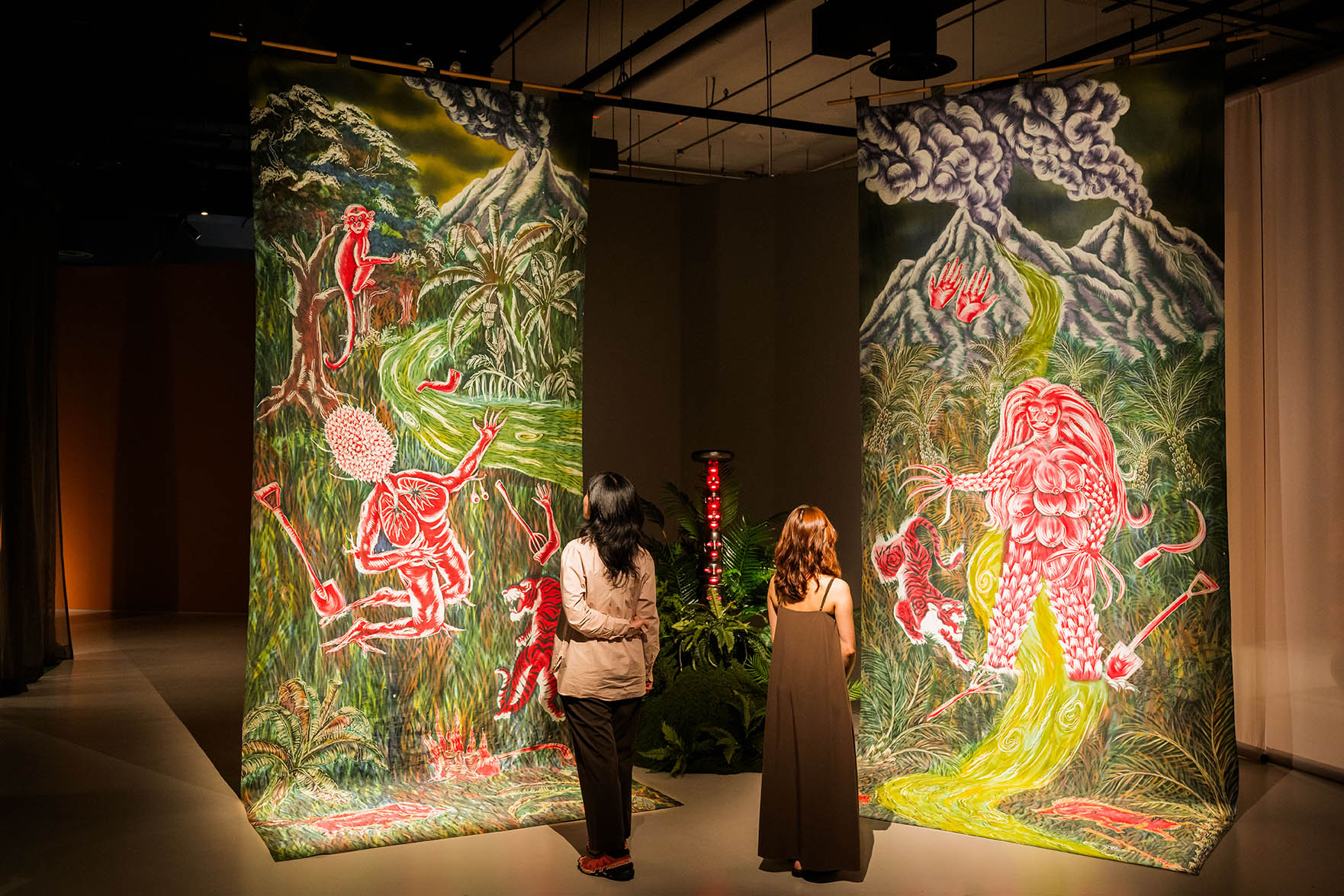
Nearby, Elia’s batik work Exhausted (2026) extends her ongoing Long Hanging Fruit series. Using palm oil wax within batik’s wax-resist process, she depicts palm trees, fruits, and the bodies that harvest them.
These bodies appear mutated under toxic plantation conditions, drawing attention to women whose unseen labour sustains these economies.
Plantation Tragedy: The Film at the End of the Room
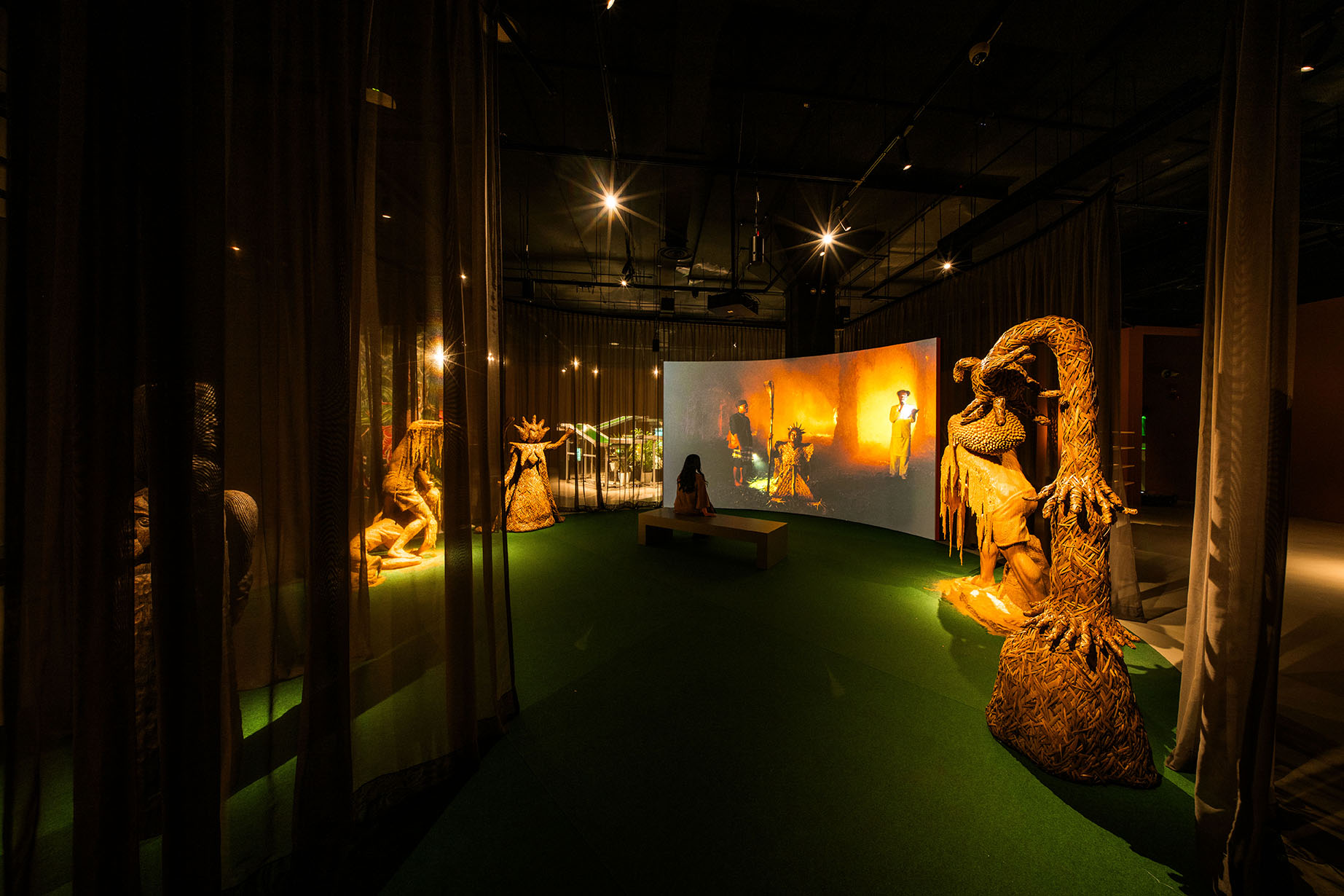
At the end of the gallery space, Plantation Tragedy unfolds within a circular pavilion, drawing on the language of Renaissance architecture while unsettling it.
Instead of marble columns, the pavilion is anchored by sculptures from Bodies in Penumbra: The Soft Machinery of Light (2026), made from processed palm fronds, wax, palm oil residue, and carved palm trunk.
The film presents a surreal dreamscape where labourers, scientists, artificial intelligence, and vegetal communicators confront one another in shared exhaustion.
Four figures, Francis the overseer, Dona the vegetal communicator, Watiman the scientist, and Cyborg the sentient machine, express competing desires for progress, justice, and rest.
As the oil palms begin to groan, complain, and ultimately refuse to produce, a fantasy of vegetal strike emerges.
The plantation becomes a scene of imagined resistance, inviting us to consider whether the Earth itself might one day refuse.
Ghost Stories, Feminist Hauntings, and Becoming Palm
In her batik works, Elia also draws from Indonesian horror folklore, where female ghosts often embody repression, anger, and unresolved violence.
“The ghosts are female,” she said. “They become ghosts coming from oppressed social situations.”
Rather than treating these spirits negatively, Elia frames them as powerful manifestations of resistance.
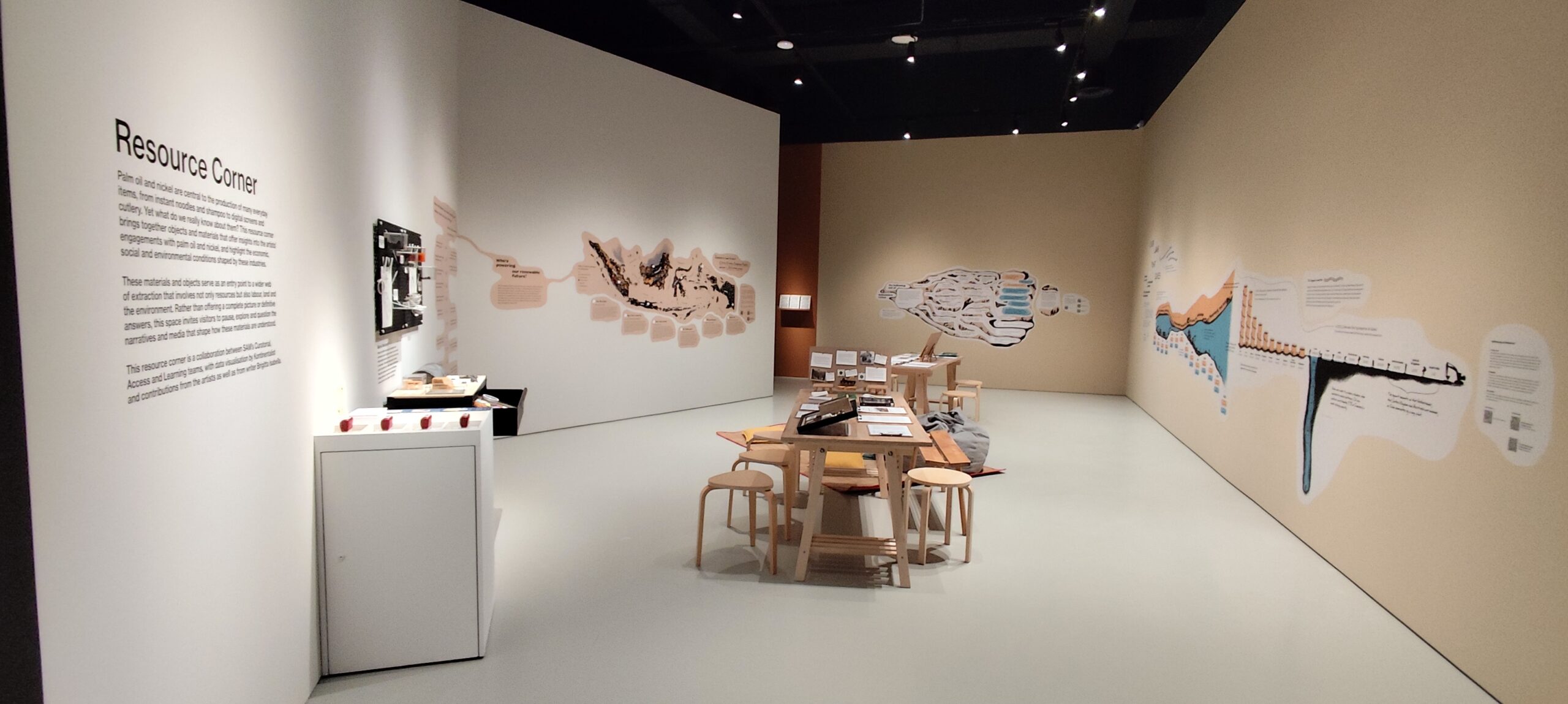
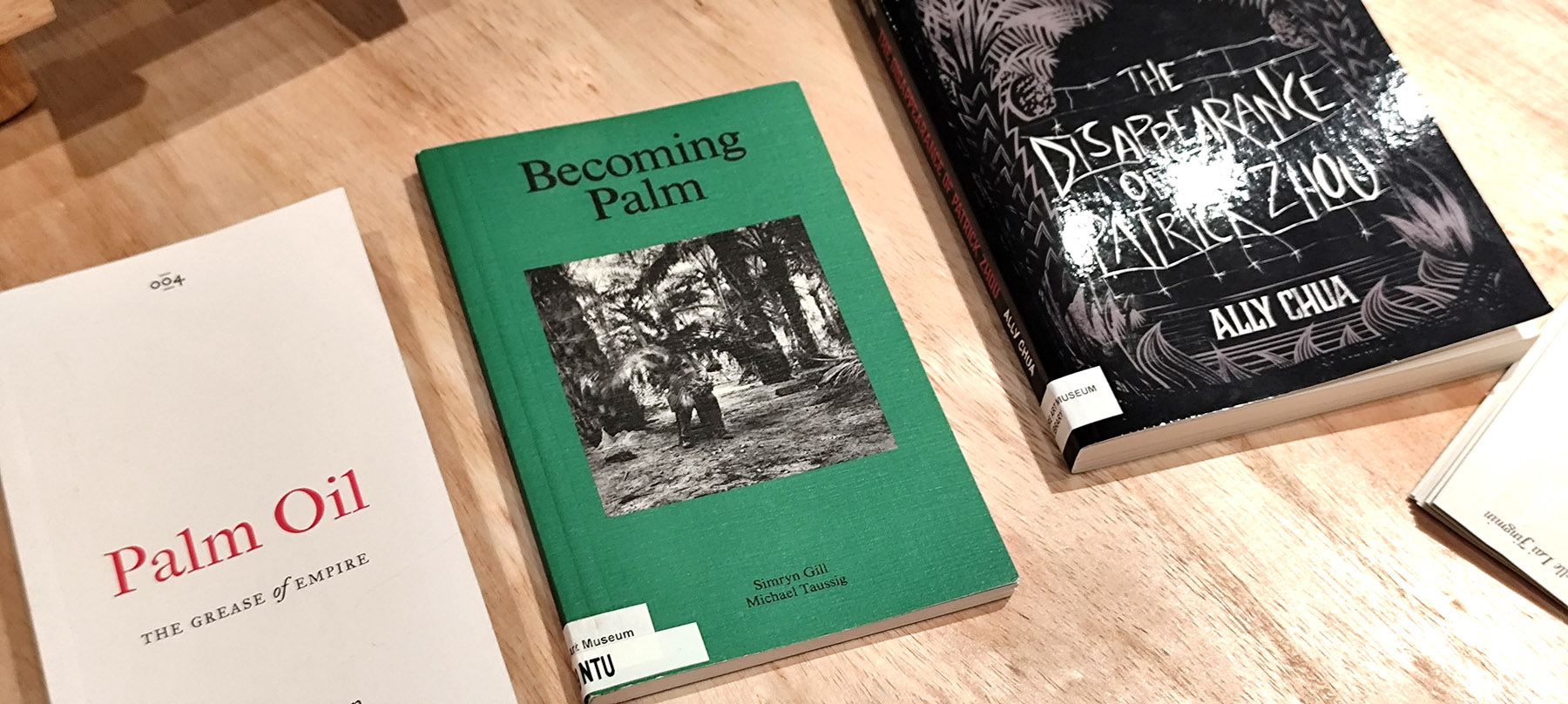
The activity corner of the exhibition includes Becoming Palm by Simryn Gill and Michael Taussig, a text that resonates with Elia’s interest in palm landscapes as sites of haunting, transformation, and colonial residue.
In Nafasan Bumi, the plantation becomes more than an economic structure.
It becomes a haunted ecology.
Bagus Pandega: Nickel and the Other Extractive Frontier
While Elia’s works centre on palm oil, Nafasan Bumi is also a dialogue with Bagus Pandega, whose practice turns toward another extractive economy shaping Indonesia today: nickel mining.
Nickel powers lithium-ion batteries and renewable technologies, often framed as part of the global green transition. Yet Bagus reveals the violence beneath this promise.
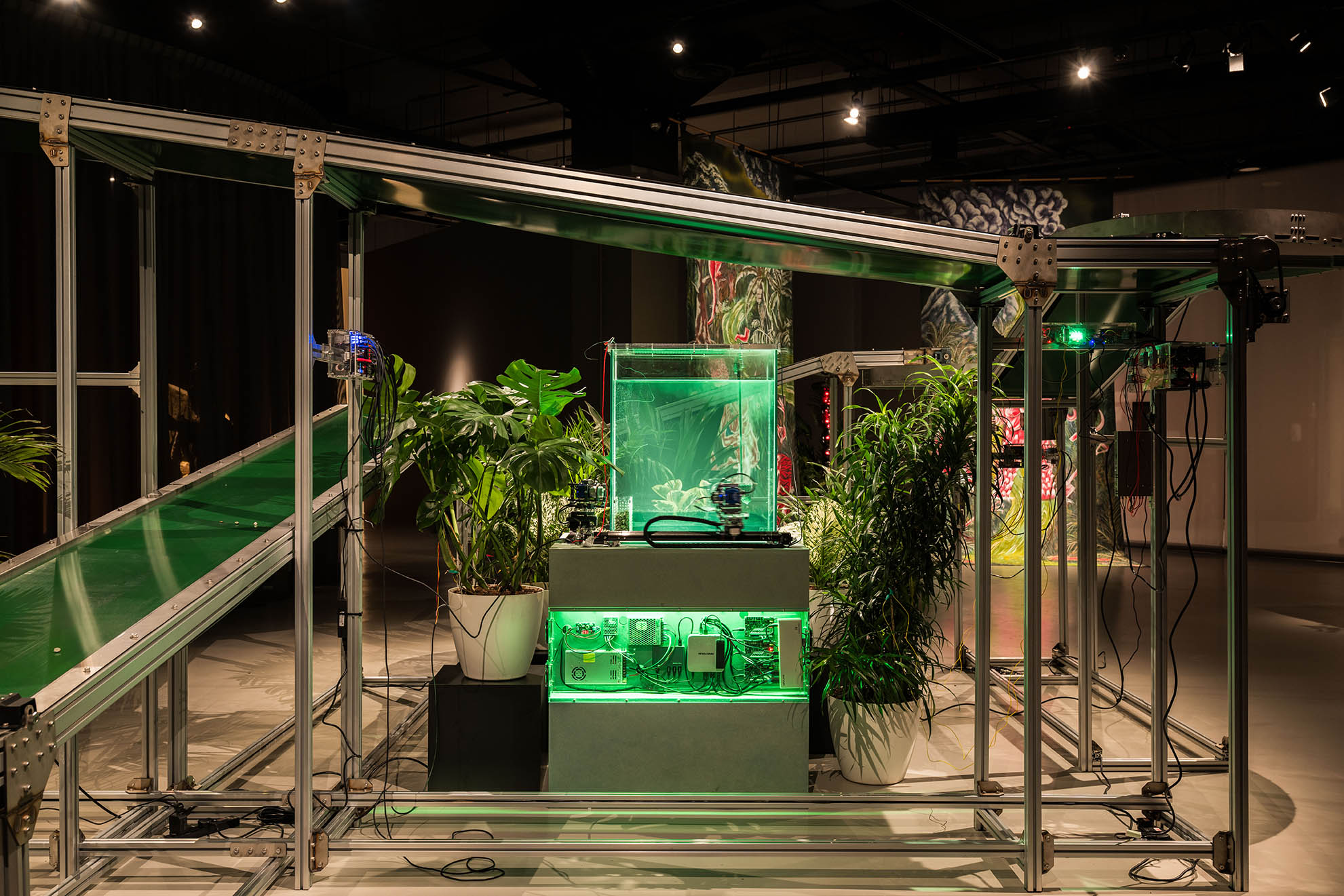
Their kinetic installation L.O.O.P (Less Organic Operation Procedure) features a conveyor belt transporting nickel ore sourced from Indonesia, its movement modulated by the bioelectric impulses of living tropical plants.
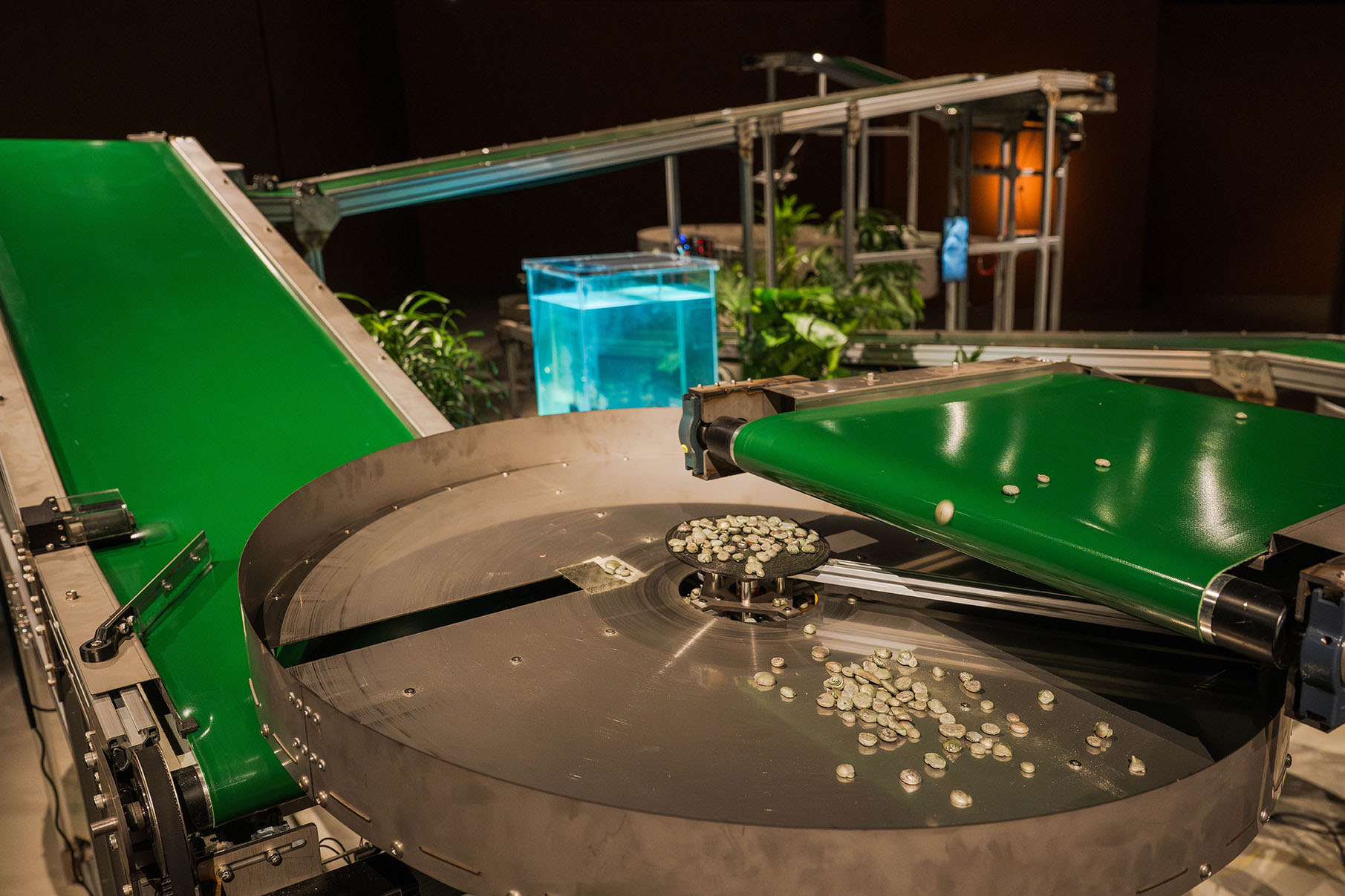
The work becomes an unsettling circuit, where nature and industry are locked into endless feedback.
Bagus’s works do not overshadow Elia’s plantation inquiry, but instead expand it, reminding us that extraction takes many forms, plantation, mine, commodity chain, and that both palm oil and nickel circulate through our everyday lives.
An Endless Cycle, and What We Carry Home
Leaving Nafasan Bumi, one cannot help but feel more aware of what sits behind the surfaces of modern convenience.
Palm oil and nickel are not distant materials. They are embedded in snacks, soaps, cosmetics, batteries, and the technologies we rely on daily.
This exhibition makes visible what is often hidden: the land cleared, the bodies exhausted, the labour erased, and the ecosystems pushed toward collapse, all in the name of progress and production.
Nafasan Bumi asks us not only to look, but to reckon. And perhaps, to listen, before the Earth itself refuses.
Nafasan Bumi: An Endless Cycle
16 January 2026 to 31 May 2026
10am to 7pm daily
Level 3, Gallery 3
Singapore Art Museum (SAM) at Tanjong Pagar Distripark
General Admission (Free for Singapore Citizens and Permanent Residents)