
This year’s Art World Forum Singapore edition attempted to stay relevant by addressing topics such as technology, millennial demands and behavioral trends in the cultural landscape.

Held on 27 September at One Farrer Hotel & Spa, the conference managed to display some semblance of robust discussion thanks to a few speakers such as Kay Vassey, chief connecting officer, MeshMinds and Lisa Polten, director, Chan+Hori Contemporary. These women stood out because of their passion, on-the-ground experience and heightened awareness of the Singapore and regional arts scene.
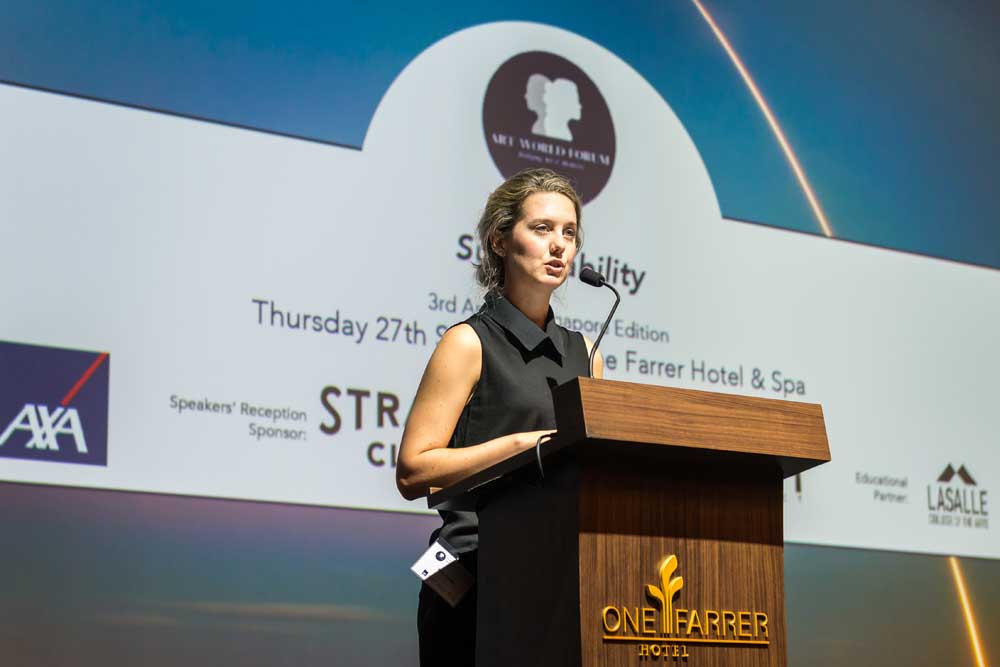
Their participation can perhaps be credited to Anni Oates, director and co-founder of Art World Forum, which calls itself a global networking platform for art and business professionals and holds editions in London and Hong Kong.
At the end of the conference, Artitute spoke with Oates to find out more about her take on the day and her future plans for the next edition.
Q: Could you share how Art World Forum has evolved since its first edition?
A: To be honest, it’s the third time we’ve been back, and every year has gotten better. We have had homegrown support since the beginning from people like AXA Art, which is an invaluable aspect of the organisation. We’ve also paired up with the Straits Clan, who hosted our speakers’ reception last night, and also Hatch Art Project.
Luckily, this year, and I think it’s also tied to our theme of sustainability, we also paired up with Lasalle College of the Arts. This is an invaluable opportunity to work with students, but also lecturers, and hear more about what the local players and international players are looking at in the art market and looking at moving forward.
Q: How has the event grown in terms of attendance and impact?
A: In terms of growth, Singapore has always been our flagship event, so from year one, we had about 100 international guests. Last year, we increased it to 120, 130, and this year our starting agenda was 140 plus, so as you can see, the room was also full. We did have a few extra seats, but overall, people stayed for the entire agenda, they were actively involved, and they asked a lot of questions. Also, it’s been surprising and interesting to see people feel more comfortable in addressing issues that are maybe more taboo, more controversial, especially here in Singapore.
Q: How different is this edition from previous ones?
A: Every event is very different. Overall, we position ourselves as international, but the agenda has a local aspect, so it’s important to keep it grounded in the place we host it. In terms of attendance and audience engagement, it depends. For example, we had an edition recently in London, the Saatchi Gallery in association with an art fair. It was the first time we were doing it as part of an art fair, and it was great. 110 people attended. It was open to all guests at the fair, so whoever wanted to come they could sit in for as little or as long as they wanted. In terms of audience, we had people from the various institutions, from the Tate, from the National Heritage, from corporate entities, from banks, art fairs and so on, so it was a kind of dynamic ecosystem. Singapore is different because it’s younger, but that doesn’t mean it’s not as dynamic in its discussion; rather, it’s got a different context.

Q: What were the topics discussed in the London edition?
A: In the London one, the theme was emergence and confluence. We discussed startups and new initiatives versus established ones, how they align themselves or don’t and how they are propelling change together.
Q: Which panel do you find interesting at today’s Singapore edition?
A: What makes a great panel is the dynamic of the speakers, that they’re well matched, doesn’t mean that they agree or disagree, but they’re strong enough in their own opinion and perspective, which makes for a good argument. Honestly. I think all discussions had passionate people keen and inspired in what they do and how they want to keep doing i,t and help as many people along the way, possibly inflicting change. Change is something people think of as negative. Sometimes it isn’t. Sometimes it is. But overall, I think you need the negative and the positive to find out what works.
Q: A lot of today’s discussion centred around the future, specifically, how technology is already influencing and shaping the arts. What do you think about this subject?
A: I think the influence of technology is inevitable. It’s already happening, even in the day-to-day. We’ve got our smartphones, and we’ve got the internet, which is a limitless availability of information and options. In terms of its influence in the art world, I think it’s clear to say that artists are using it as a tool and also as a production method.
In terms of influencing the practice, creating growth, the rest of the art industry is also seeing the need to adapt and adapt it. There are mixed relationships (with tech), and I agree with the mixed relationships – personally, I don’t find them financially beneficial. I wouldn’t say my outreach on social media platforms has translated into physical support, but it’s more about getting your name out there and making it more accessible.
Q: Do you think you want the next edition of Art World Forum in Singapore to focus on this issue of technology and change solely because it seemed like something that could be elaborated a bit more?
A: Perhaps. I know Singapore and the National Arts Council are pushing for a lot of kinds of tech and adaptive methods, and incentives. New technologies are a hot topic today, and social media doesn’t really come close to what new technology is. For example, Marcelo Garcia Casil, (a speaker at the conference from Maecenas, a blockchain startup geared towards fine art collecting. I had a discussion with him yesterday on blockchain, and I told him honestly, I don’t get it. I get some of it, but I don’t get all of it. It takes time, and for people who aren’t part of it on a day-to-day basis, it takes even longer, which is understandable.

Q: How do you intend to continue this discussion so more people will be aware of these developments?
A: I think it’s a matter of finding the right people at the right time. Kay Vasey (Chief Connecting Officer, MeshMinds) for example, is so passionate about what she does, it’s so obvious in the way she speaks about it. So if there are more people like that who can come and share their own perspective, their insight, that would be great.
As for our own events, ideally, some support, which we’re always in need of, partners, sponsors, etc. We’d like to have bigger, stronger events, so it wouldn’t simply be a talk program, which I love, don’t get me wrong. I mean, if you paired it with some sort of display, perhaps it would provide some context for discussions taking place. I have attended events where they use a mix and match of discussions, AR, VR, interactive scenarios, and they are very attractive, and it’s almost as if they answer all your curiosities, and I’m a very curious person, so for me it ticks a massive box…no harm in trying.

Q: Is there anything else you would like to add?
A: I love what we do. Art World Forum is a startup, and there is a clear need for something like this in the market. It’s independent, international. It’s unbiased so we welcome people from all over the industry, but we need support. If it’s going to grow and it’s going to be sustainable, we need a helping hand. So if there’s anywhere, any organisation that could pair up with us to make a greater impact, please call me.
Reena Devi is a freelance writer and editor. She has written essays for art exhibition catalogues and social commentary pieces for TODAY. She has previously worked at the Singapore Art Museum (SAM) and Singapore Contemporary Young Artists (SCYA).