
The word cleanse sounds almost comforting.
We cleanse our bodies, our homes, our surroundings. We clean because something is dirty, because something needs maintaining, or simply because we want things to feel right again.
But what happens when cleansing is no longer about removing dirt?
What happens when we begin to cleanse memories, histories, identities, spaces, bodies and even people?
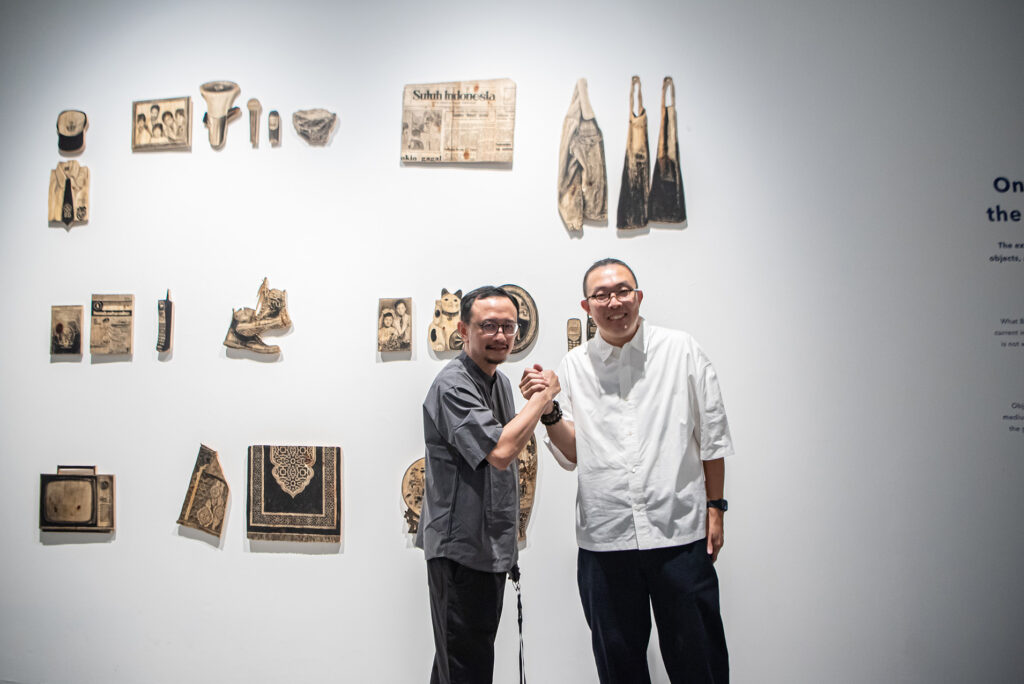
Curators, Desmond Mah and Adrian Tan, standing infront of Maharani Mancanagara’s Organised Memory, Unresolved Past begins.
Image courtesy of Prestige Gallery and Asia Pacific Now
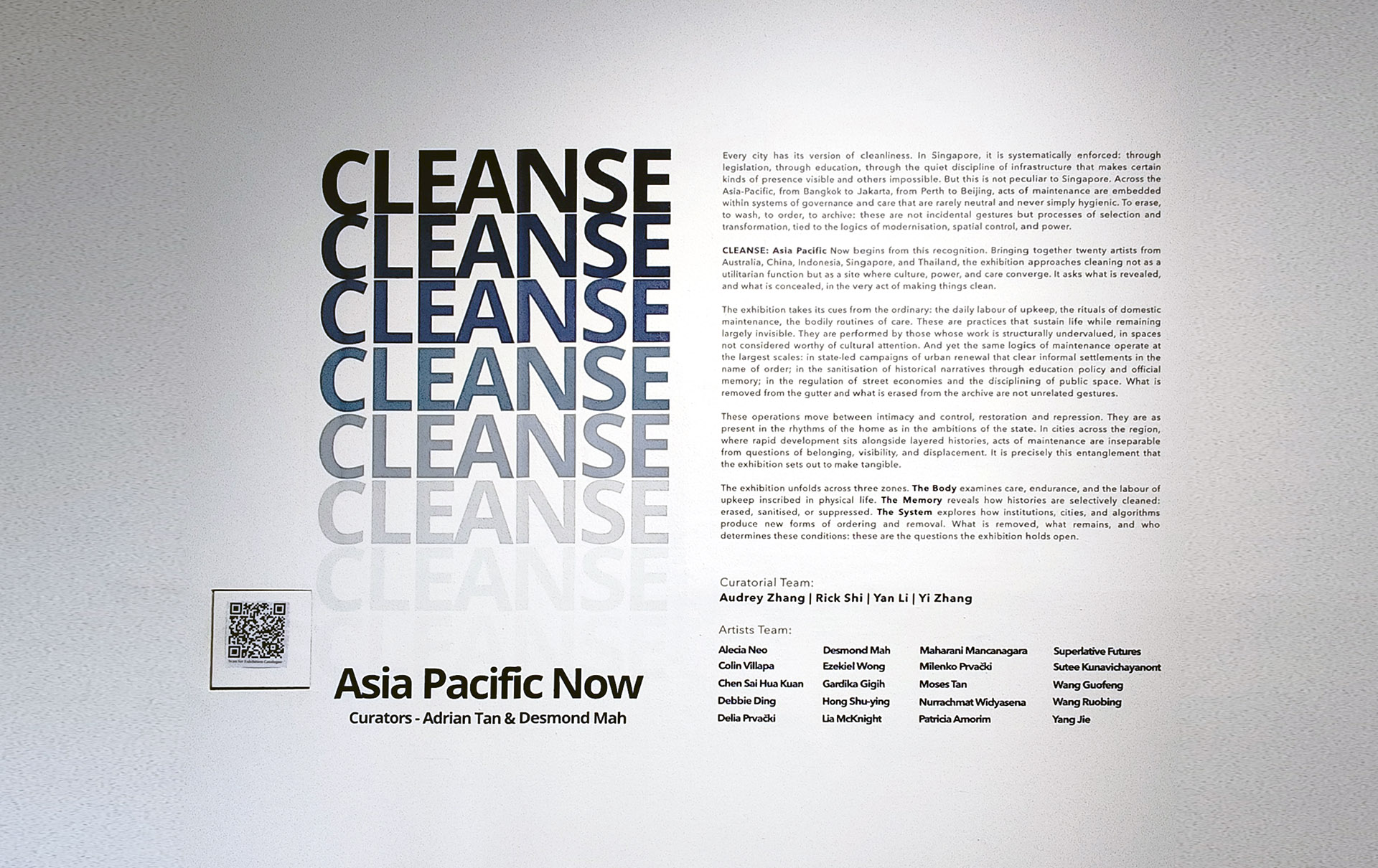
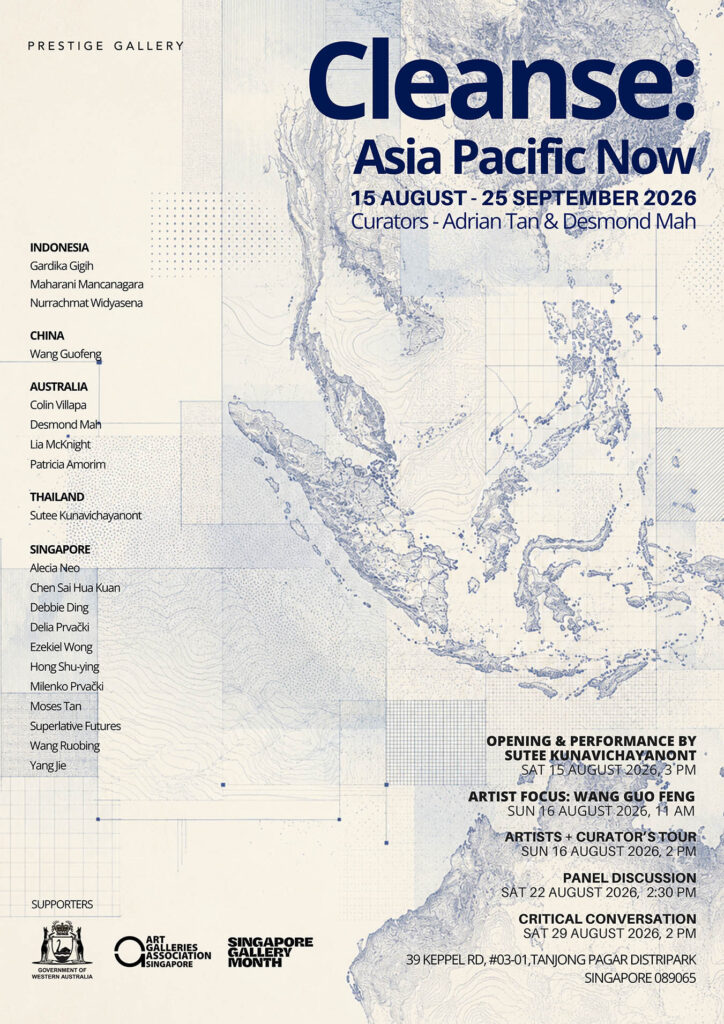
These were some of the questions that stayed with me after spending time with CLEANSE: Asia Pacific Now, a group exhibition bringing together 20 artists from across the Asia-Pacific, including artists based in Singapore and Australia. Curated by Adrian Tan and Desmond Mah, the exhibition brings together a diverse range of practices to examine a deceptively ordinary act and reveal the many layers hidden beneath it.
What makes CLEANSE compelling is how familiar its starting point feels. Cleaning is something all of us understand. Yet as I moved through the exhibition, it became increasingly clear that cleansing is rarely neutral.
It can be an act of care.
It can be labour.
It can be control.
It can be an attempt to erase.
And sometimes, it can also be an act of resistance.
When Home Is Never Quite Yours
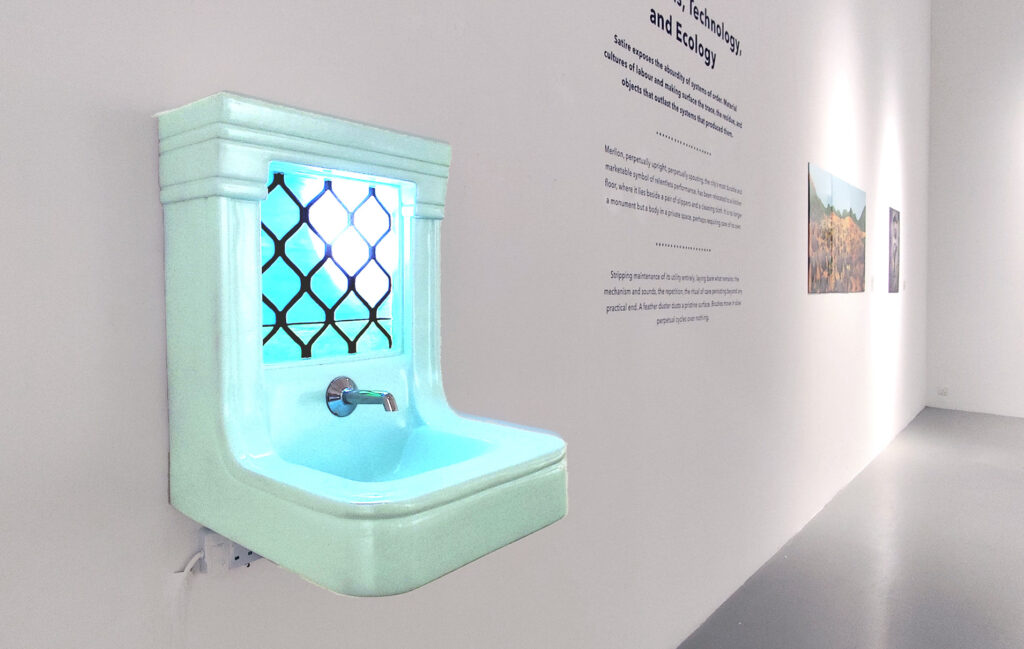
COLIN VILLAPA, Dream (Share) House Sink. 2026
One of the first works that made me reconsider the word “cleanse” was Colin Villapa’s Dream (Share) House Sink.
At first glance, it is recognisable: a wash basin, faucet, water and what appears to be a stained-glass window behind it. But look closer and the familiar domestic object begins to feel strangely ceremonial.
Villapa, an Australia-based artist with a Filipino Catholic background, draws from his own experience of renting and maintaining a share house. What began with something as mundane as bad plumbing evolved into a reflection on the frustrations of living in a space that you occupy but do not truly own.
There is the shared labour of cleaning. There is the negotiation of how people live together. And there is the frustration of wanting to change something about your environment but not necessarily having the authority to do so.
For Villapa, the act of cleansing becomes almost ritualistic.
“The nature of cleansing is imbued in this work as a sort of shared ritual in our share house.”
That idea stayed with me. A sink is designed to wash things away, yet Villapa uses it to think about what people are trying to build and preserve: community, friendship, harmony and a sense of belonging.
As he puts it, “We need to learn how to be and live together and be able to negotiate how we maintain the spaces that we occupy.”
Perhaps home, then, is not simply a physical space. It is something negotiated every day.
The Objects That Remember
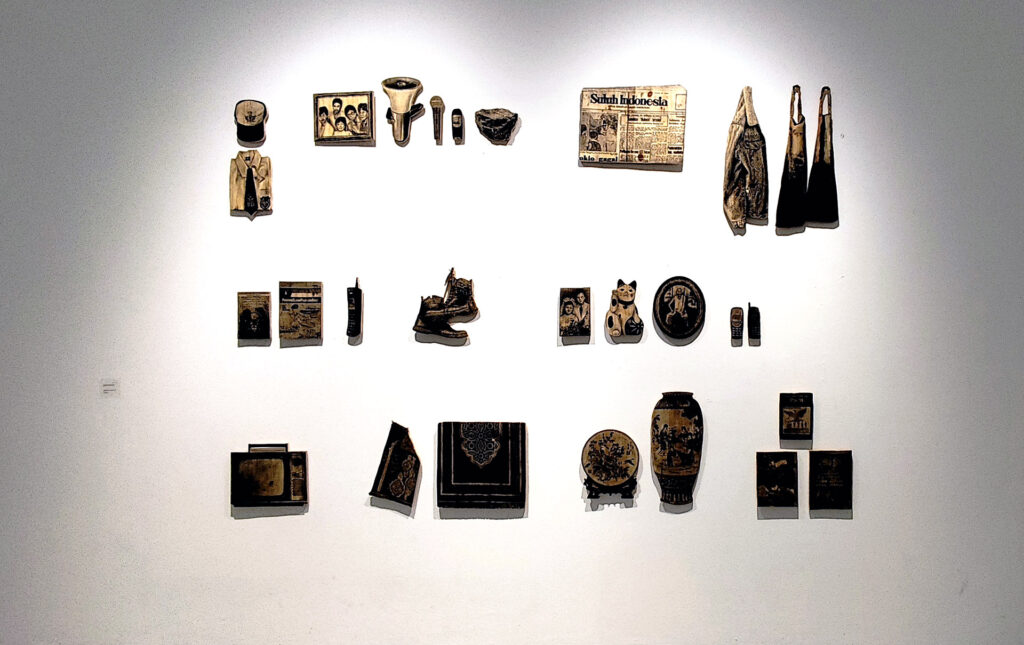
MAHARANI MANCANAGARA, Organized Memory, Unresolved Past, 2026
For Indonesian artist Maharani Mancanagara aka Rani, cleansing takes a much darker turn.
Her practice begins with everyday objects, memories and histories, often working with recycled wood, charcoal, installation and other materials. For CLEANSE, she responds to the ongoing rewriting of Indonesia’s history, particularly the New Order period and its unresolved histories of mass violence, censorship and disappearance.
Rather than producing another written historical account, Rani chose to create an installation of objects.
A school uniform. A cap. A tie. A megaphone. Microphones. An old newspaper.
Arranged almost like museum specimens, they appear orderly and official. But their meanings are anything but tidy.
The school uniform points to the earliest stages of indoctrination, where young minds are introduced to a particular version of history. The megaphone remains deliberately ambiguous: it could belong to the military controlling a crowd, or to students calling for reform. The newspaper represents publications that were censored or shut down.
Even the material carries meaning.
Rani uses charcoal because it refuses to remain completely fixed.
“It smudges, it rubs off. It’s never fully fixed on the surface.”
For her, that instability becomes a metaphor for memory itself.
Official histories may attempt to organise the past into something coherent and authoritative, but lived memories do not always behave so neatly.
Rani is not interested in presenting another definitive version of history either.
“I’m not trying to correct the official book with my own official version.”
Instead, she leaves the objects unresolved, allowing them to remain as fragments of what refuses to be organised.
It is perhaps one of the most powerful interpretations of cleanse in the exhibition: the idea that history can be repeatedly “tidied up” until the uncomfortable parts become easier to forget.
But some things refuse to disappear.
The Labour We Inherit
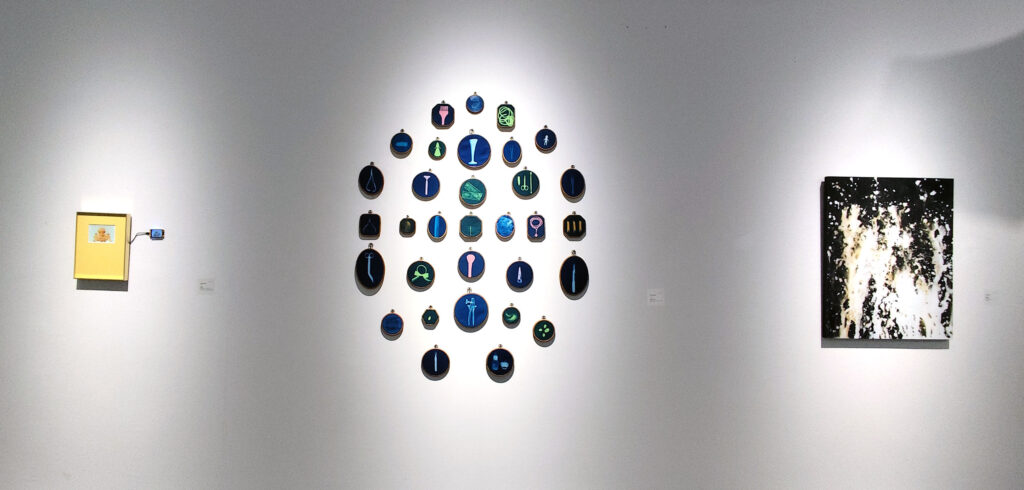
HONG SHU YING, 藤壶 Barnacles 2020–2021 (left) and 回Kuala 2022-2026 (right) and PATRICIA AMORIM, Hopscotch Series II 2026 (center)
Patricia Amorim’s Hopscotch Series II brings cleansing into another kind of domestic space.
An Australia-based artist originally from Brazil, Amorim works across photography, installation and textile-based practices, exploring feminism, migration, memory and diaspora.
Her cyanotypes are made through a process of coating fabric with a light-sensitive chemical, placing objects on the surface, exposing them to light, then washing the fabric. What remains is what has resisted the wash.
It is a simple process, but within CLEANSE, it becomes deeply symbolic.
Amorim draws from the childhood game of hopscotch, where movement takes place within bounded squares according to a set of rules. For her, those limited spaces become a metaphor for the expectations placed upon women.
Domestic work. Care. Ritual. Repetition.
The things women have traditionally been expected to perform, often quietly and without recognition.
Yet Amorim does not see domestic space only as a place of restriction.
She recalls women in her own family gathering together to embroider. Within a space shaped by expectations, they found another kind of expression and connection.
There is therefore a tension between control and freedom, care and coercion.
And then there is the washing.
“What lasts us here is just what resisted the wash.”
It is a line that quietly anchors the work.
The cyanotype process becomes a metaphor for women resisting disappearance—not simply surviving the structures that attempt to define them, but leaving traces of themselves behind.
“We resist to be washed away from history,” she says.
The Uniform and the State
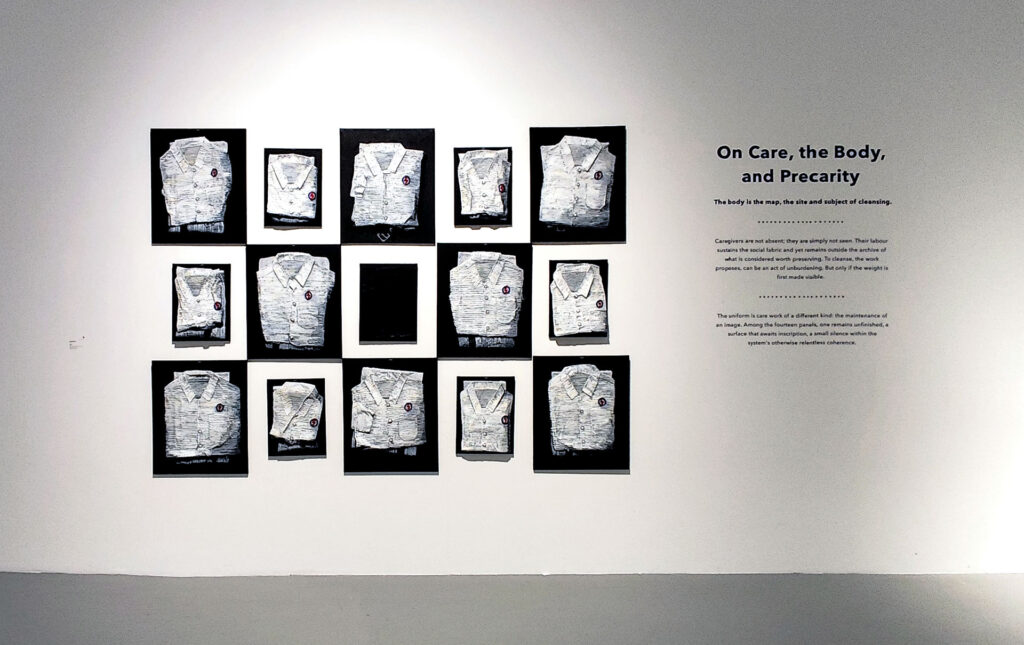
DESMOND MAH, Gahmen, 2026
If there is one work in CLEANSE that feels particularly close to home, it is Desmond Mah’s Gahmen.
Mah, who was born in Singapore and now lives in Australia, is both artist and curator of the exhibition. His work takes its title from the Singaporean slang pronunciation of “government”, while playing on the word “garment” to create “Gahmen”, bringing together the structures of governance and the uniforms that embody them.
The pun is simple. The implications are not.
Across a series of paintings, neatly folded white shirts, trousers and belts evoke the familiar visual identity associated with Singapore’s political establishment. The garments are arranged with a precision that feels unmistakably Singaporean: orderly, structured, clean.
The bodies are absent.
Only the uniform remains.
Mah explains that each painting corresponds to a general election, beginning in 1968. The repeated white garments become a visual record of a political system that has shaped modern Singapore for generations.
Yet he deliberately avoids telling us how to read them.
Are they a celebration of stability?
A critique of conformity?
Perhaps both.
“I wanted my work to be like this in a way, because I do not want to pigeonhole people’s opinion.”
There is also a gap in the sequence of paintings—an absence that Mah leaves unresolved.
“I don’t know,” he says when asked what happened.
And perhaps that uncertainty is precisely the point.
For Mah, CLEANSE is not simply about making something clean. It is about maintaining order.
“It’s not just about cleaning, it’s about maintaining an order or a way of, a standard way of looking.”
That idea extends far beyond the neatly folded garments.
Singapore’s reputation for efficiency, safety and stability is something Mah acknowledges, even as he asks what might be surrendered in exchange.
“What do we give up for this stability?”
It is an uncomfortable question precisely because there is no easy answer.
The Caregivers We Don’t Always See
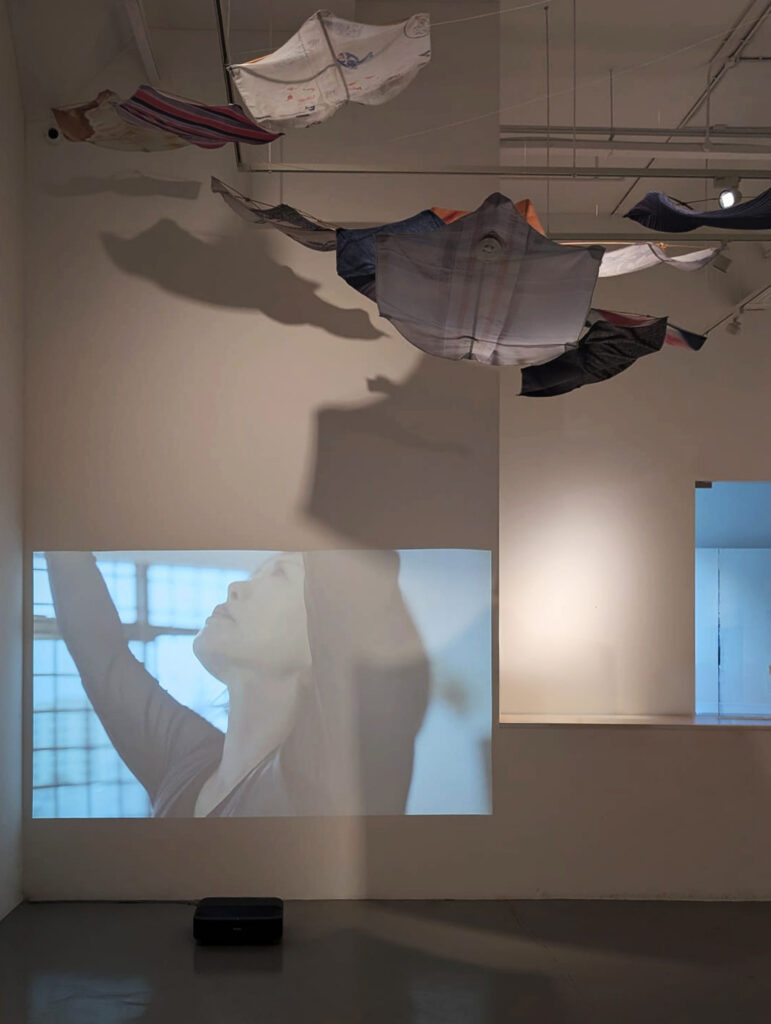
ALECIA NEO, Between Earth & Sky, 2025
Image courtesy of the artist
Alecia Neo’s Between Earth and Sky brings the exhibition somewhere much more intimate.
The work centres on seven caregivers and their lived experiences of caring for family members with mental health conditions. Some care for spouses, some for children, parents or siblings. Their circumstances differ, but all have had to make significant changes to their lives in order to provide care.
The centrepiece is a series of kites, accompanied by video documentation of performances created with the caregivers.
The kite becomes a metaphor for the caregivers themselves: bodies navigating different kinds of weather, tension, stigma and uncertainty.
The fabrics are imprinted with close-up photographs of the caregivers’ clothing and that of their loved ones. When brought together, they form something larger than the individual.
A community.
A collective body.
A reminder that caregiving is rarely carried by one person alone, even when it can feel that way.
Neo spent a year working with the caregivers, developing workshops and eventually documenting their performances. The kites were also flown in public spaces, inviting members of the public into the process.
What moved me most was not simply the sacrifice involved in caregiving, but Neo’s desire to shift the conversation away from sacrifice alone.
She hopes audiences will recognise that caregivers are also individuals with their own dreams, creativity and identities beyond their caregiving roles.
And then she asks an even bigger question:
“How do we move from individual caregiving to care sharing?”
It is a question that feels particularly pertinent in a society where mental health can still be difficult to speak about openly, and where families often find themselves navigating care quietly behind closed doors.
Perhaps cleansing, in this context, is not about removing the stigma.
It is about making the invisible visible.
A Region Full of Traces
Beyond these five artists, CLEANSE continues to expand its questions across different histories, geographies and material practices.
The exhibition moves between personal and collective memory, environmental concerns, migration, political systems and the everyday rituals that hold communities together. Artists working across the Asia-Pacific bring very different experiences to the same deceptively simple premise.
And perhaps this is where the exhibition’s title becomes most interesting.
There is no single definition of what it means to cleanse.
For some, it is the washing away of what is unwanted.
For others, it is maintenance.
For some, it is control.
For others, it becomes resistance.
And sometimes, what remains after the cleansing is more revealing than what has been removed.
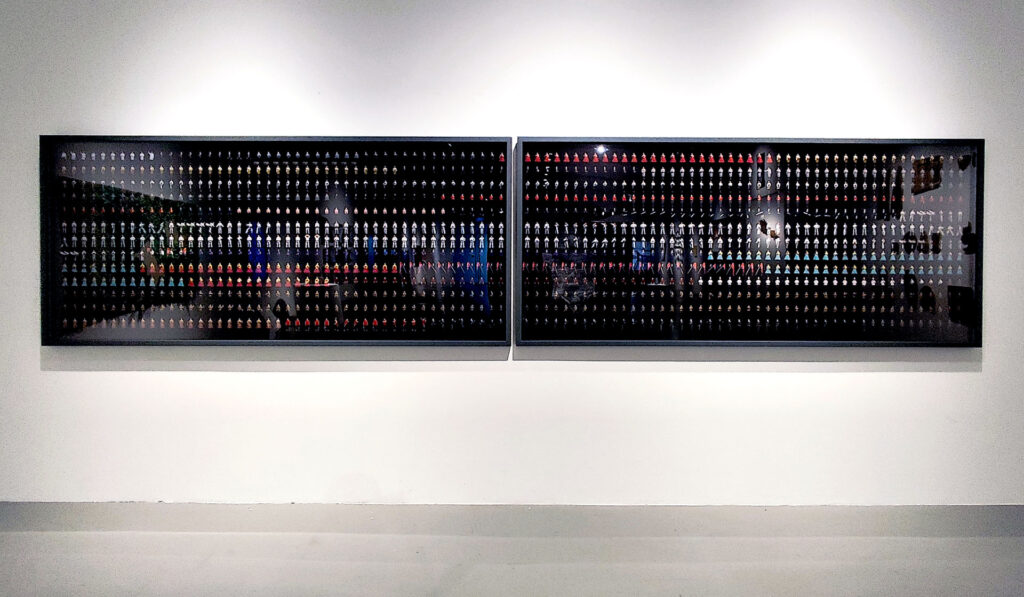
WANG GUOFENG, Ordering the Body 2015 No.2, 2015
Even the exhibition itself encountered a small reminder of how complicated movement and visibility can be. One of the works by a Chinese artist, Wang Guofeng, was held up at Singapore customs and did not arrive in time for the opening.
Its absence was unfortunate, particularly for an exhibition built around bringing different voices and perspectives together. Yet there was something strangely fitting about a missing work in an exhibition concerned with erasure, absence and the things that fail to make it through.
Rather than allowing that absence to diminish the exhibition, it became another reminder that artworks do not exist in isolation. They carry histories, identities and perspectives across borders—and sometimes, those journeys are far more complicated than we imagine.
What Are We Really Trying to Remove?
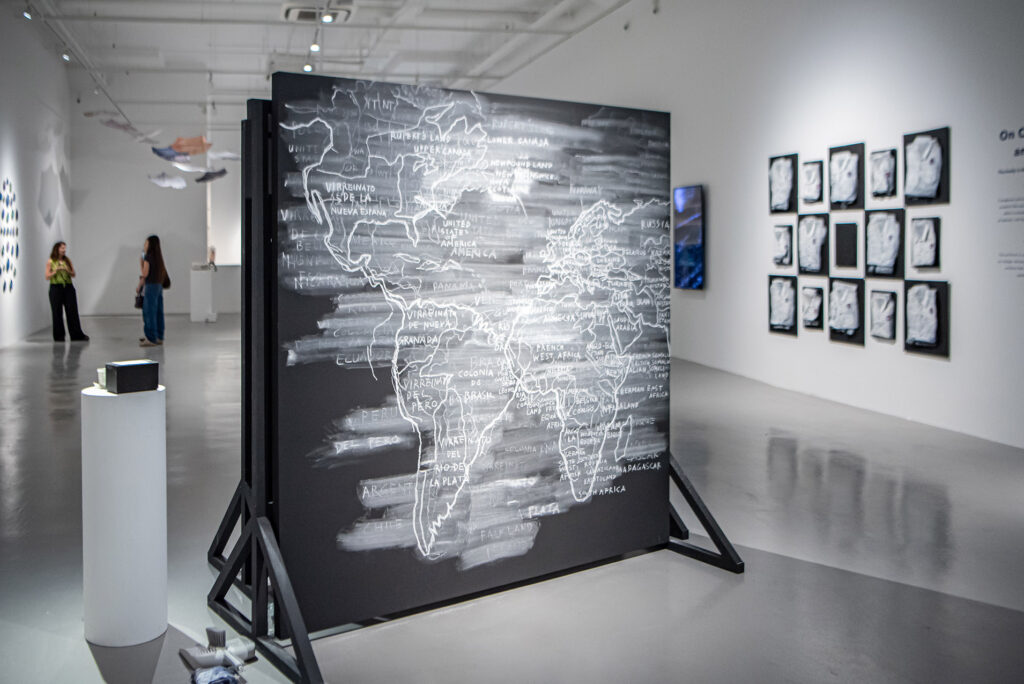
SUTEE KUNAVICHAYANONT, Blackboard, 2026
Image courtesy of Prestige Gallery and Asia Pacific Now
Walking through CLEANSE, I found myself thinking less about dirt and more about residue.
What remains after we clean?
What remains after a history has been rewritten?
After a woman has spent years caring for others?
After a family has learnt to live with mental illness?
After a tenant leaves a house they were never allowed to truly change?
After a political system has spent decades building an image of order?
Perhaps cleansing is never as complete as we imagine.
There will always be traces.
Charcoal that refuses to stay fixed. Cyanotypes that preserve what resisted the wash. Folded garments that carry the identity of a political system. A sink that becomes a ritual object. Kites carrying the stories of caregivers into the sky.
These works remind us that what we attempt to remove does not necessarily disappear.
Sometimes, it simply changes form.
And perhaps that is what makes CLEANSE such a relevant exhibition for our time. In an age where we are constantly encouraged to tidy our environments, curate our identities, simplify our histories and move quickly past discomfort, these artists ask us to pause.
To look again.
To question what has been removed.
And, perhaps most importantly, to ask ourselves:
Who decides what needs to be cleansed in the first place?
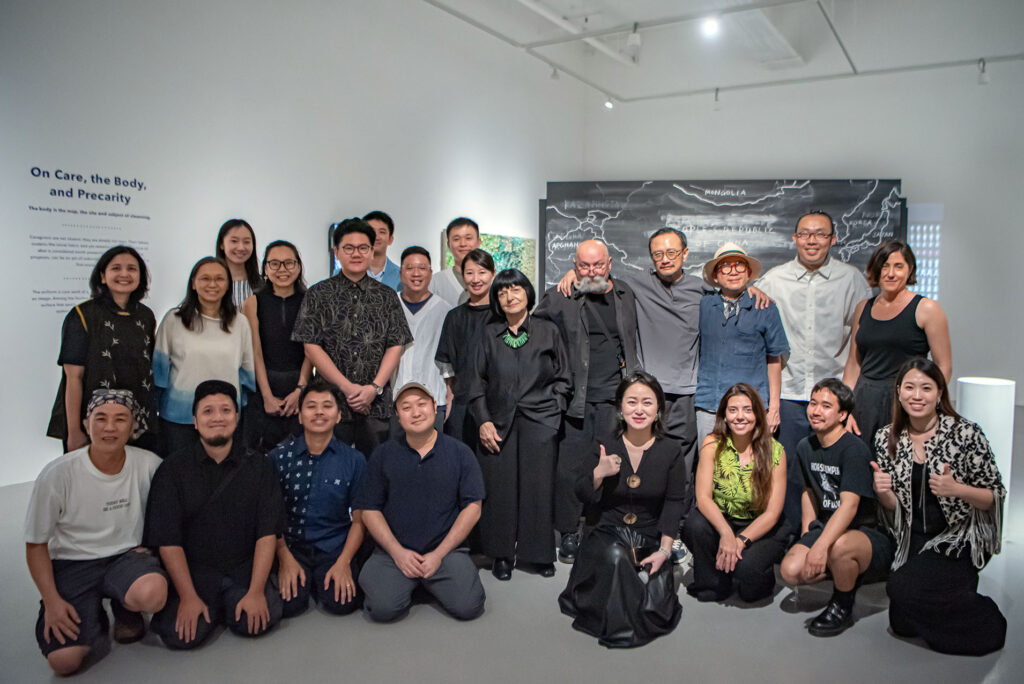
Group photos of participating artists and the staffs at Prestige Gallery.
Image courtesy of Prestige Gallery and Asia Pacific Now
The Artists
While this article focuses on five artists whose works and perspectives particularly resonated with me, CLEANSE: Asia Pacific Now brings together 20 artists from across the Asia-Pacific, each approaching ideas of cleansing, maintenance, erasure, care and order from very different cultural and personal perspectives.
The exhibition features Patricia Amorim, Desmond Mah, Lia McKnight, Colin Villapa, Wang Guofeng, Gardika Gigih, Maharani Mancanagara, Nurrachmat Widyasena, Sutee Kunavichayanont, Chen Sai Hua Kuan, Debbie Ding, Hong Shu-ying, Alecia Neo, Delia Prvački, Milenko Prvački, Superlative Futures, Moses Tan, Wang Ruobing, Ezekiel Wong and Yang Jie.
Together, their works extend CLEANSE beyond the simple act of cleaning, opening up conversations around the body, memory, environment, politics, migration, domestic labour, urban development and the systems that determine what is preserved, removed or rendered invisible.
CLEANSE: Asia Pacific Now
15 August – 25 September 2026
Prestige Gallery
Tanjong Pagar Distripark
39 Keppel Road, #03-01
Singapore 089065
CLEANSE: Asia Pacific Now runs from 15 August to 25 September 2026 at Prestige Gallery, Tanjong Pagar Distripark.