
At Whitestone Gallery Singapore, two artist couples turn partnership, disagreement, family, memory and the everyday into a meditation on balance, connection and the systems that hold us together.
15 August – 17 October 2026 | Whitestone Gallery Singapore
There was something about the title Counterweight: The System of Two that immediately caught my attention as I walked into Whitestone Gallery Singapore’s newly opened exhibition space at Tanjong Pagar Distripark on 15 August.
The word “counterweight” sounded heavy.
Almost physical.
And yet, there was something strangely personal about it too.
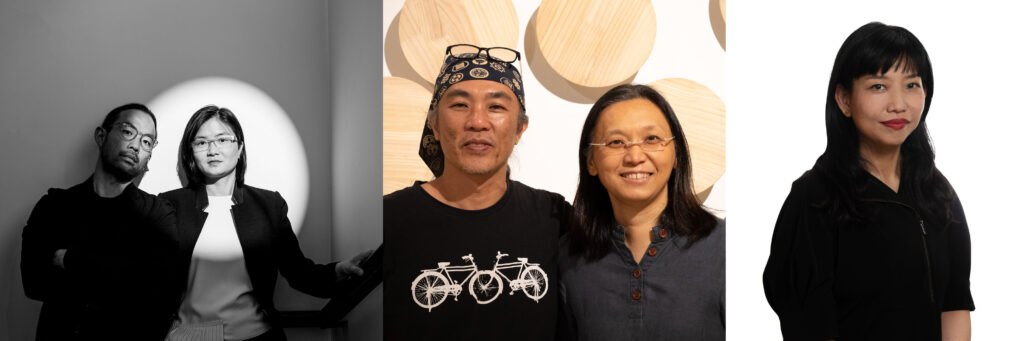
Artists Chow and Lin (left), Roubing and Sai (Center) and Tamares Goh, curator (right)
I wondered why this particular word had been chosen until I saw the names of the artists: Chow and Lin, comprising Stefen Chow and Huiyi Lin, and Ruobing & Sai, comprising Wang Ruobing and Chen Sai Hua Kuan.
Two artist duos. Two couples. Two very different practices.
And two relationships in which the personal and professional are almost impossible to separate.
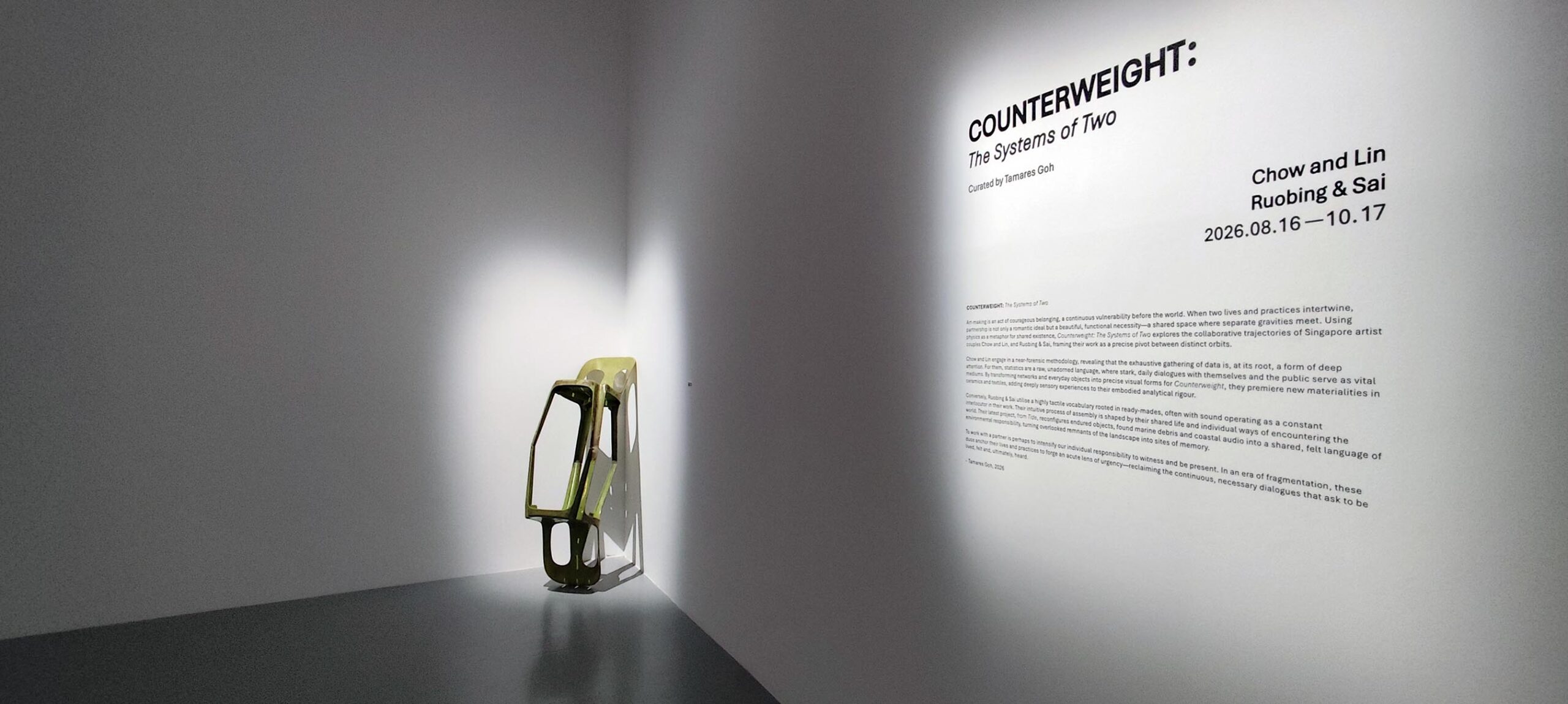
Curated by Tamares Goh, Counterweight: The System of Two brings together these two Singapore artist couples for an exhibition that uses physics, balance and counterweight as a metaphor for how two people navigate a shared life. But after spending time with the works and speaking with the artists, I realised that “counterweight” is not really about achieving perfect harmony.
It is about what happens in between.
The disagreements. The negotiations.
The moments when one moves faster while the other slows down.
The times when they see eye to eye, and the equally important moments when they simply agree to disagree.
As Sai candidly told me during our conversation, there are fights and even “cold wars” when two artists with strong personalities work together. Yet somehow, they find a way to strike a balance.
Perhaps that is what makes the exhibition feel so human.
Two people, one system
Tamares Goh told me that the idea of Counterweight came from looking at both the similarities and differences between the two practices, as well as what happens within each couple. What do they have to give up? Where do they disagree? And what do they eventually have to agree on in order to make working together possible?
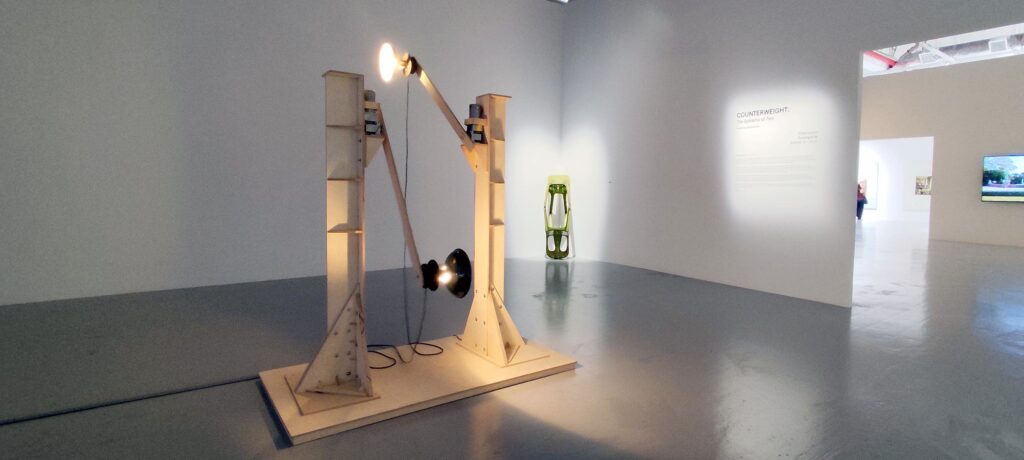
Roubing and Sai, Sometimes We Meet
For her, the physical idea of a counterweight, a fulcrum or pulley system became a visual way of thinking about the relationships.
It is a fitting metaphor.
Ruobing is the quieter presence of the two. Sai is more outward, playful and spontaneous. Yet there is a strength in Ruobing that grounds the relationship, while Sai’s free-spirited approach seems to create space for experimentation and unexpected possibilities.
Their differences are not obstacles to the work.
They are part of the work.
Ruobing & Sai have collaborated since 1997, whenever their ideas converge, while maintaining their individual artistic practices. Their shared practice is rooted in dialogue, experimentation and sustained engagement with everyday materials, ecology and the environment.
And you can see that relationship unfolding almost literally when you encounter their new installation, Sometimes We Meet.
Two lamps face each other, rotating at slightly different speeds. They operate on the same electrical grid, yet one gradually moves faster while the other moves slower. Eventually, after roughly an hour and fifteen minutes, they meet before falling out of sync again.
I found myself standing there watching them.
It is such a simple action, yet it says so much about relationships.
Sometimes we meet. Sometimes we don’t.
Sometimes we are completely in tune. Sometimes we are just slightly out of step.
Interestingly, the artists told me that the difference in speed was not entirely planned. They had initially intended to use controllers to regulate the motors, but when the system was wired up, one simply ran slightly faster than the other. They eventually removed the controller altogether and allowed the work to behave according to its own rhythm.
It was intentional, and yet unintentional. A beautiful coincidence.
And perhaps that is exactly what relationships are.
When the sea remembers
Moving deeper into Ruobing & Sai’s works, the exhibition becomes increasingly tactile and environmental.
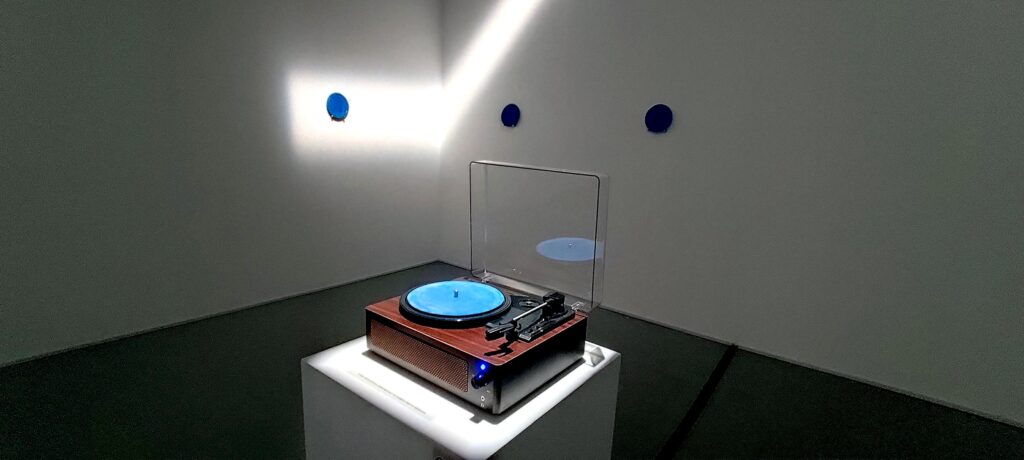
Roubing and Sai, from Tide… sound check 2026 – ongoing
Their practice has long been concerned with how humans interact with and shape their immediate environment. Ruobing described her own practice as an exploration of environmental issues and the relationships we create with our surroundings, while Sai works extensively with materials, sound and space.
In from Tide… sound check (2026–ongoing), discarded marine plastic collected along shorelines is transformed into vinyl records carrying recordings of the sea.
The idea sounds almost poetic. But the process behind it is anything but simple.
Sai told me that the family had been beach cleaning for years, initially with their children collecting seashells and small pieces of plastic. Over time, they began encountering larger objects, including discarded plastic drums. He became fascinated by the idea that these objects had effectively been “listening” to the sea all along.
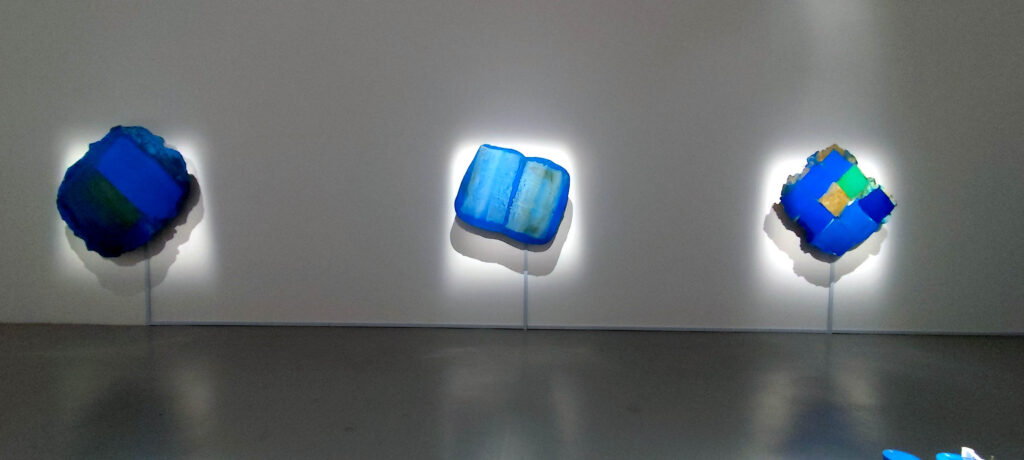
Roubing and Sai, from Tide… sound check 2026 – ongoing
So instead of simply treating the objects as waste, they asked another question:
What if the sea could speak through the very material that has polluted it?
The resulting vinyl records collapse the distinction between medium and message. Marine debris becomes both evidence of environmental damage and a carrier of the ocean’s sonic memory.
It is one of those works that becomes more compelling the longer you think about it.
The plastic came from somewhere. It travelled somewhere. It ended up somewhere.
And now it carries a sound from the very environment it has helped to damage.
What we keep, and why
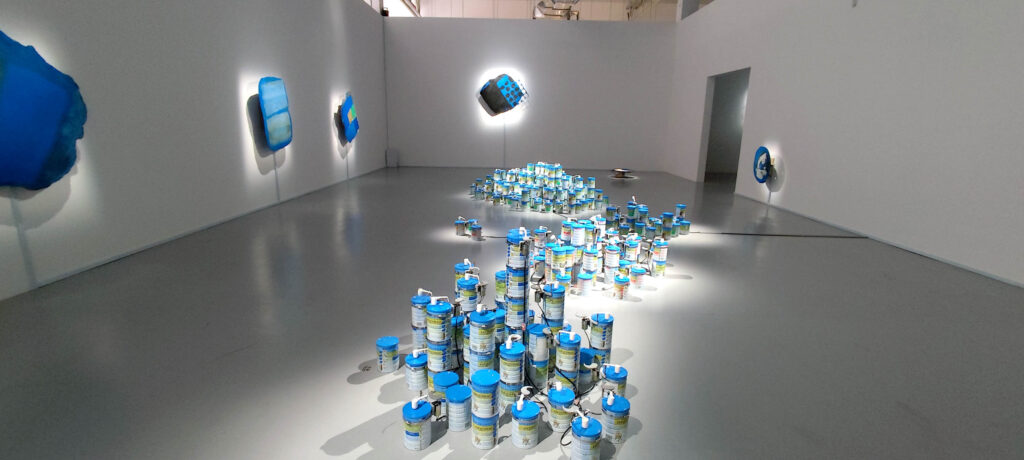
Roubing and Sai’s installation view of Counterweight: The Systems of Two , Whitestone Gallery
Another work that stayed with me was the installation made from hundreds of empty milk formula tins.
At first glance, it could easily be read as an accumulation of discarded containers.
But these are not anonymous objects.
They are the formula tins that Ruobing & Sai kept while raising their two children.
The children are now teenagers, and the cans have accumulated over roughly fifteen years. The artists told me they never knew exactly what they would eventually do with them. They simply kept them. More than 300 eventually found their way into the work.
Sai jokingly described himself as a “professional hoarder”.
But beneath the humour is something more interesting.
For the artists, used objects carry social context. They carry histories of who used them, how they were used and what they meant within a particular life. The milk tins were not simply waste. They were records of their children’s early years.
Even the materials hidden within the installation become part of this idea of counterweight. Glass bottles filled with sand are used to stabilise the moving system. The artists had accumulated these bottles too, remnants of everyday consumption that have been given another function.
Nothing is really wasted.
It simply waits for another meaning.
That seems to be an important part of Ruobing & Sai’s practice.
From coffee shop chairs to family histories
This same relationship between discarded objects and memory can be found in Eight Legged on Back, part of their Green for Something series.
The work uses plastic chairs inherited from Sai’s parents’ former coffee shop.
The chairs still carry traces of their previous life: marks, dirt, cigarette burns and the wear that comes from years of use in a Southeast Asian coffee shop. Rather than cleaning away those signs, the artists chose to leave them as they were.
There is something particularly Singaporean about these chairs.
They are so familiar that we barely notice them.
But here, two chairs are placed back-to-back, their legs supporting one another in an unusual configuration. What might otherwise be an ordinary plastic chair becomes a small physical metaphor for dependence.
One cannot quite stand in this particular configuration without the other.
Just like the relationship at the heart of this exhibition.
The Poverty Line returns, but it has expanded
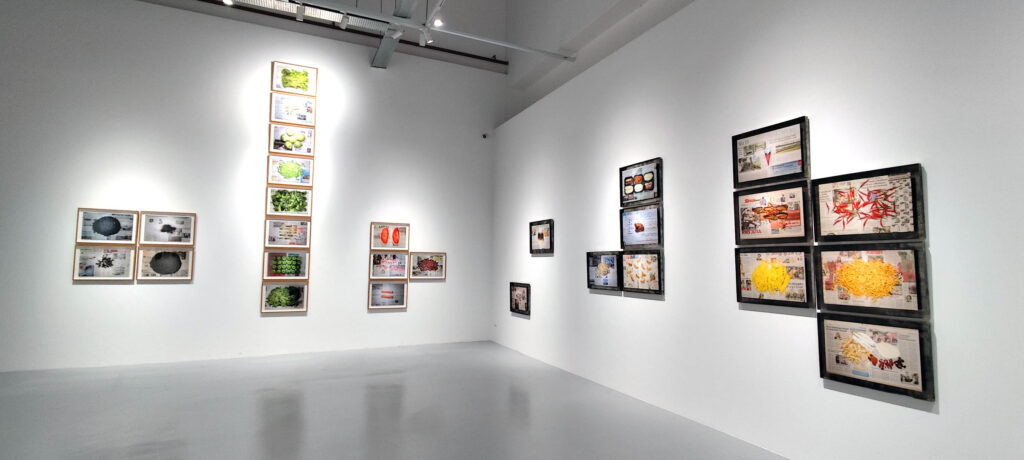
Chow and Lin, The Poverty Line
Chow and Lin, meanwhile, are no strangers to me.
I first encountered their practice through The Poverty Line, a project I have followed since seeing it at PMQ’s deTour Festival in Hong Kong in 2015.
But the project itself began much earlier, in 2010.
What started as a question about poverty and inequality has grown into a long-term research project spanning six continents. Using food as a universal language, Chow and Lin calculate what a person living at the poverty line could afford to eat each day according to the official definition in each country or territory, then photograph the resulting food against that day’s local newspaper. The project has since expanded across 38 countries and territories.
For those of us living in Singapore, the word “poverty” can sometimes feel distant.
It is easy to think of it as something that exists elsewhere.
But The Poverty Line has always made that abstraction tangible. It takes something as ordinary as food and turns it into a measure of economic reality.
At Counterweight, Chow and Lin extend this thinking into new territory.
The work is still interested in value, consumption and systems, but the language has become more domestic, tactile and personal.
In Decentralized Value Systems (2026), familiar IKEA objects such as lamps, baskets and other household items are placed alongside food objects including canned food, coffee capsules and eggs, creating visual equations that ask us to reconsider the things we encounter every day.
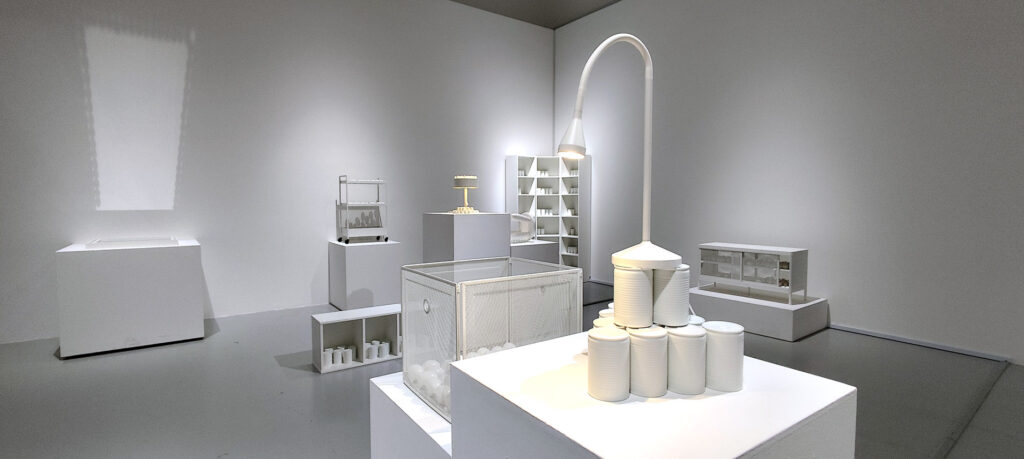
Chow and Lin, Decentralized Value Systems, 2026
Why IKEA?
The answer is surprisingly global.
After travelling to dozens of countries through The Poverty Line, Chow and Lin became interested in how certain brands and systems have embedded themselves into everyday life across different cities. An IKEA object may look anonymous and familiar, yet carry different meanings in Singapore, Brazil or the United States. At the same time, its familiarity is inseparable from consumer culture.
This is where Chow and Lin’s practice becomes particularly clever.
A simple household object is never simply a household object.
A basket has a price. Eggs have a price. A lamp has a price.
And when these things are placed together, we start to think about what else those prices might represent.
How much food can a particular object buy?
How many everyday necessities can be weighed against something we barely think twice about purchasing?
The familiar suddenly becomes a system.
When the family becomes part of the artwork
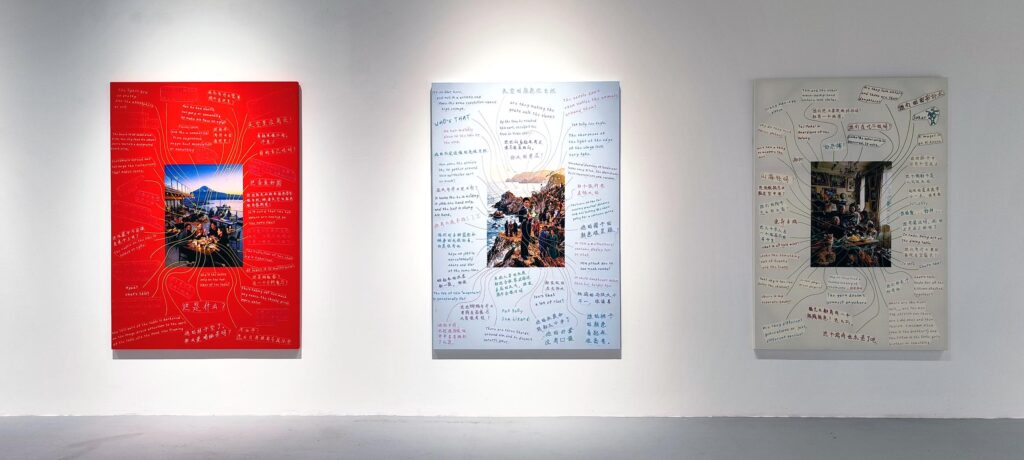
Chow and Lin, Blink, 2025
Perhaps the most heartwarming part of Chow and Lin’s presentation is the way their children have become collaborators in their practice.
In Blink (2025), the artists explore the growing tension between artificial intelligence and human evolution through AI-generated images of food, combined with text embroidered onto fabric. The work was developed with their two children, who belong to Generation Alpha and are growing up alongside these technologies.
When I spoke to the children, they explained that their parents generated the AI images using different platforms, while they responded to the images with their own observations.
Their responses to AI were also refreshingly nuanced.
They recognised its usefulness, particularly for finding information and inspiration, but also acknowledged the danger of becoming overly dependent on it and losing the habit of thinking and observing for ourselves.
This makes Blink more than an artwork about AI.
It becomes a conversation between generations.
The parents are not simply making a work about the future.
They are making it with the people who will actually inherit that future.
As Tamares pointed out to me, the children may not appear as artists in the conventional sense, but they are important collaborators across the exhibition. The concerns of the parents, whether around AI, plastic pollution or a changing world, are ultimately concerns about the future their children will live in.
Bringing the world home
This idea of family and memory continues in I Want to Bring You Around the World, created between 2020 and 2022.
The title alone made me smile.
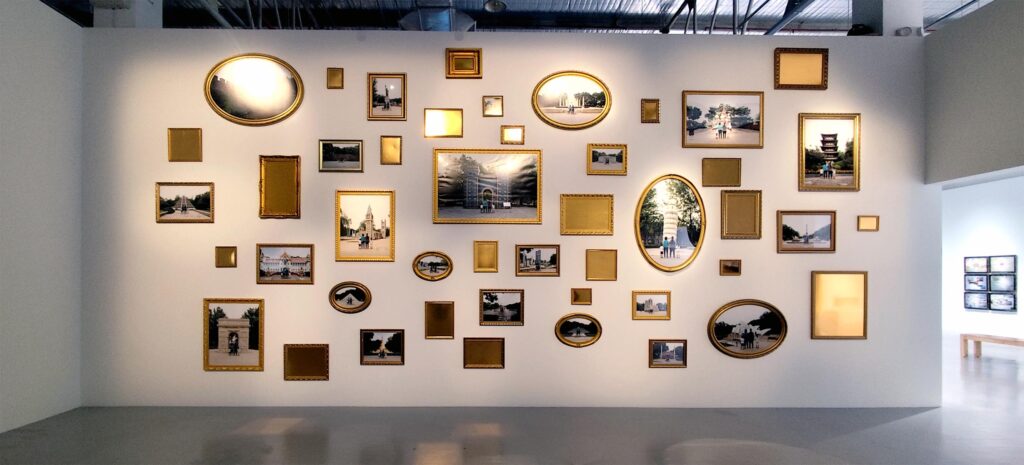
I Want to Bring You Around the World, 2020 – 2022
During the pandemic, when international travel had suddenly become impossible, the Chow and Lin family found a miniature World Park in Beijing. Instead of travelling around the world, they travelled around a park containing miniature monuments from different countries.
They returned three times to make the work, eventually photographing the family over the course of a single day.
The result is an affectionate record of a strange period in history.
The world was closed, but curiosity remained.
And instead of simply documenting the pandemic, Chow and Lin turned that limitation into an exploration of family, identity and memory.
What struck me most is how the children, who were young at the time, are present not merely as subjects but as participants in the family’s attempt to make sense of an altered world.
They could not travel around the world.
So their parents found another way to bring the world to them.
The weight of two
Walking through Counterweight: The System of Two, I began to realise that the exhibition is not really asking whether two people can agree.
It is asking something more interesting:
What happens when they don’t?
Because balance does not mean that everything weighs the same.
It means that different forces are constantly responding to one another.
One moves faster. One slows down. One questions. The other insists. One wants to experiment. The other grounds the idea.
And somewhere in between, something new emerges.
That is what connects the two duos despite their very different practices.
Chow and Lin approach the world through research, economics, policy, data and systems, translating large social questions into familiar objects and everyday experiences. Ruobing & Sai approach it through material, sound, ecology, found objects and embodied encounters.
One begins with systems.
The other begins with materials.
But both ultimately arrive at relationships.
Between people.
Between objects.
Between humans and the environment.
Between parents and children.
Between what we consume and what we leave behind.
And between two people trying to make sense of the world together.
Perhaps this is why Counterweight feels so much more personal than its title initially suggests.
It is not really about weight.
It is about what allows us to carry it.
As I left Whitestone Gallery that evening, I kept thinking about the two lamps facing each other.
Sometimes they meet.
Sometimes they don’t.
But they continue moving.
And perhaps that is the most honest description of any long-term partnership, whether in life or in art.
You do not always have to be in perfect sync.
You just need to keep moving together.
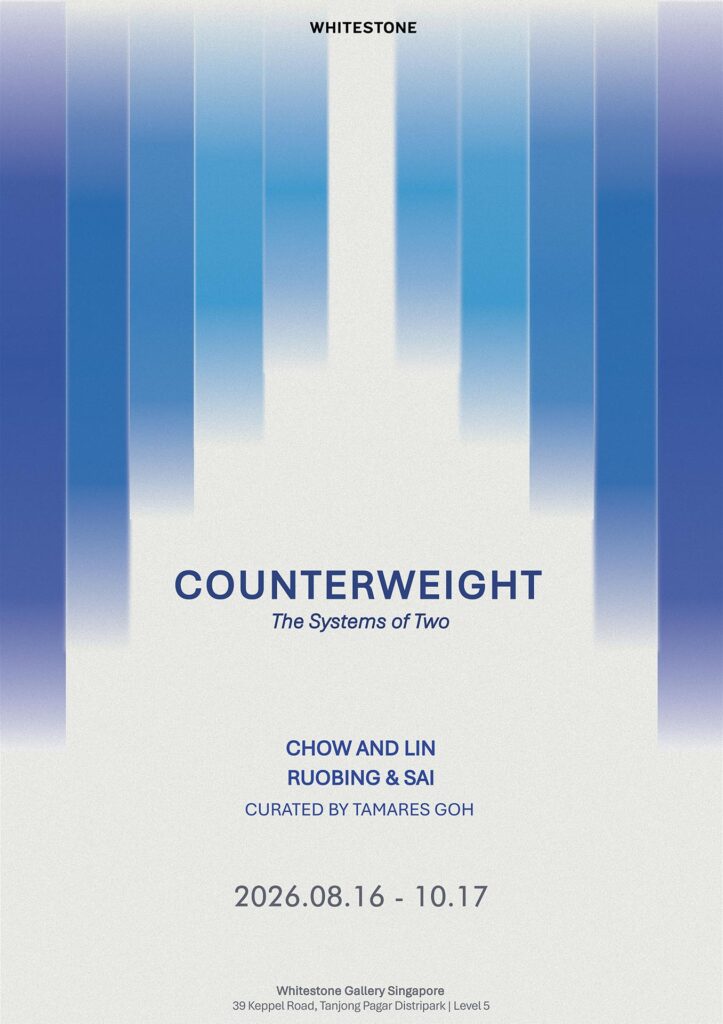
Counterweight: The System of Two, curated by Tamares Goh and featuring Chow and Lin and Ruobing & Sai, runs from 16 August to 17 October 2026 at Whitestone Gallery Singapore, 39 Keppel Road, Tanjong Pagar Distripark. The exhibition marks the relaunch of Whitestone Gallery’s new Singapore exhibition space and presents 42 works by Chow and Lin alongside works by Ruobing & Sai.
Counterweight: The Systems of Two
16 August – 17 October 2026
Whitestone Gallery
Tanjong Pagar Distripark
39 Keppel Road, #05-03/06
Singapore 089065