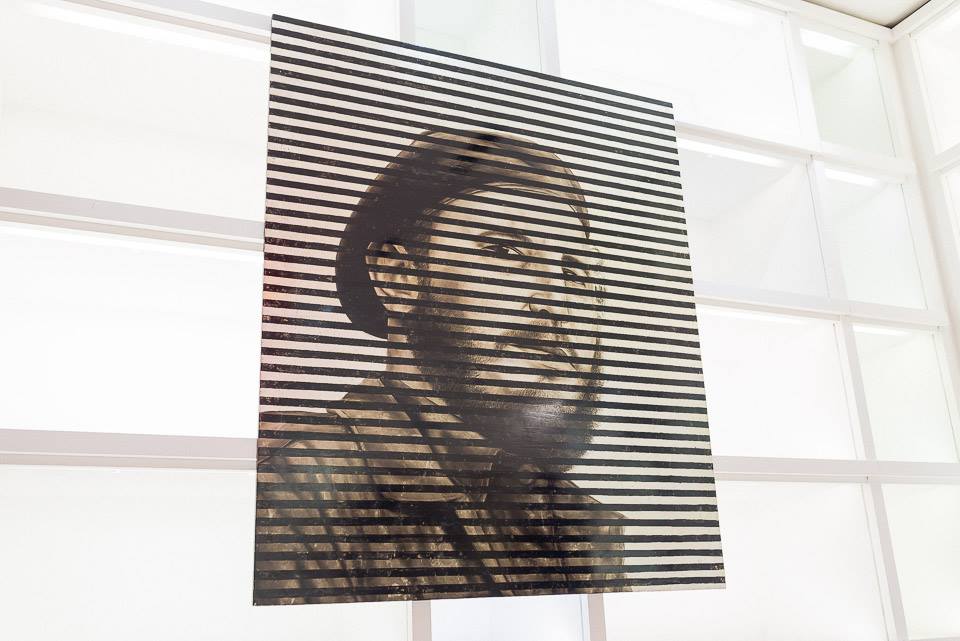
On a recent trip to Japan, Artitute was privileged in being invited to an exclusive private tour of the newly inaugurated Yayoi Kusama Museum in Tokyo. This museum is so exclusive that they only allow 280 visitors per day in 4 slots of 70 people, which makes the experience even more intimate. Tickets are released 5 times a year and have already sold out until the end of the inaugural exhibition’ season in 2018!
So, we would like to invite you to sit back and enjoy this Artitute exclusive and hope that one day you have the pleasure of visiting it in person. (more…)
Chan Hampe Galleries’ last exhibition at its Raffles Hotel Arcade location closed earlier this month with four artists’ line-up of three solo exhibitions. In January, the exhibits, which opened during Singapore Art Week, were curated by Khairuddin Hori and brought together Kenny Pittock, Ruben Pang, and the Le Brothers in three separate projects exhibited in various shop lots hotel arcade.
Exhibition View – Kenny Pittock, She Smiled at Me
Kenny Pittock is a Melbourne-based artist, and his works are in the form of sculptures, drawings, books and paintings that are fun and light-hearted. His maiden exhibition at Chan Hampe Galleries was titled She Smiled at Me and included all kinds of everyday material made of ceramic (a piece of gum stuck on a canvas; apples, oranges and avocados; a Lonely Planet travel guide to Singapore) as well as paintings, drawings and colouring books. At first glance, the works appeared childishly simplistic, but the accompanying captions provided an alternate way of seeing and reading the works.
Kenny Pittock, Today’s Top Story (2017), 121 x 91 cm, Acrylic on Canvas
When asked about the show’s title, Pittock explained: “I nearly called the show Single and Poor in Singapore, which I like as a title, but it didn’t fit the tone of the show. She Smiled at Me references the largest painting in the exhibition, a playful and sentimental look at how we prioritise the importance of everything around us (and our place within it). Like the work in the show, the title is simultaneously serious and silly.”
Kenny Pittock, All Sorts, 2016, 2.5 x 2.5 x 2.5 cm, Acrylic on Ceramic
“Gum” and all things related to it featured prominently in the exhibition…. gumboots, Forrest Gump, bubble gumby – all alluding to the ban on chewing gum sales on the island. However, Pittock seemed to be appeasing gum lovers with a work that said, “anyway, it doesn’t matter if there’s no gum because there are all sorts of other good things”!
Kenny Pittock, Gum Leaf (2016), 24 x 7 x 1 cm, Acrylic on Ceramic
Pittock explains his fascination with chewing gum: “I was in a Singapore 7-11 and they had a whole range of souvenir mugs and tea towels with the heading “Singapore is a fine city”, with the word fine italicised and in red, and below the heading was an extensive list of things that are illegal in Singapore, including the gum thing.
Kenny Pittock, Gum Boot, 2016, 30 x 30 x 19 cm, Acrylic on Ceramic
Besides the ceramic book, there were two “real” books: a colouring book about birds and a limited-edition collection of 99 drawings of people whom Pittock encountered daily on his train commute to his studio near Flinders Street in central Melbourne.
The artist revealed that the main thing he was worried about in Singapore was that it was illegal to eat on the train, which he’d done almost daily for over a decade. He adds: “In fact, just last September, I finished a project called Drawings of People Eating on the Train. So I was genuinely worried I might be on a train and start eating a banana just out of habit, and they’d lock me up and throw away the key.”
Kenny Pittock, An Appealing Encounter (2017), 60 x 91 cm, Acrylic on Canvas
We asked Pittock, who has never been to Singapore before, what impressed him the most in this island city? “Mostly, it was all the amazing people I met during my time in Singapore that left the biggest impression on me. It was an extraordinary time, and I made a lot of great friends. Also, I ate a durian, well, I tried to eat a durian. So far out, that certainly left an impression and inspired a painting I’m working on called “The Picture of Durian Grey”.
Installation view, Ruben Pang, A Totem for your Genuine Internals
In another shop space, diagonally across from the gallery, was Ruben Pang’s A Totem for your Genuine Internals. Not only spatially but visually and conceptually too, Pang’s work was quite contrary to Pittock’s. Unlike Pittock’s works that look outwards and observe the world, Pang’s installation was an inward reflection.
As you entered the gallery space, what struck you immediately was how different this was from Pang’s usual oeuvre of ethereal paintings on aluminium. The space felt sacred and cultish …perhaps the pink-purple and black graffiti-style painted walls that closed in around you evoked that emotion or was it the strange neon altar facing you that created this conflicting sense? The work drew you in and then wouldn’t let you leave as you tried to decipher the separate elements that made the whole.
Ruben Pang, The Path to Success and The Way to Suck Eggs (2016 – 2017), 178 x 57 x 30 cm, Ceramic Mounted on Mild Steel Pedestal
For this installation, Pang drew upon Chris Martin’s philosophy that an artist should avoid assessing his works as good or bad paintings and see it as a work reflecting a point in time. While working on this installation, Pang was also reading Oscar Wilde’s Picture of Dorian Gray (where Gray’s flaws remain hidden from the public, while his portrait displays the unsavoury elements of his character), and he said that all these elements drew him to the notion of confronting and accepting oneself. Pang elaborated that “I think we’ve all experienced times where we look in the mirror and see nothing but defects. And as an artist, we look back at our past creations and only see what we’d rather have changed.”
Given carte blanche by the curator, Pang treated the walls intending to make gestures that he felt authentic and without thinking compositionally. Instead, he says he “did it quickly because I was very certain that if it mirrored what I was to myself at that moment, it had to be captured quickly. So I stopped at the point where I could recognise myself in the present moment”.
The third and last series of works at Chan Hampe Galleries was by the Vietnamese twin brothers Le Duc Hai and Le Ngoc Thanhe, more commonly known as the Le Brothers. Titled North.Centre.South the exhibition included videos, installations and paintings that dealt with issues of post-war Vietnam. From the outside in, the war in Vietnam has been generally viewed as one between the North and the South. The Le Brothers, who are based in Hue, a city in the centre of Vietnam, highlight the sentiments of those in the centre – caught between the differing ideologies of Hanoi and Saigon.
The exhibition includes several projects or series of works that the duo has undertaken since 2010: The Mao Suit Project, The Bridge Project, The Game Project, The 365 Days Project, The Numbers Project, Before ’86 Project and The Red project.
Le Brothers, Mao Suits from Mao Suits Project, 2016, 4 sets of Mao Suits, special edition.
The Mao suit popularised by Mao Zedong and synonymous with communist China is said to have been designed by a Vietnamese tailor for Sun Yat-Sen when he visited Hanoi. Mixing Japanese, Chinese and western elements, the suit has become an icon of communist doctrine because of its association with Mao Zedong. The Le Brothers appropriated this suit by reproducing and wearing them in red and bright yellow – colours of Vietnam’s national flag. However, unlike the Mao suit, these outfits were embroidered with motifs of the dragon and phoenix, and another set made in military camouflage.
Le Brothers, Military Uniforms from The Game Project (2013-2015), two sets of military uniforms, edition 2 of 4 + 1 artist copy
The military imagery re-appeared in TheGame Project as motifs cut and patched onto the two uniforms of the People’s Army of Vietnam (North Vietnam) and the Army of the Republic of Vietnam (South Vietnam). Interspersed with symbols of peace, like birds and flowers, the motifs were cut in duplicates from one uniform and stitched onto the other. Originally signifying opposing factions of the country, these uniforms continue to evoke painful emotions of the past and point to the desire for peace and a true union of the Vietnamese people while the stitches were alluding to the process of healing.
Le Brothers, AK-47 from The Game Project (2013-2015), Gold leaf with lacquer on wood, 140 x 40 x 7 cm
The Bridge Project, a 5-channel video, continues the narrative from the Le Brothers project “The Bridges of Vietnam, Korea and Germany”. They illustrated a post-war and post-communist consciousness, the work documented performance by the twin brothers on the borders of the three countries that navigate a North-South/East-West identity. It showed them dancing with local artists and passersby and explored the consequences of living under a communist rule even if the governance and the rule of law had changed.
The multitude of projects and works by the Le Brothers are overwhelming. The past seems to tighten the artists’ consciousness even though they were born post-war. But the serious themes of their works are offset by a playful and humorous style – a device used by Pittock.
Chan Hampe Galleries is now Chan+Hori Contemporary and moves to Gillman Barracks this month. More information on upcoming exhibitions can be found at http://www.chanhori.com/.
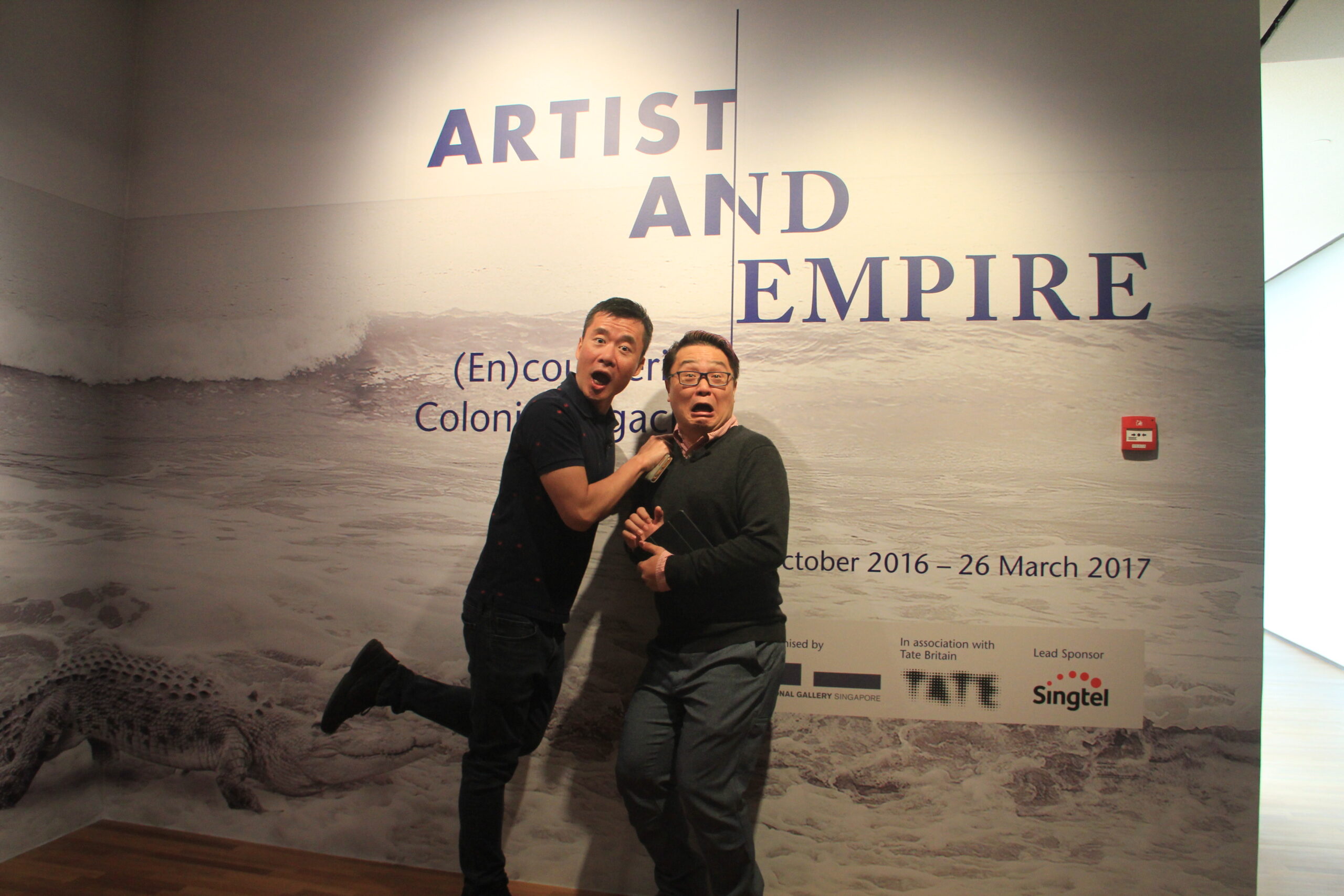
They make quite a pair Mr Brown and Mr Curator. Mr Brown is none other than Singapore’s very own social commenter and blogger; Mr Curator is Low Sze Wee, the National Gallery’s curator of ‘Artist and Empire’ which is a temporary exhibition ending 26 March, 2017.
I’ve never met Mr Brown personally nor had heard of him until recently. However, through Singaporean friends, I’ve come to know Mr Brown after watching recommended YouTube videos of his skits. He has a blog “documenting the dysfunctional side of Singapore life since 1997”. The man is Funny! I roared with laughter at his quips and his grammatically correct English sentences infused with smatterings of Singlish adding a very Singaporean flavour to his voice.
The tour began with Mr Brown acknowledging that he is a side-kick to Mr Curator and bashfully admitting that he had to do a lot of homework before putting on his museum guide hat. He loves art and he is a self-professed ‘gallery junkie’ which is helpful in terms of talking about the artworks he likes. The tour takes the audience through 15 key highlights in the exhibition with narratives provided by both Mr Brown and Mr Low.
The National Gallery’s collaboration with Mr Brown is an attempt by the art institution to engage artfully with the public through humour and storytelling. In theatre, humour is a device that makes sensitive issues more palatable. It cannot be denied that a topic like colonialism and its effects touches the raw nerves of people who are still reeling from memories of colonisation and instigates shame amongst the younger generations whose ancestors have been the victors of Empire.
’Artist and Empire: (En)countering Colonial Legacies’, with artworks loaned from Britain, Australia, India, Myanmar and Singapore, is a mirror to Tate Britain’s 2015 ‘Artist and Empire: Facing Britain’s Imperial Past’ but refracted to tell stories about Empire through Singapore’s lens. The Tate exhibition met with some acerbic comments from art critics in England. Mark Hudson of The Telegraph entitled his review of the Tate exhibition with the tagline “just not good enough”; Laura Cumming of The Guardian calls it ‘illustrations minus the narrative’. By staging this exhibition, the NGS being a newly minted art institution, barely two years old since its inception, takes the lead by bringing a controversial exhibition to the shores of Southeast Asia.
It must be said that Singapore’s curation of the exhibition has been thoughtful about a sensitive issue. How could it not be? Singapore was, after all, part of Empire and many citizens in their golden years can still testify to having been a part of it. Throughout the tour, there was a marked attempt to critique colonialism via the artworks. I gather that this was not the curatorial intention but being critical of colonisation is the privilege of post-colonial citizens. Besides, making fun of certain British habits like ‘the swag’ of Sir Frank Swattenham’s pose does bring on laughter.
George William Joy, ‘General Gordon’s Last Stand’, 1893, oil on canvas, 236 x 175 cm. Collection of Leeds Museums and Galleries (Leeds Art Gallery).
Inviting a personality like Mr Brown who openly critiques Singapore in his blog is a political undertaking by the NGS, although it was not with this intention in mind that this collaboration has taken place. This is an exercise to invite the local public into an art institution housed in two historical monuments for a fun-filled and easy-to-understand tour of its temporary exhibition which will end soon. But when discussing colonisation and imperialism, the politics cannot be omitted. How this topic is broached requires careful orchestration and insightful deliverance. Take ‘General Gordon’s Last Stand’, by George William Joy, for example, where Mr Curator explained how this painting was used to glorify Empire. This is an art historical fact; a political statement by an artist of Empire. Low shared his profound knowledge in a matter of fact way which was both academically critical but engaging without intimidating his audience. Historically, the event of Gordon’s massacre was really nothing to be boastful about. The amok and rowdy soldiers who murdered the General was pointed out by Low who painted a picture of how the English viewed the Other: hostile, unruly and rowdy. These Sudanese soldiers were painted piled up one on top of another in a frenzied endeavour to murder Gordon who remains proud and strong even at the hour of death. Mr Brown performed The Last Stand by mimicking Gordon’s stance which left the audience in fits of giggles.
A little boy in the audience asked “Why does the mannequin have a knife in the face?” This was in reference to Andrew Gilbert’s work which is just across Joy’s portrait of Gordon. Indeed, this bizarre installation does feature a life size mannequin with a knife protruding from its face. Mr Brown was stumped by this question. His facial expression suggested that he wasn’t expecting this but his equilibrium in answering the curious child indicated a desire to engage with the public and to find humour in a most surreal art work. In this way, the NGS has found an engaging balance between contemporary art works, which can sometimes be intimidating, and its public. Mr Brown’s respond was also very candid which led to further conversations amongst the audience of how the parade of soldiers in Gilbert’s installation wore high-heeled boots, an attempt by the artist at emasculating the British military, which brought laughter amongst its viewers. Low added that this piece of work asks its viewers to question what would’ve happened if African Zulus had colonised England instead and brought back booty made up of English everyday objects for display in African museums and homes. What if, indeed?
John Singer Sargent, Portrait of Sir Frank Althelstane Swettenham, 1904, Collection of National Museum of Singapore
It must have been a challenging exhibition to curate, I would think, given such public rancour in England when the Tate Britain staged theirs. However, the Singapore version does justice to perceptions of Empire; it is with this in mind that the exhibition was curated. It uses artworks to open up dialogues with the past and the present; yellow lines mark contemporary artworks that are juxtaposed with pieces from the past; this curatorial line of thought reflects Singapore’s self-image because it is very clear that nuances of the past co-exist with the contemporary in the Little Red Dot. For example, the exhibition opens with a portrait of Sir Thomas Bingley Raffles by George Francis Joseph. This is a portrait of Raffles in Java before he founded Singapore. Mr Brown pointed out that Raffles had a middle name – Bingley. In true Singaporean style, Mr Brown was immediately on friendly terms with the sitter, calling him “Bings”. This opening comical line set the pace and tone of the tour: fun but serious too. Low then pointed out the display on the adjacent wall. Visitors are shown a blown up photograph of Lee Wen’s erected platform where Raffles’ statue can be approached eye to eye. In this staging, the public is given a platform to engage directly with Raffles; for the first time, the powerful and the subject are locked in a face to face, eye to eye confrontation: the contemporary meeting the past in its face. Lee Wen subverted the notion of putting the colonial authority on a pedestal which was the function of portraiture in the 19th century. Mr Brown points out Raffles’ foot hovering over a map of the British Empire. This little snippet of information is precious because from the position of the viewer who has to look up at this statue, this aspect is completely obviated: we would never see this.
Portraits take up a considerable chunk of the exhibits. Portraits were status symbols used by victors to announce their success. The portrait of Tan Jiak Kim, a renowned Peranakan community leader in the 20th century stands authoritatively on its own. The purpose of this highlight was to show how portraiture was adopted and adapted in the colonies to reflect the status of a community of people who were subjects yet not subjected to the tyranny of Empire. Mr Brown offers up a personal historical tidbit: he’s a quarter Peranakan.
Mr Brown lent a comical quality to a rather touchy subject: Empire. As Low Sze Wee explained, the Singapore version of this exhibition is not about glorifying Empire but about showing works of art that were produced during Empire through the lens of Singapore. It is about opening dialogues with the public through specific pieces of artworks carefully curated to engage Singaporean audiences on the type of art produced by colonial painters, how certain artists responded to Empire through art, and to showcase artists who painted on the cusp of Empire and their nations’ independence.
I was glad to know Mr Brown and I liked similar pieces of art. His absolute favourite is ‘The Secret of England’s Greatness ’ on loan from the National Portrait Gallery in London. Mr Brown was knowledgable enough to know that the event depicted in the portrait never happened. Instead, he told the audience that he liked how the artist used vibrant colours, and played with light and shadows to make the protagonists realistic. An elegantly dressed figure tucked behind the Queen was pointed out by Low to be the Queen’s dresser; she is an aristocrat. Mr Brown added a bemused quip suggesting that the Queen can only have an aristocrat dress her and none other.
It was refreshing to see a member of the public engage with art from Britain’s past in the passionate manner shown by Mr Brown. It was especially heartwarming to see a local celebrity who professes in his blog to be a voice of dissent adopt a respectful tone yet remain critical about certain pieces of art on the tour. Mr Brown had indeed done his homework; the pairing of the curator and the comedian worked successfully for the National Gallery. I had a thoroughly fun-filled guided tour of ‘Artist and Empire’.
Mr Brown’s tour is back by popular demand on March 11, 2017. Do check the National Gallery website to see how you can get complimentary tickets to a guided tour.
Published Writer, Former Blogger and Emerging Art Historian, Eva Wong Nava combines her love for art with writing personal reviews and anecdotes. Her flash fiction are found in Jellyfish Review and Flash Fiction Magazine. Her art writings have appeared in several independent arts magazines