Category: Reviews

  • Exhibition Review: Sriwhana Spong and Maria Taniguchi – Oceanic Feeling

    Exhibition Review: Sriwhana Spong and Maria Taniguchi – Oceanic Feeling

    Oceanic Feeling, a term originated by French dramatist, Romain Rolland and later popularized by Sigmund Freud, refers to the a boundless feeling of the eternal that is the source of all religious energy. There certainly is a semblance of this oceanic feeling as one enters the monastic sobriety of this alabaster space, echoed and amplified by the reverberating ombak by Singaporean musician Vivian Wang that washes over the gallery.

    Three of Maria Taniguchi’s brick painting series are on display, spaced far from each other on the distal walls of the gallery. Large in size, matte in surface and tessellated in composition, these defiant abstract canvases possess a very practical purpose: to “take time and help me (Taniguchi) regulate my own production, my thinking”, as she attends to the quotidian task of filling in the grid. In the catalogue essay, curator Susan Gibb points out that these paintings do not exist as pure abstractions, with the stacked cell-like rectangles in the painting resembling bricks on the wall. This fact is complicated by the choice to hang some of theses canvases and have others rest against the wall, such that they appear to be “neither wholly image nor object”.

    Maria Taniguchi, Untitled 2014, synthetic polymer paint on canvas 274 x 488 cm. © Courtesy the artist and private collection, Hong Kong
    Maria Taniguchi, Untitled 2014, synthetic polymer paint on canvas, 274 x 488 cm. © Courtesy the artist and private collection, Hong Kong

    Taniguchi and Spong are both interested in the moving image, their works functioning as inquiries into how the camera influences the way we view the world. With Untitled (Marble Lions), Taniguchi shoots a pair of marble lions like a five year old fiddling with a camera, playing with the zooming controls whilst holding the camera unsteadily, self-reflexively foregrounding the intrusion of the camera in the act of viewing. Mies 421 further riffs on the issue of framing, producing an accidental “horror movie” with a set of black and white pictures of Mies van der Rohe’s Barcelona Pavilion set on loop. The sculpture Alba within the Pavilion is shot from various angles, such that a long shot renders the sculpture innocuously like a decorative piece, whereas a steady close up animates the sculpture in a move where she seems to be shielding herself from the light. As the screening intervals of each photograph decreases, suspense builds and a semblance of a narrative emerges. Alba contorts herself away from the sun; a lone security guard lingers; a woman crosses a space. What gives?

    In the case of Halberd head with naga and blades, Indonesia (Java), Eastern Javanese period, Singasari kingdom, ca. second half of the 13th century, copper alloy. Samuel Eilenberg Collection. Gift of Samuel Eilenberg 1996. 1996.468 a, b, Spong’s pinhole camera denies the viewing of this artifact, instead recording flashes of light from the display space surrounding the object, overlaying it with color filters. This results in a sort of double appropriation – the first as a rebellion against the Metropolitan Museum’s ‘no filming’ policy, and the second using the recording of the spearhead to explore the psychological effects of different colors on perception.

    Spong, Sriwhana, Villa America, 2012, silk dyed in Fanta, 463 x 1600 cm. © Courtesy the artist and Michael Lett
    Spong, Sriwhana, Villa America, 2012, silk dyed in Fanta, 463 x 1600 cm. © Courtesy the artist and Michael Lett

    Occupying the most space in the exhibition is Spong’s Villa America, an orange expanse of silk suspended and hung like curtains. All 740,800 square centimeters of this has been soaked not in industrial dye, but in orange Fanta. In the catalogue essay, Spong references an obscure essay on beverages and how “a culture’s adopted beverage represents the blood of their vanquished foe”. Is Spong implicating herself in an act of colonial vampirism, with Villa America as a sort of victory flag? Like Taniguchi’s brick paintings, this too seems neither image nor specific object.
    Sriwhana Spong and Maria Taniguchi: Oceanic feeling is the first major survey of New Zealand artist Sriwhana Spong’s and Filipina artist Maria Taniguchi’s decade-long practices. The exhibition reflects on the two artists’ concerns with material, technological and natural processes, through sculpture, painting, film and video, and performance.

    Exhibition period: Sat 20 Aug – Sun 16 Oct 2016
    Opening hours: 12:00pm – 7:00pm, Tue to Sun
    Closed on Mon and public holidays

    Institute of Contemporary Arts, LASALLE College of the Arts,  Singapore

  • New Waves in Southeast Asian Cinema: And the Wind Falls – A Review

    New Waves in Southeast Asian Cinema: And the Wind Falls – A Review

    And The Wind Falls
    And The Wind Falls

    In a bid to share the works and experiences of young Southeast Asian filmmakers with a wider audience, the Singapore International Film Festival is hosting open dialogue sessions that bring together Singaporean artists, writers, curators with emerging filmmakers.

    He Shuming and Marc Nair
    He Shuming and Marc Nair

    The second in this series is a conversation between He Shuming and Marc Nair on the themes of femininity present in Shuming’s work. An alumnus of LASALLE and the American Film Institute Conservatory, Shuming has written and directed several short films, and is currently based in Los Angeles and Singapore. Marc Nair is a local poet and photographer, both mediums that he draws on to discuss Shuming’s work.

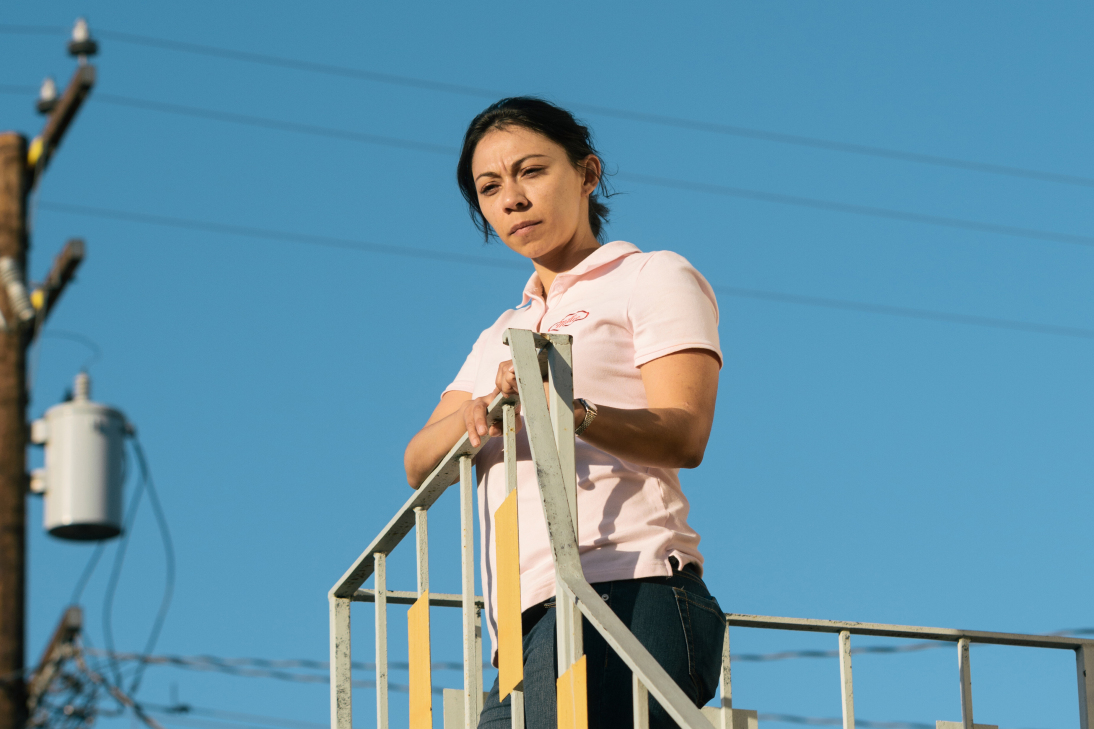
    The event began with a brief introduction of Shuming and a screening of And The Wind Falls, a film he wrote and directed as a student at the American Film Institute Conservatory. With a morally ambiguous, relatable female lead and a conspicuous absence of male characters, the connection with that night’s theme was obvious.

    Discussion ranged from gender, misogyny, and class to issues of identity, including how Shuming was able to navigate the filmmaking process – as Asian, as Chinese, as male, as non-American or non-Latinx. Marc led the conversation with incisive questions and remarks that pushed Shuming, and those of us in the audience, to rethink certain aspects of the film we were taking for granted.

    I was especially curious about how Shuming thought about this work in the context of his Singaporean-ness, and was reminded of Tan Shijie’s Not Working Today, screened at the 2014 Singapore International Film Festival. Both follow economically/socially marginalised individual in a day-in-the-life that goes awry. Both show the quiet resilience alongside the moral grayness that these individuals inhabit. For Shuming, a priority was making the film’s protagonist feel like “a real person”; I would say he succeeded.

    Watching hoon/Ramlah after And The Wind Falls – achronologically, I might add – framed Shuming’s oeuvre in an interesting way. One couldn’t help making comparisons between the two. And The Wind Falls was, as Shuming and another audience member pointed out, overdeveloped and at points melodramatic. hoon/Ramlah was minimalistic, adhering less to the classical narrative of Individual against the World because it centered the connection between the eponymous hoon and Ramlah.

     As a viewer, it was exciting to see how Shuming has evidently grown, and adapted to the situation and resources available to him. Props to the SGIFF team for that decision!

    While the space was not the most conducive, the dialogue felt intimate. It helped that Shuming and Marc were forthcoming with details in their personal lives that informed their work – Shuming even talked a lot about his mother, and the inspiration she provided for many of his films. There were moments of genuine laughter, and the audience questions revealed a real interest in what Shuming and Marc were bringing to us. There was no barrier between audience and artist to make the art in question inaccessible or opaque to us.


    NEW WAVES: Emerging Voices of Southeast Asian Cinema promises to continue to bring emerging filmmakers closer to an audience that is keenly inquisitive about their work, and eager to see more.

    Celeste Teng is enamoured of storytelling across any and all platforms, particularly film and new media. She is inspired by community-based arts and fond of reading and making lists ..  


  • Exhibition Review -Transformation and Colour: Anthony Poon

    Exhibition Review -Transformation and Colour: Anthony Poon

    Anthony Poon at the Shelford Apartment Studio, 1993. Photograph courtesy Sundaram Tagore Gallery and the estate of Anthony Poon
    Anthony Poon at the Shelford Apartment Studio, 1993. Photograph courtesy Sundaram Tagore Gallery and the estate of Anthony Poon

     A figure like Anthony Poon needs little introduction. With a productive career spanning three decades, this second-generation Singaporean artist is best known for his Wave series and sculptural commissions, which range from the St. Regis Singapore to the Beijing Olympics. Now on display at the Sundaram Tagore Gallery is a broad overview of Poon’s oeuvre, showcasing shaped canvases completed early in his career, the Frequency and Wave series and most fascinatingly, his preparatory sketches and maquettes, allowing us to peer past the unspeaking matte surfaces of his canvases into his assiduous working process.

    Compared to his coevals in the 1970s (Teo Eng Seng and Goh Beng Kwan to name a few), Anthony Poon’s works stand out very distinctly for their post-painterly aesthetic and conceptual matter. There are no hints of brushstrokes or anything revealing about the process of painting, nor is there any local subject matter. First trained under the tutelage of Cheong Soo Pieng at the Nanyang Academy of Fine Arts and later at the Bynam Shaw School of Art in London and at the Bradford Regional School of Art, Poon proved to be highly articulate in the international geometric abstractionist style and remarkably consistent in his pursuit of hard-edged abstraction.

    Anthony Poon, untitled, undated, acrylic on canvas, 223 x 295 cm. Photograph courtesy Sundaram Tagore Gallery
    Anthony Poon, untitled, undated, acrylic on canvas, 223 x 295 cm. Photograph courtesy Sundaram Tagore
    Gallery

    From the beginnings of his career, Poon’s working method was systematic, meticulous and unvarying, operating in phases from sketch to maquette to canvas. We see how he plans the shape of his canvas to scale and the ordered symmetry of the lines within on graphing paper, while assigning individual colors to each sharply delineated space. Poon’s fastidious attention to the technical aspects of his art would remain a constant throughout his career, later evidenced by how he titled paintings in his Wave series by codes used in acrylic paint color charts. Poon was very clear on the kind of optical effects he wanted in his work, where he writes in a sketch how he intends for the “three standing squares” tilted sideways “to form a rhythm like moving wheels” and the use of a “square to enlarge the in-between like a microscope enlarging the in-between movements”.


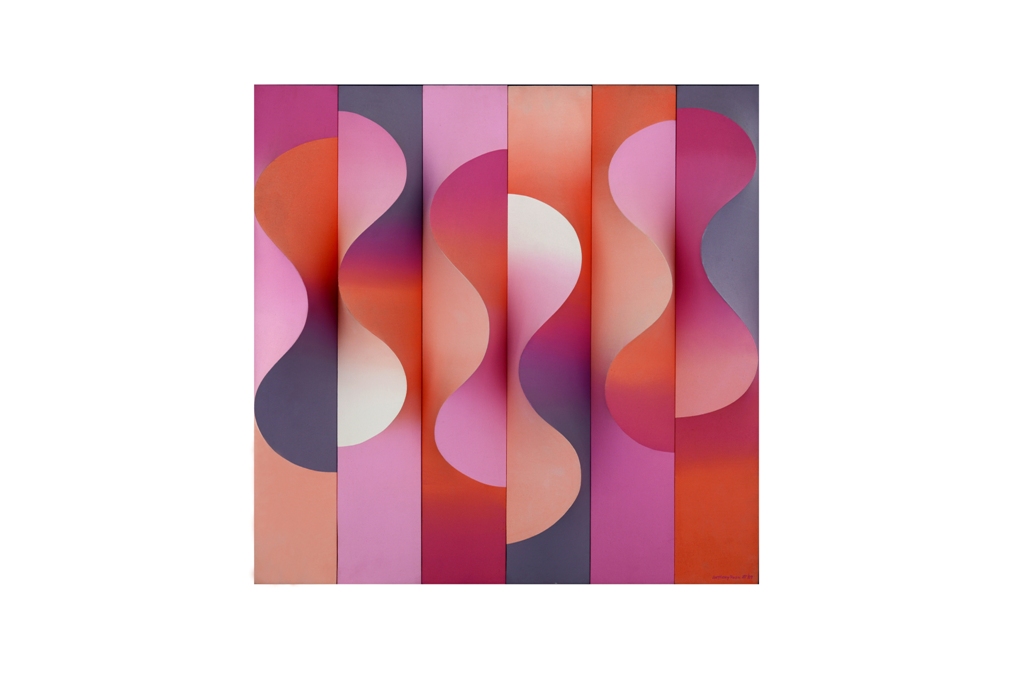
    Emerging from the austere rigor of his shaped canvas paintings in the 1970s is a softer, more fluid sensibility that extends from the 1980s to the 1990s. His interest in color widens into the expanse of color field theory. Here, the undulating frequency wave – his eventual signature visual – sweeps across his canvases in both two and three-dimensional form. With his flat Frequency series, symmetry now exists as a looser concept as Poon deploys ombré such that certain shapes appear to advance while others recede, conveying spatial depth while preserving a lyrical tonal harmony. What he produces is not plain repetition, for this is repetition with a difference, and no two waves are the same.

    Anthony Poon, P8-B7 on Verti-Waves, 1988, acrylic on canvas, 52 x 152 x 18 cm. Photograph courtesy of Sundaram Tagore Gallery
    Anthony Poon, P8-B7 on Verti-Waves, 1988, acrylic on canvas, 52 x 152 x 18 cm. Photograph courtesy of Sundaram Tagore Gallery

    For his Frequency series, perhaps Rothko’s advice to appreciate his works 18 inches away from the canvas might come in handy. But for the Wave series, experiencing it from far and walking around it, as you would a sculpture, might prove more instructive in appreciating the movement inherent in this series. When looked at frontally, the eye not only looks at the painting’s general composition, but also traces the curved armature visually. Tactility is felt in his relief paintings, almost as if you want to feel the fold of the canvas over the aluminum strips beneath. Within these raised contours that break the fourth wall reside an immanent sensuality, its spatial depth enhanced by both the light (and its attendant shadows) and the gradated tonal symphony.

    Anthony Poon, Re-PU6 on 6P Waves, 1989, acrylic on canvas, 87 x 87 x 13 cm. Photograph courtesy Sundaram Tagore Gallery
    Anthony Poon, Re-PU6 on 6P Waves, 1989, acrylic on canvas, 87 x 87 x 13 cm. Photograph courtesy Sundaram Tagore Gallery

    From this formal inventiveness in painting, it only made sense that his next step would be to embrace the truly three-dimensional form of sculpture. Poon’s obsession with color now takes a backseat, as the three mono-colored sculptures on view now explore space instead, where lithe planes of steel and bronze cavort, duck beneath one another, and fuse. I would have liked it if there was some sense of chronology in the exhibition, or at least to see paintings of the same series displayed beside each other, to get a fuller sense of how Poon continually toyed with issues of form and color. Regardless, there is a real sense of the maturation of his style, as Poon takes his works from 2D to 3D, from flat to fold.

    Anthony Poon, Growth, 1997, painted bronze, 59 x 79 x 59 cm. Photograph courtesy Sundaram Tagore Gallery
    Anthony Poon, Growth, 1997, painted bronze, 59 x 79 x 59 cm. Photograph courtesy Sundaram Tagore Gallery

    “I would like to end my life with a paint brush in my hand.” This was an artist with such clarity of vision, so keenly focused on the expression of and relationship between line, form and color that he fashioned a new painterly idiom so unlike anything else in Singapore in the 1970s. In this light, no one is more deserving of the epithet ‘pioneer of Singapore abstraction’ than Anthony Poon, and this exhibition is a fitting testament to that.

    Transformation and Colour: Anthony Poon

    Sundaram Tagore Gallery

    May 27 – July 10, 2016