Category: Reviews

  • Reframing the Frame of Modernism: National Gallery Singapore’s latest exhibition

    Reframing the Frame of Modernism: National Gallery Singapore’s latest exhibition

    Nguyen Gia Tri, The Fairies, c. 1936, Collection of Geraldine Galateau Paris.
    Nguyen Gia Tri, The Fairies, c. 1936, Collection of Geraldine Galateau Paris.

    Framing an ideology is not a task easily accomplished. Reframing it, is possibly, even harder. The National Gallery Singapore’s newest exhibition which opens on the 31st of March attempts to do this through its latest exhibition titled Reframing Modernism – Painting from Southeast Asia, Europe and Beyond.

    The exhibition which is co-curated and co-presented with Centre Pompidou, Paris is the inaugural exhibition at the Singtel Special Exhibition Gallery. It showcases 217 works from 51 artists from the collection of both museums as well as loans from private and national collections. This is the first time that an exhibition displays significant Southeast Asian and European artists in parallel through its study of one of the most influential artistic and intellectual drives of the 20th century – modernism – from the perspective of Southeast Asia.

    Gallery 1 view, Reframing Modernism, National Gallery Singapore
    Gallery 1 view, Reframing Modernism, National Gallery Singapore

    Beginning with the existing paradigm that modernism or modernistic painting was mainly a response by Western European and American artists to the events that were shaping the world in the late 19th and early 20th century (the industrial revolution, World War I, urbanisation, etc. ); and that modernism in the rest of the art world was a derivative of it, Reframing Modernism challenges this framing from the Southeast Asian context. Though not a survey exhibition, it observes and compares the individual practices of selected artists from both regions and hopes to create a new and different narrative of modernism by highlighting shared concerns.

    Gallery 1 view, Reframing Modernism, National Gallery Singapore.
    Gallery 1 view, Reframing Modernism, National Gallery Singapore.

    The 217 paintings are presented in three galleries. The artworks in the first gallery which includes  those  of Henri Matisse, Marc Chagall, Georgette Chen, Cheng Soo Pieng and S. Sudjojono draw on themes of the vernacular, visual harmony, exoticism, and cross cultural exchange. The second gallery focuses on concerns of art fundamentals like colour, form, space, pattern, perspective and composition. Abstraction and the move to geometric patterns is featured here in the works of Vassily Kandinsky, Hernando R Ocampo, Georges Braque and Henri Valensi.  The last gallery presents artists who explored abstraction through diverse pathways of spirituality, materiality and mythology.

    Gallery 2 view, Vassily Kandinsky's works, Reframing Modernism, National Gallery Singapore
    Gallery 2 view, Vassily Kandinsky’s works, Reframing Modernism, National Gallery Singapore

    The exhibition is not chronologically or stylistically arranged. According to the National Gallery curators, they began the curating process by identifying Southeast Asian artists whose practices and works reflected the diversity of modernism or modernity in the region. The Centre Pompidou curators then responded by identifying artists whose works resonated with the Southeast Asian artists, thereby privileging the region as an entry point.

    Gallery 2 view, Henry Valensi's works, Reframing Modernism, National Gallery Singapore
    Gallery 2 view, Henry Valensi’s works, Reframing Modernism, National Gallery Singapore

    Throughout the exhibition, visitors are invited to draw their own connections and conclusions about the history of modernism and its relevance to the development of art in Southeast Asia. Lisa Horikawa, senior curator at the National Gallery, noted that the exhibition is very different from the ones that have travelled here in the past as this is collaboration between the two museums rather than a pre-packaged exhibition that travels the world.

    Gallery 3 view, Tang Chang's work, Reframing Modernism, National Gallery Singapore
    Gallery 3 view, Tang Chang’s work, Reframing Modernism, National Gallery Singapore

    Looking at the artworks, it does seem that the practice of many artists from diverse parts of the world were similar stylistically or conceptually but as Catherine David, Deputy Director of Centre Pompidou’s National Museum of Modern Art –Industrial Design Centre, observed, while the works of some artists may seem similar, genealogically they are very different from each other.

    The exhibition also includes four works by  Singaporean artist Georgette Chen. Three from the collection of the National Gallery Singapore and one from the collection of the Centre Pompidou. The latter painting, which is an oil on canvas titled Landscape and dated c. 1930s, was inherited by the museum when it was set up in 1947 and its complete provenance is still being established.

    This is the second time works from the Centre Pompidou’s collection are being shown in Singapore. The first was in 2011 when a travelling exhibition titled Video an Art, a History (1965-2010) was held at the Singapore Art Museum.

    Whether viewers to the exhibition are able to reframe the ideology from a Southeast Asian perspective or not, one thing is for sure: with over 200 works, the exhibition is a visual treat for appreciators of art. However, with an admission fee of $15-25, it makes it difficult to make multiple trips to the exhibition since it is virtually impossible to see think and wonder at the immense collection in one go.

    The exhibition will run at the National Gallery Singapore till July 17, 2016.

    All images courtesy of National Gallery, Singapore.

    For more details visit www.nationalgallery.sg


  • Exhibition Review: Ye Shufang’s The Loss Index II

    Exhibition Review: Ye Shufang’s The Loss Index II

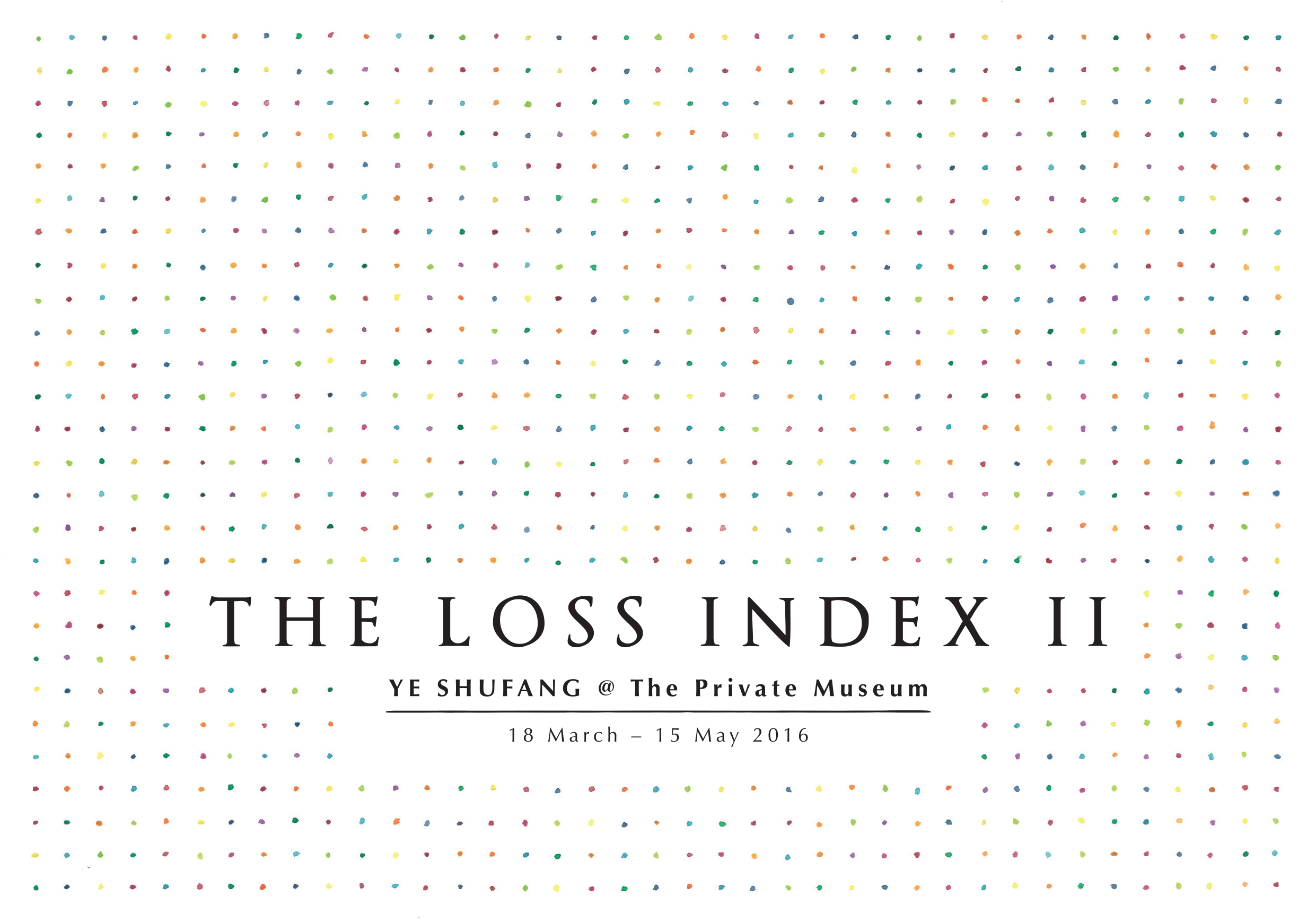
    Ye Shufang’s latest exhibition is The Loss Index II at The Private Museum, a sequel to The Loss Index: Perishables and Other Miscellanea in 2013. Comprising deceptively simple surfaces in unconventional forms of presentations – the three works are suspended by functional black binder clips, laid flat on a white plinth and in small plastic cups respectively – Ye reaffirms her affinity with the mathematical precision of a grid and manifests loss through honey.


    Ye Shufang, Exercise in counting (27,005 days), 2016, watercolour on paper, 70x100cm
    Ye Shufang, Exercise in counting (27,005 days), 2016, watercolour on paper, 70x100cm

    The first piece, depending on how you wish to navigate the space, is Exercise in Counting (27,005 days). Short, vertical strokes of pink or red are lined side-by-side like matchsticks in a box, forming thirty-nine rows packed in a dense grid. Each slender line is rendered in a shade of watercolour lighter or darker than the previous one, producing a rhythmic ombré pattern, sparingly accented by snatches of non-pink or red colours. These recordings are inscribed on a piece of paper, whose serrated edges still bear trace of the crinkly adhesive that binds a drawing block together.

    Ye Shufang, Exercise in counting (27,005 days), 2016, watercolour on paper, 70x100cm
    Ye Shufang, Exercise in counting (27,005 days), 2016, watercolour on paper, 70x100cm

    Instinctively, one could view this as Ye’s remarkably disciplined exercise in recording the passing of each day, with the highlighted lines representing days of personal significance. The parenthesis in the title would then be a hyperbole, for there are no 27,005 lines on the paper, and Ye is no septuagenarian. What Ye does is to hold eternity not in a grain of sand, but on a piece of paper. The long-drawn process of creation through quotidian recording is juxtaposed against the quick viewing experience of the seemingly simple surface, as she materialises the accretion of days lost and time past in a calendar-like rectilinearity. A morning alarm, an editorial deadline, a wedding anniversary – what is life but an exercise in counting?

    Ye Shufang, In Vivo 25mg (within the living 25 mg), 2016
    Ye Shufang, In Vivo 25mg (within the living 25 mg), 2016


    Art theorist, Rosalind Krauss, once declared the grid to be “what art looks like when it turns its back to nature”. In Ye’s case, this is not quite true, as she reprises the grid and turns to nature in In Vivo 25mg, or more precisely, draws from nature in vivo, using sweet viscous honey. This time, translucent multi-coloured dots of honey – each no larger than the size of a pea – speckle a white surface in an 55 by 37 invisible order. There is an uncanny resemblance to Damien Hirst’s spot paintings, in terms of the use of the grid and colour harmony, except Ye’s synthetically-coloured droplets of honey are much more diminutive, and uneven in size, like the lines in Exercise in Counting. Collectively, these drops look back at us flatly, resembling piped icing on a cake. This gives rise to a naked materialism in In Vivo 25mg, and I invariably think of the bees and their honeycombs, where these twenty-five milligrams of honey are extracted – within the living.

     IMG_2698

    The conceptual possibilities of the honey medium are stretched in the last piece, found sequestered in a corner. Atop another white platform is a large mason jar of 100% longan honey, flanked by stacks of plastic cups containing that very liquid, “available for take-away”. A title and the name of the artist are absent in the label, which only states Ingredients: 100% Longan Honey, a notice that it is free and an allergy warning. I think Ye is trying to say something about the production and consumption of art here. In a sense, we have commercialised the bees’ ‘loss’ of their food stores as a human ‘gain’, what with the well-advertised health benefits of eating honey. She cannot claim that she has produced the medium, and just as we are consuming the art, she too, is a consumer herself in repurposing the honey for an art exhibition. Thus, what results is a curious triangulated relationship between the original producer, the appropriator, and the end-consumer.

    This certainly is not Ye’s first time using honey, the previous instance being Project: Honey Sticks (6,425) at the Singapore Art Museum, where multi-coloured honey sticks are dispensed from a rectangular receptacle. By the end of this exhibition, the end-result of would not be too different from Project: decreasing quantities as the process of loss is stretched out across the span of the exhibition and finally, an empty container noted for its absence of material, reminding us of the stark, ineluctable presence of death. Unlike the decomposing agar-agar used in The Loss Index: Perishables and Other Miscellanea (2013), you will not find any decomposition before your eyes here, for honey does not decay as easily. Instead of showing loss and the passing of time during the exhibition, this inevitable process has already happened before the exhibition. In these installations, we bear witness to the sum of her age, honey in its post-extraction and post-processed form, proffered for public consumption. Static, solitary and distinct, The Loss Index II is an extension of Ye’s lament on the cruelly slow realisation of loss.


    The Loss Index II is on at The Private Museum until 15 May 2016

    All images courtesy the author.

    Alex Foo is all mirth and no matter, both the innocent flower and the serpent under it. He luxuriates in the arts and views Paradise as a life in museums, a library and the theatre.

  • Exhibition Review: Donna Ong’s Five Trees Make a Forest

    Exhibition Review: Donna Ong’s Five Trees Make a Forest

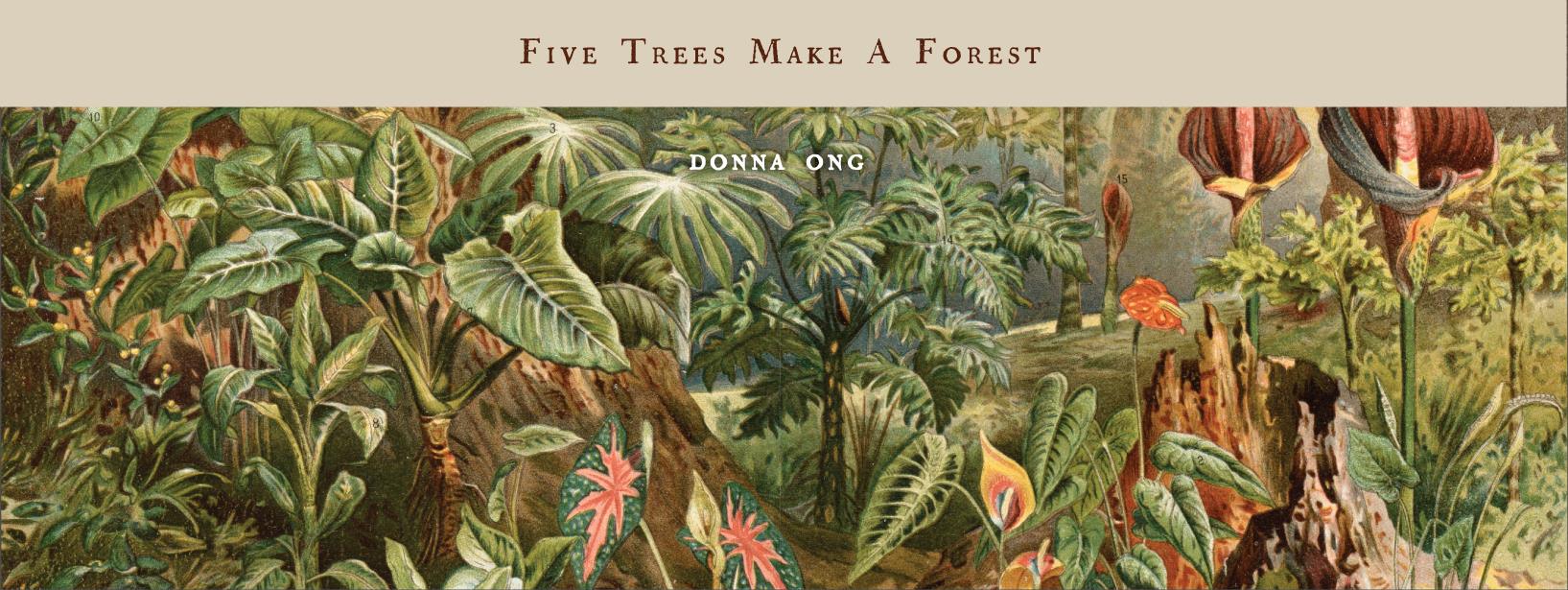
    Exhibition Review: Donna Ong’s Five Trees Make a ForestFive Trees Make a Forest has recently opened at the NUS Museum and brings to the public artistic approaches in the portrayal of tropical landscapes. The exhibition combines Donna Ong’s collection of antique lithographs with NUS Museum’s selected nineteenth-century watercolors made by Charles Dyce, as well as Ong’s installation that gives the name to the show.

    As in many contemporary art exhibitions, the theme and research behind the show is much more complex and dense than the exhibition itself displays. In questioning the way artists have been representing landscapes since the nineteenth century, Five Trees Make a Forest invites us to reflect upon artistic choices and its role as truthful documentation through history.

    Donna Ong’s installation that gives name to the exhibition. Photo Credit: Christine Veras
    Donna Ong’s installation that gives name to the exhibition. Photo Credit: Christine Veras

    Ong’s installation is a modern interpretation of the nineteenth-century dichotomy between reality and representation that the entire exhibition reflects upon. In her installation, she follows instructions on a children’s book on how to create a forest. Using paper cutouts she builds a scale model of a forest, following the book’s premise that using a few different types of trees/plants, you would be able to ‘make’ a forest. According to Ong, ‘the instructions are so easy and straightforward that even a kid can follow’ and that somehow made an impact on her and can be related to her research for ‘texts and visual examples from a variety of sources which exemplify or are informed by such conventions [stereotypes]’.

    Reflecting on these rules and guidelines on how to represent tropical landscapes the exhibition recollects a time when information was not as pervasive as it is today; therefore, it was necessary to trust artistic representations as accurate. After all, these artists were the ones on-site, representing the landscape. They were the eyes of the public in the nineteenth century, and their works were reproduced in books and maps, being mainly accessible to elite. Evidently, a lot got lost in this process of ‘translation’ making the boundaries between reality and representation fuzzier, although not always questioned. As mentioned by Simone Shu-Yeng Chung in the exhibition’s catalogue “…Such intended misalignments with the source inevitably cast doubts into the validity of the paintings as accurate records of the past.”

    The exhibition is placed in the middle of the museum’s archaeological collection, working almost like a little oasis amid all the historical artifacts. Although small, the show needs time to be fully absorbed and the viewer needs to be willing to discover the clues that relate one artwork with another. If given a chance to be looked at and appreciated, the works in the exhibition will unfold interesting curiosities, such as the little numbers floating in the lithographs that try to organize and categorize the ‘forest,’ almost as an attempt to systematize the natural chaos. Another example is in the Charles Dyce watercolors that, if looked at carefully, one will be able to find micro scale human figures within, which give to the landscape a sense of grandeur.

    In presenting these colonial views, the exhibition reminded me of the novel Baudolino (2002) by the late Umberto Eco. In the book, the manipulative central character says: ‘Yes, I know, it’s not the truth, but in a great history little truths can be altered so that the greater truth emerges.’ However, in the case of Five Trees Make a Forest, Donna Ong is not only offering a critique of these colonial views, but she is also inviting us to acknowledge these little truths, to be able to reflect more critically on the potential and stereotypical greater truth that emerged.


    Five Trees Make a Forest

    Donna Ong

    NUS Museum

    Archaeology Library

    Free admission

    11 March – 4 September 2016

    http://community.nus.edu.sg/cfa/museum/exhibitions.php


    Christine Veras is a maker who enjoys experiencing and creating art, devices and texts. She is currently pursuing her Ph.D. on ‘Animated Installations’ at the School of Art, Design and Media in NTU.