
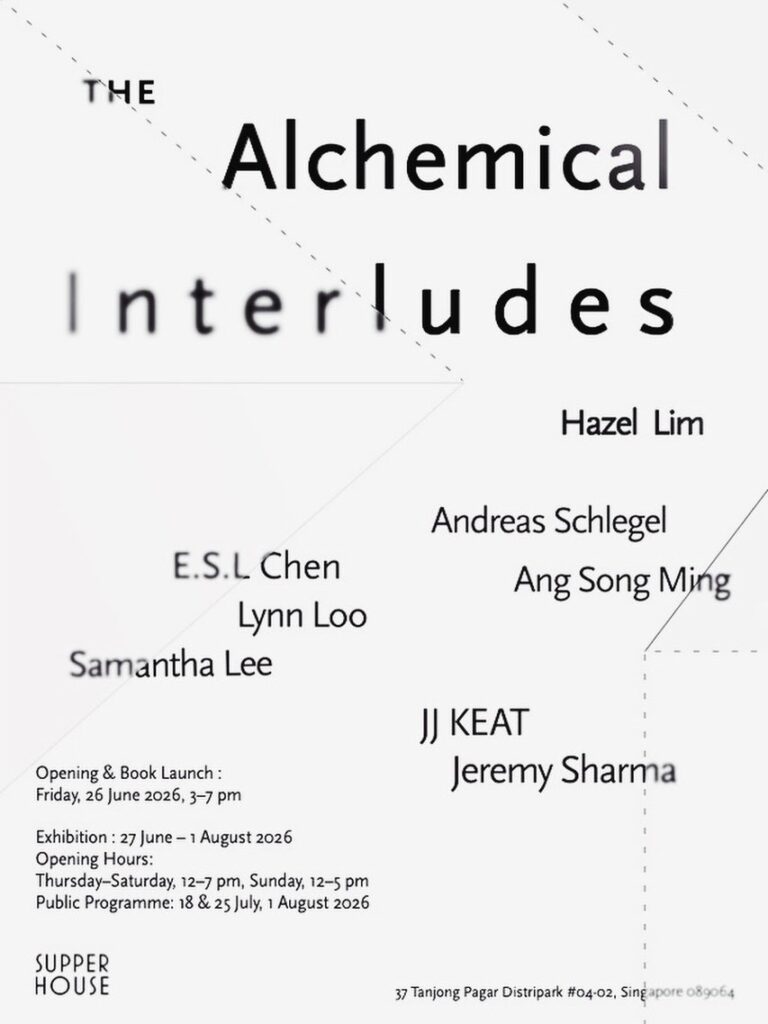
Stepping into The Alchemical Interludes at Supper House feels less like entering a conventional group exhibition and more like wandering into someone’s stream of thought. Curated by Singapore artist Hazel Lim, the exhibition gathers works by Andreas Schlegel, Ang Song-Ming, Edric Chen, JJ Keat, Jeremy Sharma, Lynn Loo and Samantha Lee, each responding to Lim’s long-standing investigation into colour, materiality and perception.
Despite occupying the expansive industrial architecture of Supper House at Tanjong Pagar Distripark, the exhibition unfolds with an unexpected sense of intimacy. Rather than filling the space with monumental gestures, the works invite slow looking, quiet listening and moments of contemplation. Every turn reveals another conversation between poetry, sound, technology and material.
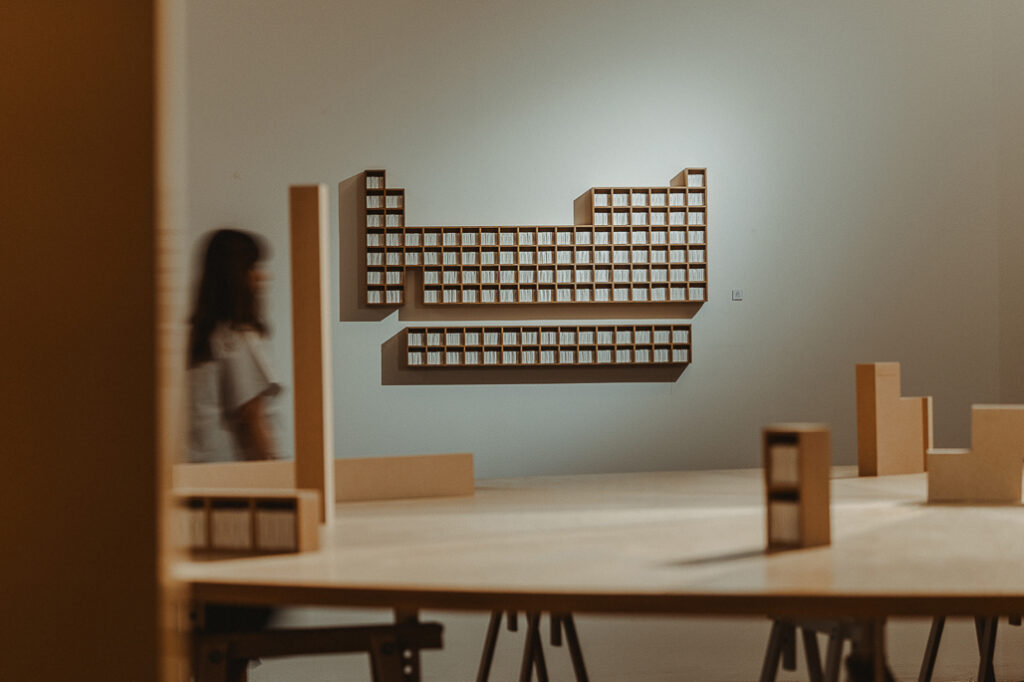
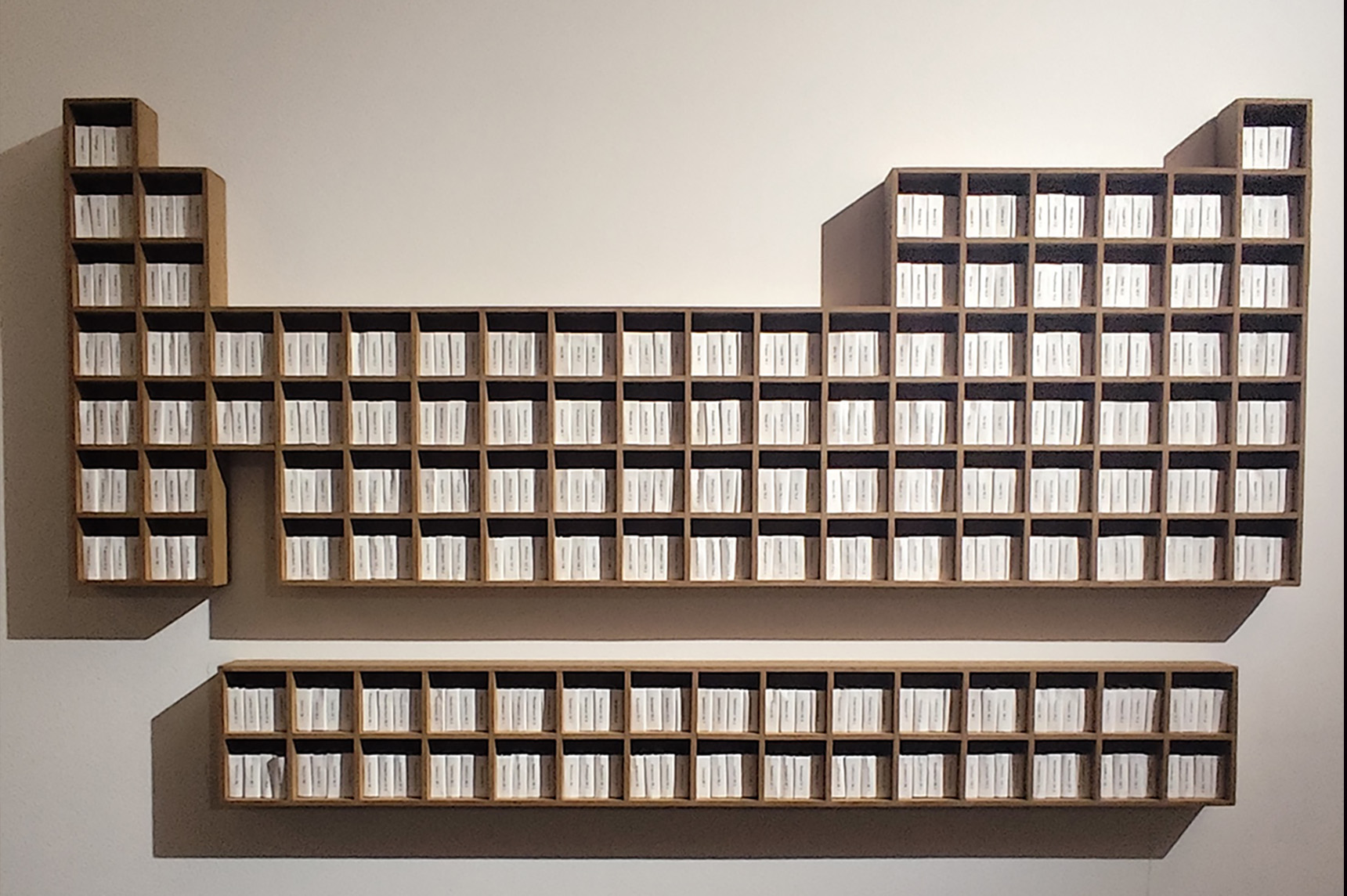
The first encounter is with Lim’s own installation. Rows of meticulously folded white booklets rest neatly on shelves, quietly resembling a minimalist library. At first glance, they appear almost archival, but each booklet contains a poem. Together they form a body of 118 poems, each inspired by an element from the periodic table.
During my visit, one of Lim’s interns explained that every element is represented by a single poem spread across four miniature books, with each page containing only a syllable. The poems unfold slowly, page by page, inviting readers to experience language almost as one would experience the gradual mixing of pigments.
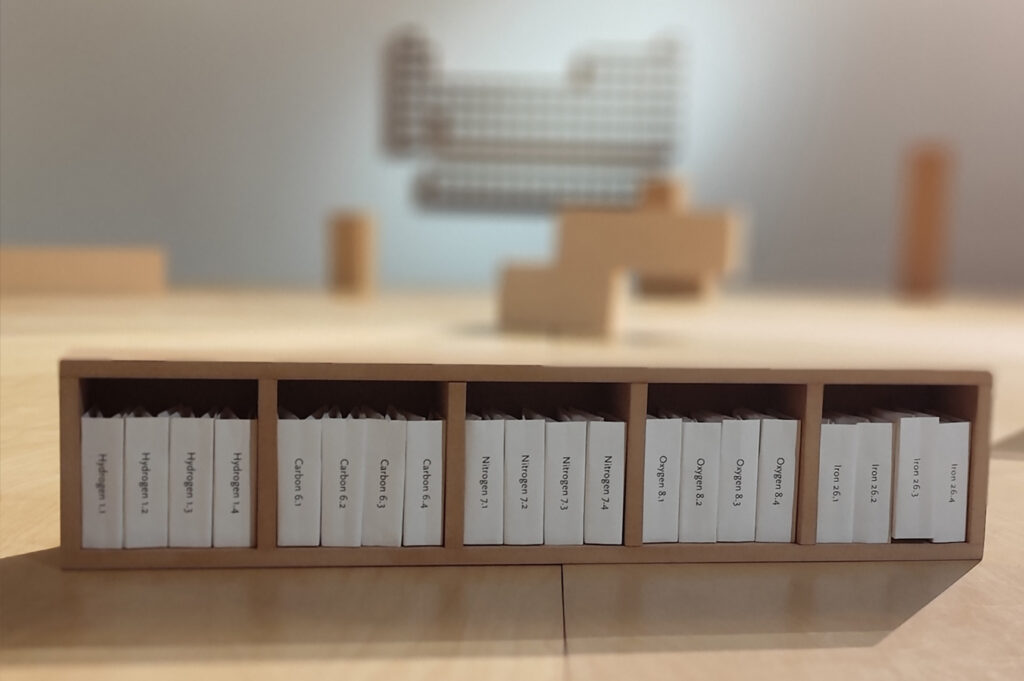
The installation culminates in a larger bookshelf arranged like the periodic table itself. More than a visual gesture, it reveals the conceptual backbone of the exhibition. Lim’s fascination with chemistry stems from years of researching colour pigments during her painting practice. Rather than viewing colour through its visual appearance, she began investigating the elemental compounds that give rise to pigments, eventually translating scientific structures into poetry.
Interestingly, almost everything is white.
When I asked why an exhibition centred on colour seemed to avoid colour altogether, the response revealed one of the exhibition’s most compelling ideas. Lim intentionally removed visible colour so that visitors would not experience it through sight alone. Instead, the blank white surfaces become what she describes as a tabula rasa, or blank slate, upon which each viewer constructs their own associations and emotional responses. Colour becomes imagined rather than seen.
Throughout the exhibition, painting gives way to poetry, music becomes sculpture, technology becomes drawing, and scientific research transforms into emotional experience.
Among the works that stayed with me was Jeremy Sharma’s digital installation. Better known for his painting practice, Sharma ventures here into moving image, light and sound. His work explores the relationship between music, text and visual form, transforming the darkness associated with Mars Black into a field where light emerges and shifts rhythmically. Rather than functioning as separate elements, sound and light move together as one, creating an immersive environment that rewards patience rather than spectacle.
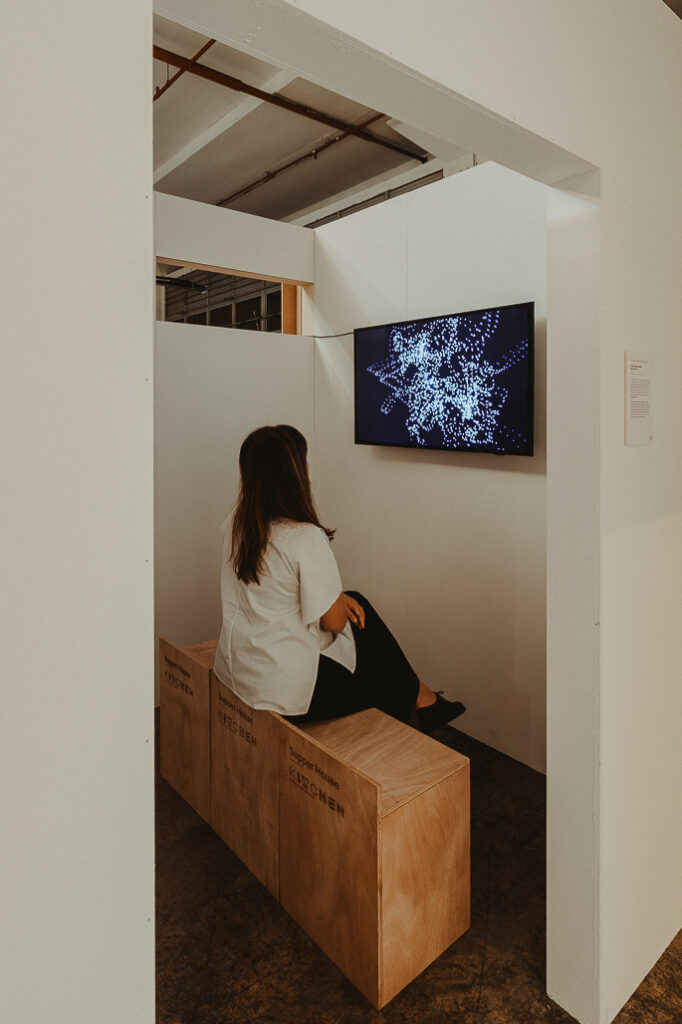
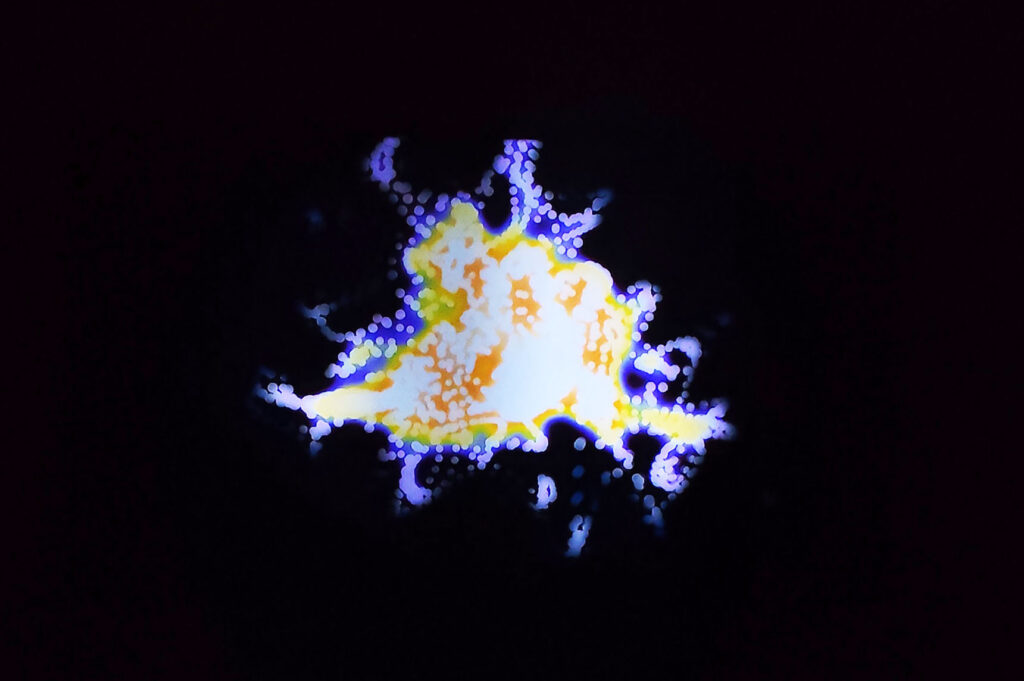
I found myself lingering there longer than expected. Listening. Watching. In the quiet intervals between the sounds, there was an almost tangible presence. It was one of those rare installations where silence becomes part of the artwork itself.
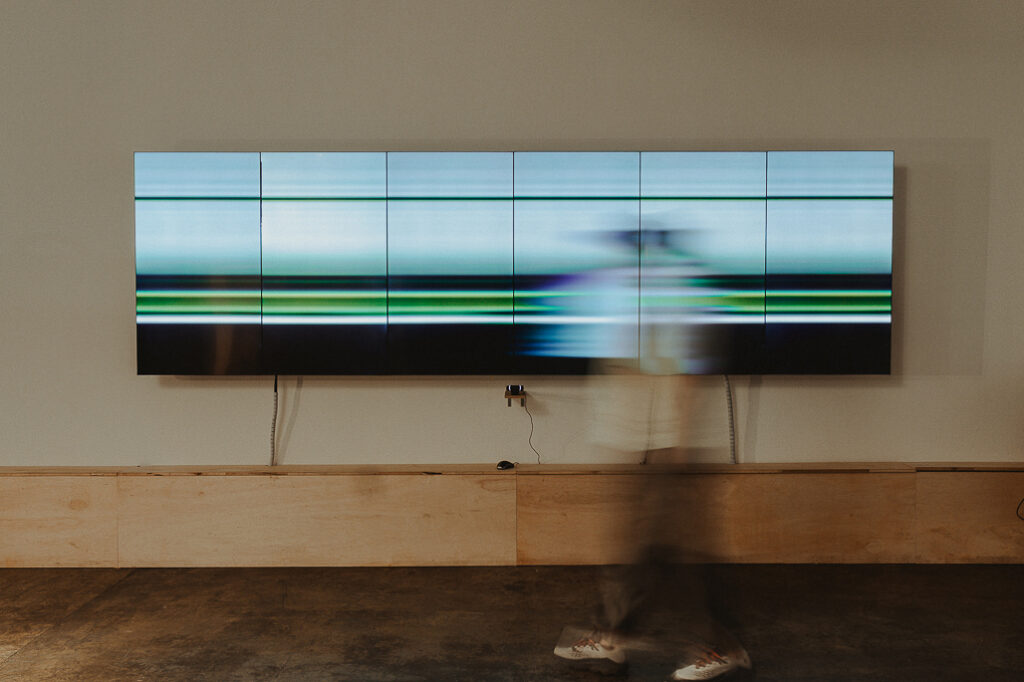
Nearby, Andreas Schlegel’s interactive installation responds to the movements of visitors. Motion sensors trigger shifting bands of colour that evolve as people enter the space, transforming passive viewing into an act of participation. Inspired by the pigment Viridian, the work quietly suggests that colour is not static but something experienced through interaction and presence.
Samantha Lee approaches the exhibition’s central ideas from another perspective. Her delicate sculptural forms, constructed from hollow aluminium tubes embedded with LEDs, draw inspiration from meteorites and the elemental materials that have existed since the beginning of the universe. By pairing these ancient materials with contemporary technology, she creates objects that seem to hover between the cosmic and the technological, reminding us that the materials powering today’s devices have histories stretching far beyond human civilisation.
Together, these works reinforce Lim’s curatorial vision. Rather than asking artists to illustrate her ideas, she invited them to respond through their own disciplines. The result is an exhibition where poetry, sound, sculpture, moving image and interactive technology speak to one another. As Lim’s intern explained during the walkthrough, what began as a solo exhibition evolved into a collaborative and interdisciplinary project because Lim wanted multiple artistic voices to expand upon the same conceptual framework.
Rather than offering definitive answers, The Alchemical Interludes encourages curiosity. It asks us to slow down, to question how we perceive colour, and perhaps to discover that our deepest experiences of colour do not always happen through the eyes.
The Alchemical Interludes at Supper House, Tanjong Pagar Distripark, from 26 June to 3 August 2026.