
For more than a decade, Indonesian-born, Singapore-based artist Boedi Widjaja has built a practice around migration, language, memory and identity. While his artistic vocabulary has evolved over the years, from maps and architecture to poetry, linguistics and now molecular biology, the questions that drive his work remain remarkably consistent. Where do we come from? What do we inherit? And how do we understand identity when language, culture and history are constantly in translation?
His latest exhibition, Peach Blossom Society :: 这里没有桃花 (“There Are No Peach Blossoms Here”), represents perhaps his most ambitious exploration of these ideas to date.
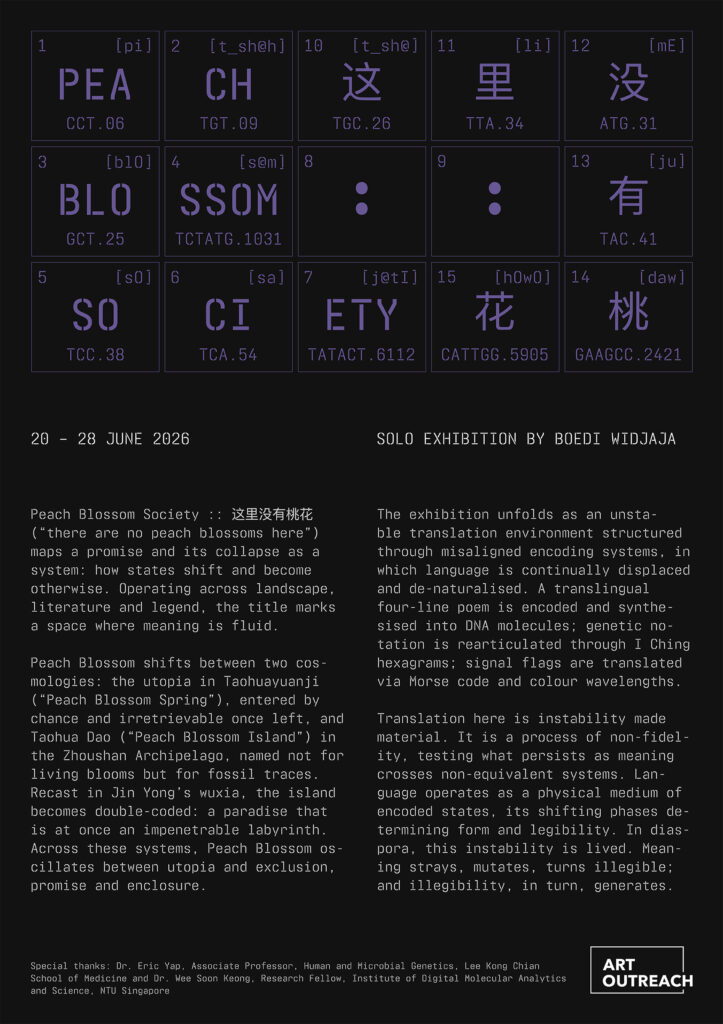
Drawing together literature, mythology, linguistics, poetry, DNA sequencing and the I Ching (易经), Peach Blossom Society presents translation not simply as the movement between languages, but as a way of understanding how identities are continually formed, transformed and carried across generations.
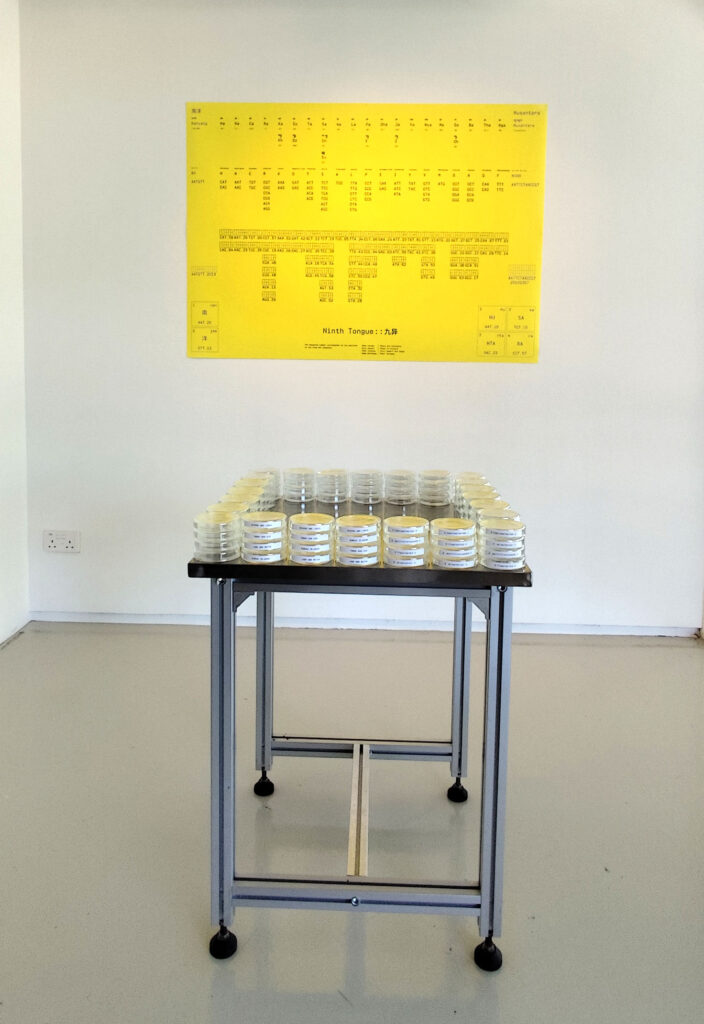
At first glance, the gallery resembles a scientific laboratory. Large wall installations evoke the visual language of periodic tables, while rows of petri dishes sit neatly arranged on stainless steel tables. Video installations reveal microscopic worlds invisible to the human eye. Yet beneath this scientific aesthetic lies an intensely personal story about ancestry, diaspora and belonging.
The exhibition title itself embodies contradiction.
It references two different “Peach Blossom” narratives from Chinese literature and folklore. One is Taohuayuan Ji (《桃花源记》), or The Peach Blossom Spring, an ancient tale of a hidden utopian village discovered by chance but impossible to return to once left. The other refers to Peach Blossom Island (桃花岛), immortalised by martial arts novelist Jin Yong (金庸) in his wuxia universe. Rather than a paradise, the island is both sanctuary and labyrinth, inviting yet inaccessible.
By bringing together these two opposing ideas of the peach blossom, Boedi creates a space where meanings coexist despite their contradictions. Translation, in his view, is never fixed or entirely faithful. Meanings shift, mutate and become something new.
Language, for Boedi, is never confined to words. It can exist as sound, image, material, biology and even code. DNA therefore becomes not merely a scientific subject, but another language capable of carrying memory and meaning.
One of the exhibition’s key works, Ninth Tongue :: 九异, visualises a translation system that Boedi first developed in 2019. Beginning with the twenty consonants of the Javanese Hanacaraka script, he maps each consonant onto the twenty amino acids that form the building blocks of life. Those amino acids are encoded by sixty-four DNA codons, which he then translates once again into the sixty-four hexagrams of the I Ching (易经).
Rather than presenting science and ancient philosophy as separate worlds, Boedi uncovers unexpected correspondences between them. The work becomes a bridge connecting language, molecular biology and cosmology into a single system of translation.
During the walkthrough, Boedi explained that his decision to work with Javanese was not simply because of the remarkable numerical correspondence between its twenty consonants and the twenty amino acids. It is also the language closest to what he considers his mother tongue.
More significantly, Javanese belongs to the Austronesian language family, whose migration history has shaped much of Island Southeast Asia. By allowing words to pass through Javanese before entering molecular code, Boedi quietly echoes the movement of peoples, languages and cultures across the region. His research may now involve genetics, but at its heart, the work continues to speak about ancestry and the Southeast Asian diaspora. Language simply becomes another vessel through which those histories travel.
The question of inheritance also surfaced in an intimate conversation about his own name.
Born into a Chinese Indonesian family whose surname is Huang (黄), Boedi revealed that he is the only member of his immediate family to carry the surname Widjaja. While many Chinese Indonesians adopted Indonesian-sounding names during periods of political uncertainty, Boedi admitted he never really asked his father why he alone was given Widjaja.
Rather than searching for a definitive explanation, he embraces the ambiguity. Identity, much like language itself, is layered, negotiated and continually translated.
Perhaps nowhere is this interplay between language and lineage more moving than in Islands of Remembering and Forgetting.
The installation centres around a four-line poem written by Boedi in both English and Bahasa Indonesia. By rearranging the order of its four verses, he generated twenty-four possible permutations. Each verse was then translated into DNA sequences using his own linguistic system before collaborating with a geneticist to synthesise them into actual DNA molecules.
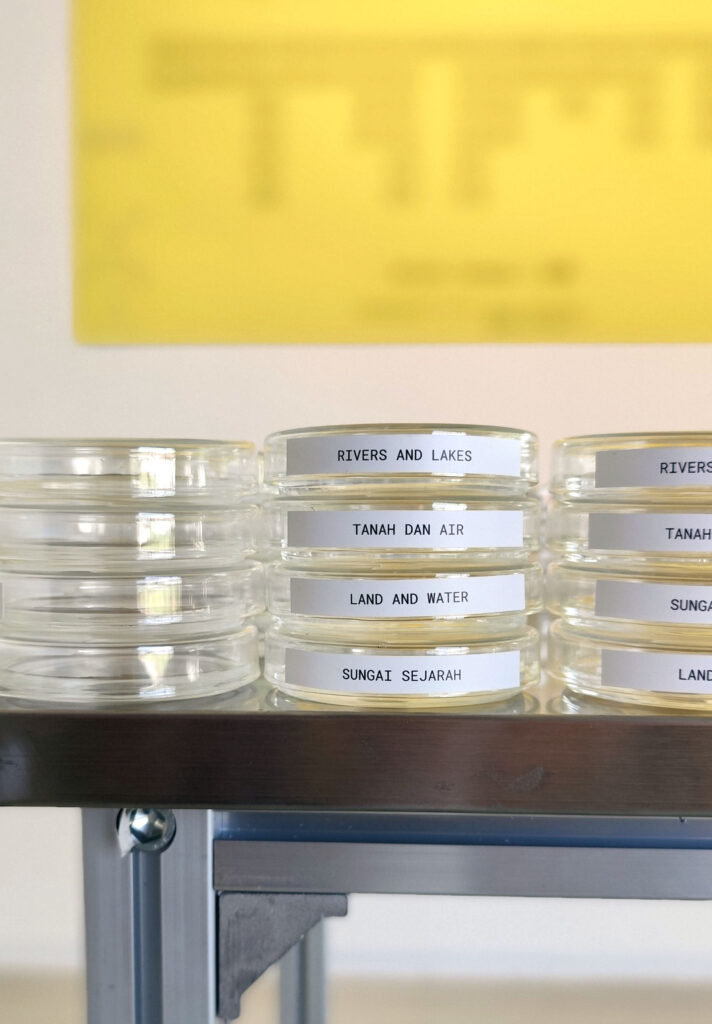
The ninety-six petri dishes displayed across the gallery each contain one encoded verse in synthetic DNA. Together, they transform poetry into biological material. Language no longer exists only on paper. It becomes molecular, physical and tangible.
The collaboration with a geneticist moves the work beyond metaphor. These are not symbolic representations of DNA, but actual synthetic DNA strands carrying encoded fragments of poetry.
Accompanying the installation are two videos that reveal the molecular processes taking place beyond our vision. One presents microscopic visualisations of DNA strands drifting through solution before gradually finding one another and self-assembling. The resulting sequences no longer reproduce the original poem faithfully. Lines repeat, reverse themselves, fragment and even generate entirely new combinations through the assembly process.
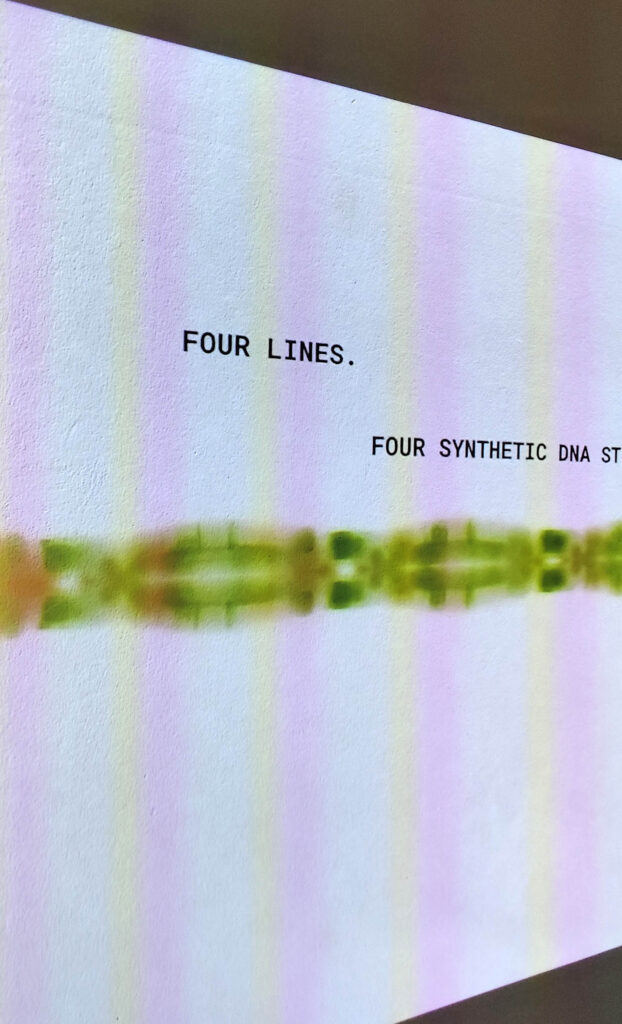
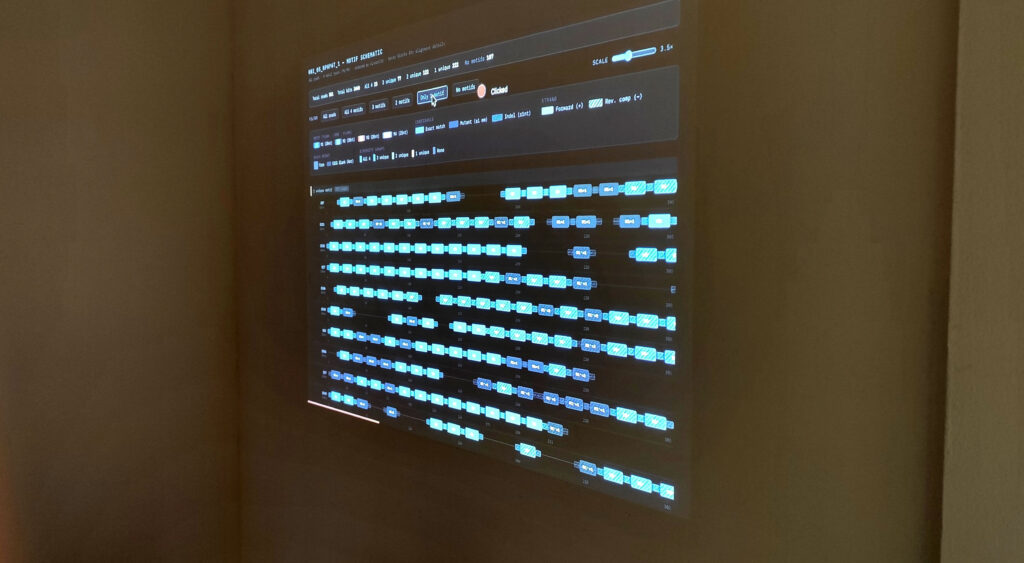
The second video visualises the sequencing results, showing the poem reconstructed from its molecular traces. Together, they suggest that memory, language and identity are never static archives. Like DNA itself, they continually reorganise, mutate and evolve.
One of the exhibition’s more playful works, Immortal Words :: 字基, invites visitors to become participants. Through a gachapon machine, visitors receive capsules containing synthetic DNA encoded with verses from Boedi’s poem. The work quietly transforms language into something collectible, portable and surprisingly intimate, blurring the line between artwork, archive and personal keepsake.
What makes Peach Blossom Society particularly compelling is that, despite its scientific appearance, it is never really about science.
Throughout the walkthrough, Boedi repeatedly returned to language. DNA, genetics, the I Ching, Morse code and molecular sequencing are all treated as languages capable of carrying meaning. His interest lies not in scientific discovery, but in revealing unexpected relationships between systems that rarely speak to one another.
In doing so, he reminds us that translation is never about achieving perfect equivalence. Something is always altered. Something is always lost. Yet something entirely new can also emerge.
For those who have followed Boedi’s practice over the years, this exhibition feels less like a departure than an expansion. His long-standing investigations into migration, ancestry and belonging have simply found a new vocabulary through molecular biology. The research has become more complex, but the questions remain deeply human.
As our increasingly interconnected world continues to blur the boundaries between language, culture and identity, Peach Blossom Society offers a timely reflection on how we carry history within us. Whether through words, names or DNA, our identities are never fixed inheritances. They are living systems, constantly translating, adapting and becoming.
Exhibition Details
Peach Blossom Society :: 这里没有桃花 (“There Are No Peach Blossoms Here”)
Artist: Boedi Widjaja
Venue: Art Outreach, Gillman Barracks
5 Lock Road, #01-06, Singapore 108933
Exhibition Period: 20 – 28 June 2026