
The moment I stepped into Maria Taniguchi: Afterimage, I instinctively slowed down.
Instead of the familiar atmosphere of a museum exhibition, Gallery 3 at Singapore Art Museum felt more like walking into a pristine contemporary white wall gallery. The vast openness of the space immediately welcomed me, allowing each work the room to breathe. There was a quietness to it. Nothing competed for attention and nothing felt rushed.
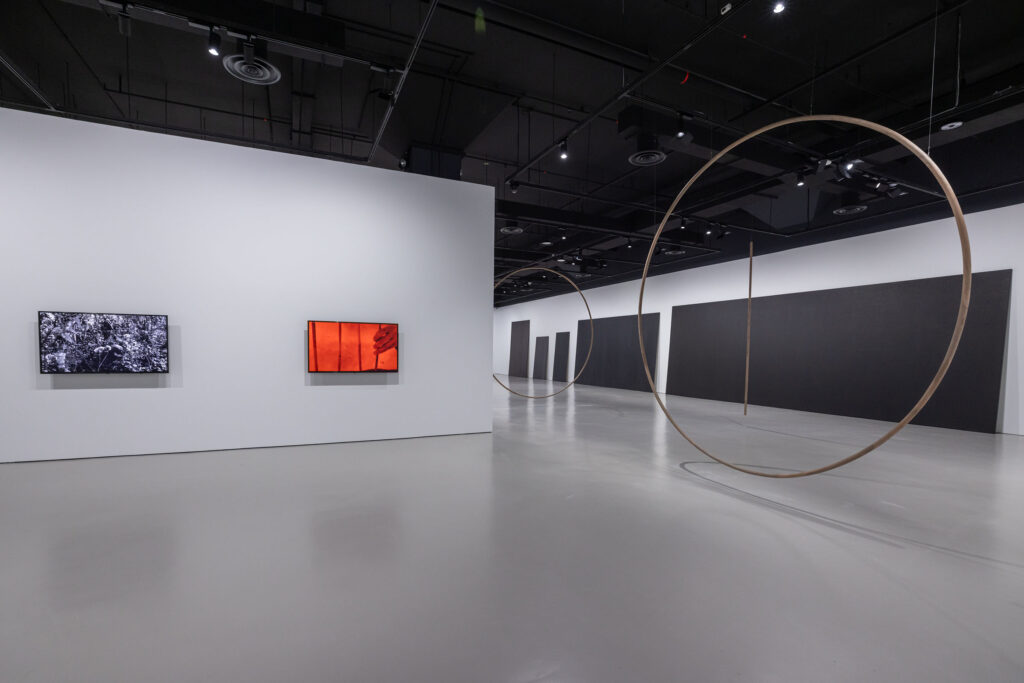
Having recently encountered several of Maria Taniguchi’s paintings at Art Basel Hong Kong 2026, I thought I had a fair understanding of her practice. Seeing a handful of works in a fair setting, however, is an entirely different experience from standing before this exhibition. Afterimage brings together 18 works spanning nearly two decades of the internationally acclaimed Filipino artist’s practice, comprising thirteen monumental “brick paintings”, a new iteration of the Runaways series created specifically for the Singapore Art Museum’s gallery, and together with four moving image works.
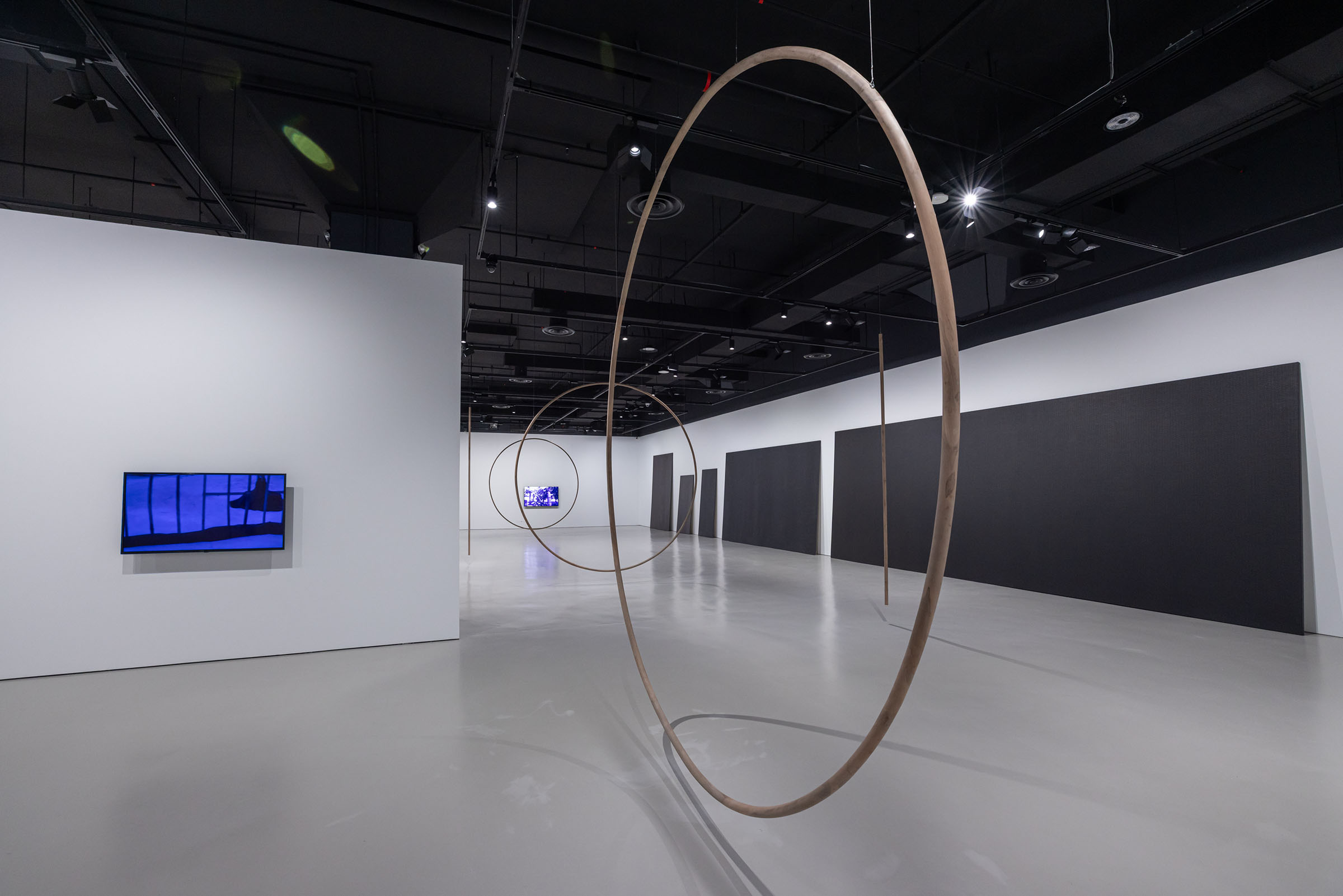
Rather than feeling overwhelming, the exhibition possesses an unexpected sense of calm. The monumental canvases, each gently leaning against the gallery walls instead of hanging conventionally, create a quiet rhythm throughout the gallery. They feel less like individual paintings competing for attention and more like companions in conversation, each contributing to a much larger whole.
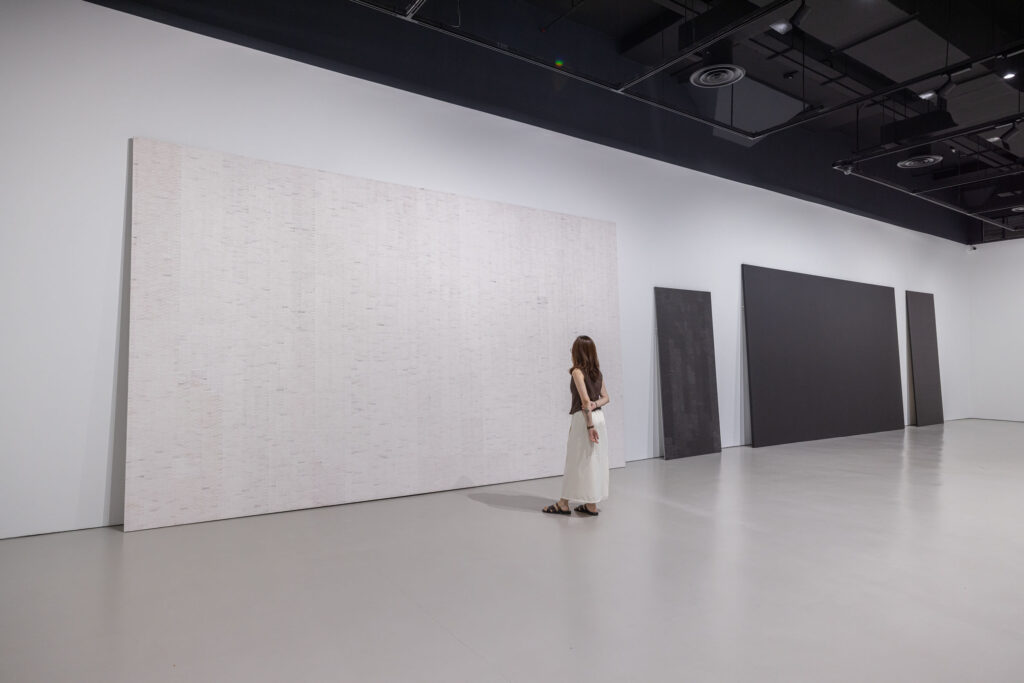
From a distance, the paintings appear almost identical. Their orderly rows of rectangular forms resemble brick walls, precise and systematic.
It is only when I found myself drawn closer that the paintings began to reveal themselves.
Tiny shifts in colour became visible. Individual brushstrokes surfaced. The texture of each painted rectangle emerged, carrying subtle imperfections that quietly testified to the artist’s labour. What initially appeared repetitive slowly transformed into something deeply human. Every painted block became a record of time, patience and physical endurance.
That, perhaps, is the quiet brilliance of Afterimage. It doesn’t demand your attention. It rewards it.
More Than What Meets the Eye
During the media preview, curator Haeju Kim introduced the exhibition by reflecting on the title, Afterimage. While many associate an afterimage with the lingering visual sensation that remains after looking at something, she explained that the title was intentionally left open. It could also refer to the memories, impressions and emotional traces that continue to stay with us long after we have left the gallery.
That idea resonates throughout the exhibition.
Although Afterimage unfolds through paintings, sculptures and moving images, each work circles back to recurring themes of repetition, labour, memory and time. Rather than presenting a chronological survey of Taniguchi’s career, the exhibition invites visitors to experience these ideas physically and emotionally, allowing meaning to accumulate gradually instead of revealing itself all at once.
Curator Duncan Bass later shared that the exhibition had been nearly eighteen months in the making. Having previously encountered Taniguchi’s works in gallery presentations and international art fairs, he explained that seeing only a few paintings at a time offers a very different experience from encountering thirteen of them together.
“The difference between the canvases becomes more and more clear the more of them that you get to experience,” he shared during our conversation after the tour.
His observation echoed my own experience.
At Art Basel Hong Kong earlier this year, I admired the paintings for their monumentality and quiet presence. Here at SAM, surrounded by thirteen of these towering canvases, something shifted. Instead of seeing repetition, I began noticing subtle differences. Some paintings felt warmer, others cooler. Certain surfaces carried denser brushstrokes while others appeared softer and lighter. They were no longer repeating themselves. They were speaking to one another.
Bass explained that the curatorial team deliberately chose to focus on the large-scale paintings, sculptures and moving image works because restraint has always been one of Taniguchi’s greatest strengths. Rather than presenting every aspect of her practice, the exhibition distils it to its essential language, allowing visitors to experience the paintings almost architecturally instead of simply as images on a wall.
Time You Can See
For nearly two decades, Taniguchi has continued her ongoing series of “brick paintings”, each painstakingly constructed from thousands of hand-painted rectangular cells.
Despite appearances, they are not paintings of bricks.
They are paintings built through repetition.
Every rectangle is first carefully drawn before being painted individually. Over days and weeks, tiny shifts in pigment, brush pressure and colour quietly accumulate, transforming what first appears systematic into something profoundly human.
Many viewers associate such repetitive mark-making with meditation.
When I asked Maria if painting brought her into a meditative state, she smiled before gently challenging that assumption.
“I don’t really use the word meditation,” she admitted.
“There is pleasure in painting and getting into it. Sometimes I get lost in the painting for sure. But it’s not always something you could use the analogy of meditation.”
She laughed as she described the less romantic reality.
“Sometimes it’s a struggle. Sometimes your neck hurts and your back hurts.”
For Taniguchi, painting is as much a physical act as it is a mental one.
“Sometimes you don’t leave your body. Sometimes you’re really in your body.”
Then came perhaps my favourite line from our conversation.
“I don’t practise meditation myself. Maybe because I already have painting.”
It is an unexpectedly honest response. Rather than escaping into another state of consciousness, Taniguchi embraces the physicality of making. Every painted rectangle becomes evidence of concentration, endurance and time.
One Painting That Never Ends
Perhaps one of the most fascinating aspects of Taniguchi’s practice is that she does not consider these paintings to be individual works.
Instead, every canvas belongs to one continuous artwork that has been evolving since 2008.
When I asked whether collectors ever found that unusual, she offered a perspective that completely changed the way I viewed the exhibition.
“I think it’s great that certain people have one piece and then share the whole painting together.”
It is a remarkably generous way of thinking about collecting.
Rather than separating the work through ownership, every collector becomes part of a much larger whole. Museums, private collections and galleries across the world each hold fragments of one ever-expanding painting that continues to grow with every new canvas she completes.
That philosophy also explains why none of the works carry individual titles or numbers. They simply continue.
Structure Meets Intuition
Given the consistency of her visual language, I was curious why Taniguchi chose the humble brick as the foundation of her practice.
Her answer was surprisingly simple.
“It could be anything,” she said.
“I guess we all just have to make a choice of one thing.”
For her, it was never really about bricks.
It was about modularity.
“The smaller forms in the paintings point to the relationships between the many paintings that I’ve made.”
Although the structure remains fixed, everything else is left open.
“Everything else is chance… maybe even chaos.”
“There is no regimental thing after the brick pattern is drawn.”
Standing before the paintings after hearing her explain this process, they transformed once again. What first appeared rigid suddenly felt alive. Every subtle variation became evidence of intuition quietly unfolding within an established framework.
Drawing in Space
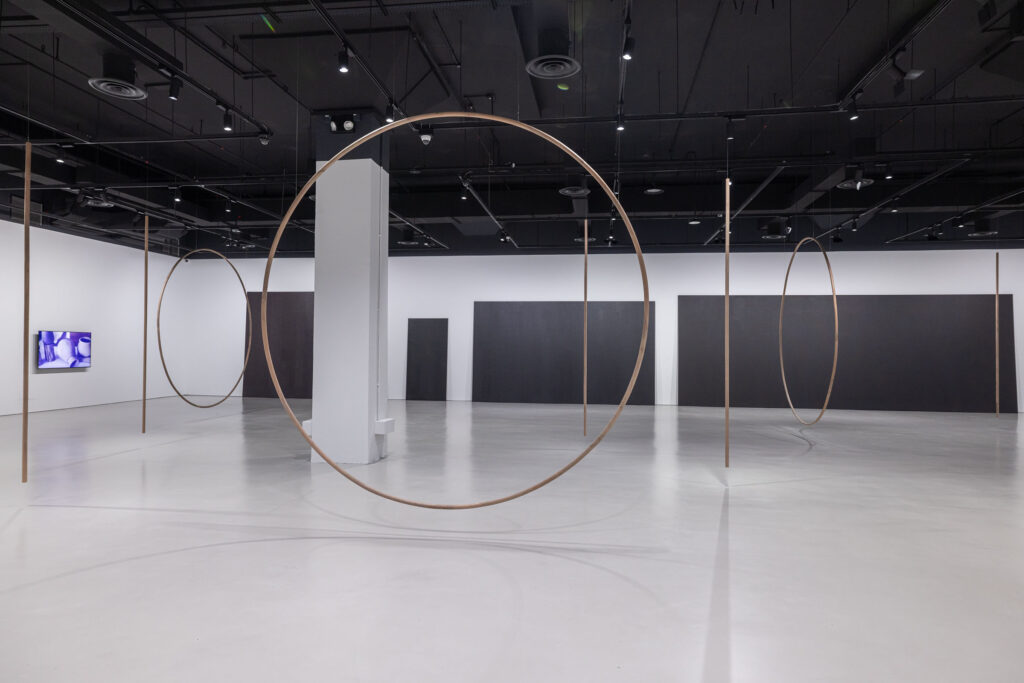
Constructed from circles and straight lines, the sculptures resemble simple drawings lifted into three-dimensional space. They gently guide visitors through the gallery, constantly shifting perspectives between paintings and videos.
The same balance between structure and intuition extends into Runaways, Taniguchi’s ongoing sculptural series. Reimagined for Maria Taniguchi: Afterimage, this new site-responsive iteration transforms the gallery into a space where sculpture, drawing and architecture quietly intersect.
Yet beneath their minimalist appearance lies an intimate personal story.
The sculptures are carved from duhat, or Java plum wood. Taniguchi shared that the material was chosen because her mother craved the fruit while pregnant with her, embedding the sculptures with a quiet familial memory.
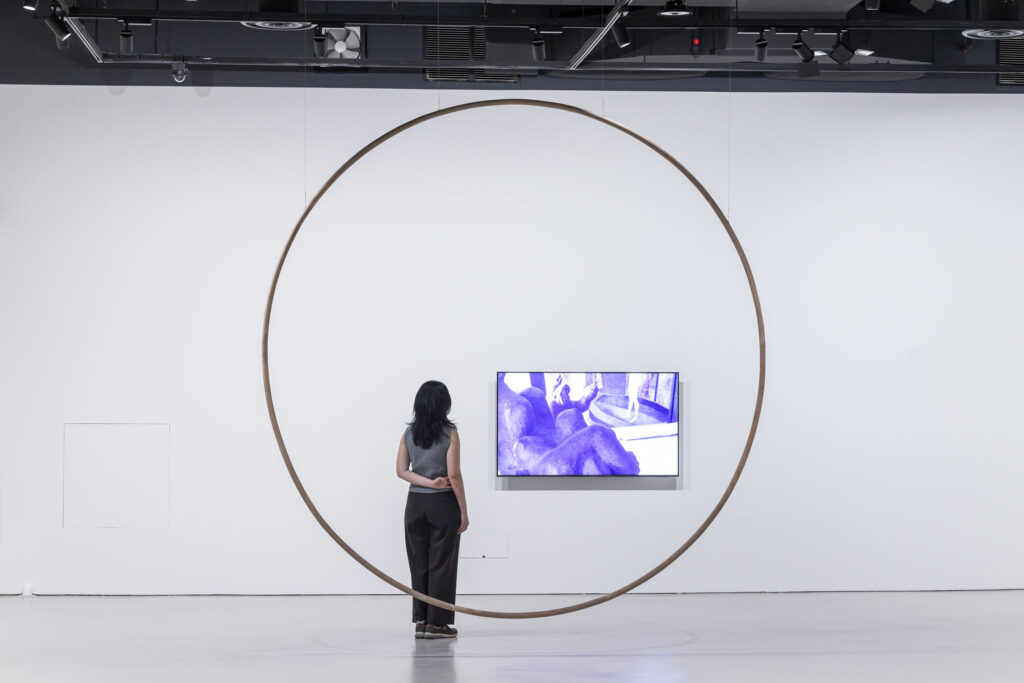
This deeply personal narrative returns in the newly commissioned video A painter, if black were a place, which reflects on her relationship with her mother through pixelated photographs, painted black surfaces and images of her family home. Together, the sculptures and moving images reveal that behind Taniguchi’s restrained visual language lies a practice deeply rooted in memory, material and lived experience.
An Afterimage That Lingers
As our conversation drew to a close, I asked Taniguchi whether she ever found it difficult to let her paintings go after spending months making them.
She smiled knowingly.
“There is an attachment and detachment.”
“Artists have to learn that.”
It felt like a fitting way to conclude our conversation.
Perhaps that is also what Afterimage quietly asks of its audience.
To spend time.
To notice.
To slow down.
In an age where images are consumed in seconds, Maria Taniguchi reminds us that some works only begin to reveal themselves after we have looked a little longer.
Long after I left Gallery 3, it wasn’t just the monumental brick paintings that stayed with me. It was the quiet awareness that every painted rectangle, every carved line and every lingering frame carried something invisible yet deeply present: time itself.
The exhibition runs from 24 July to 22 November 2026 at Gallery 3, SAM at Tanjong Pagar Distripark. Admission is free for all Singapore Citizens and Permanent Residents, with standard general admission charges applying for international visitors.