Tag: Singapore

  • Daniel Arsham – #YESTERDAYSFUTURES at Espace Louis Vuitton Singapore

    Daniel Arsham – #YESTERDAYSFUTURES at Espace Louis Vuitton Singapore

    Daniel Arsham - #YESTERDAYSFUTURES at Espace Louis Vuitton Singapore

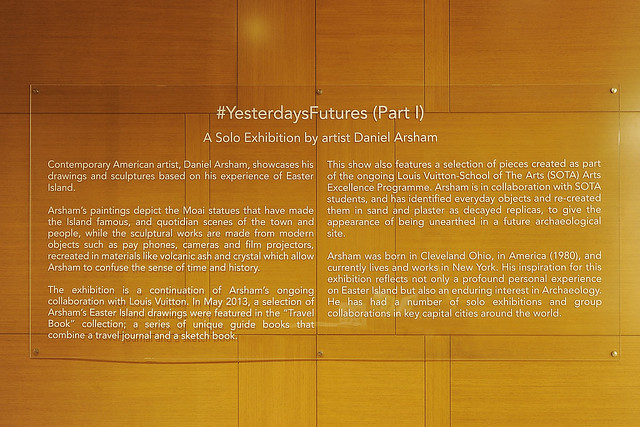
    Espace Louis Vuitton Singapore is showing a series of sculptures made of everyday objects recreated in materials such as volcanic ash and crystal by the young talented American contemporary artist, Daniel Arsham, as part of a parallel event of the Singapore Biennale 2013.  This is the artist’s first solo exhibition in Singapore featuring in two different shows: #YESTERDAYSFUTURES (PART I) a solo exhibition; #YESTERDAYSFUTURES (PART II) a collaboration with the School of the Arts, Singapore (SOTA) as part of the ongoing Louis Vuitton – SOTA Arts Excellence Programme.

    Daniel Arsham - #YESTERDAYSFUTURES at Espace Louis Vuitton Singapore

    #YESTERDAYSFUTURES (PART I) at Espace Louis Vuitton Singapore shows a collection of uniquely created eroded sculptures made of everyday objects. The artist also attempts to present the interpretation of the archaeological site of Easter Island through a series of drawings.  These gouaches on mylar drawings were featured in Vuitton’s Travel Book collection published in May 2013, and were the beginning of a successful collaboration with Arsham. They are created as a series of unique guide books that combine a travel journal and a sketch book, where the artist had a chance to “interpret the surviving monumental statues of Easter Island in a series of drawings and sculptural works that together create a fictional archaeology informed by his personal experience on the Island.”

    #YESTERDAYSFUTURES (PART II) shows a series of the artist’s collaborations with a group of Visual Arts 3rd year students from the School of the Arts, Singapore (SOTA), where the exhibition is held. The collaboration is part of the ongoing Louis Vuitton – SOTA Arts Excellence Programme. In this part of exhibition the artist and his aspiring collaborators identify our everyday objects and re-created them in sand and plaster as decayed replicas, giving them the appearance of being unearthed in a future archaeological site. The students of SOTA spent 6 months with Arsham in the studio working on the exhibits. To the students, it was an invaluable and unforgettable experience of interaction with an international artist.

    [alpine-phototile-for-flickr src=”set” uid=”artitute” sid=”72157637634009296″ imgl=”fancybox” style=”gallery” row=”10″ grwidth=”800″ grheight=”00″ size=”500″ num=”14″ shadow=”1″ highlight=”1″ curve=”1″ align=”center” max=”100″ nocredit=”1″]

    “It was quite an extraordinary challenge we all faced. I’d say the biggest challenge was staying in studio weekly for 6 months to work on these items. Even though I really enjoyed it, there’s nothing that really changes the fact that you’ve been working in school for 11 hours, 5 hours of which you spent pouring plaster into sand moulds and dusting the casts afterwards. The perseverance and endurance my fellow group mates showed together with that of the teachers in charge is, I feel, greatly admirable. I could not have asked for a better group of teammates to work with, especially for 6 months.” Caleb Goh (Year 3, Visual Arts)

    Arhsam’s unique and enigmatic artistic approach has attracted the interests of renowned galleries, institutions and individuals in the art world, including Emmanuel Perrotin of Galerie Perrotin, Bonnie Clearwater of MOCA Miami, ex-creative director of Dior Homme, Hedi Slimane, and the choreographer Merce Cunningham – who asked him to design the set, lighting and costumes for “eyeSpace,” – an ephemeral performance. The artist, who is known for collaborating with different experts while developing his works, creates spaces that combine art, architecture and design. His deliberately multidisciplinary projects remain difficult to define. He plunges them in the mystery of ruins and lost civilizations, and then projects them into the future, like an architect turned archaeologist.

    Prior this collaboration with Louis Vuitton – SOTA in Singapore, the artist was exhibiting in Amsterdam and London. He has established many followers in Europe and American over years, and making his break into the Asian art scene by choosing Singapore as his first stop before Hong Kong.

    #YesterdaysFutures (Part I) and #YesterdaysFutures (Part II) are events of the Singapore Biennale: IF the World Changed.

     #YesterdaysFutures (Part I) runs from 24 October – March 2014, Sunday – Thursday (10:00 – 23:00), Friday – Saturday (10:00 – midnight) at Espace Louis Vuitton Singapore, Louis Vuitton Island Maison, Marina Bay Sands.

    #YesterdaysFutures (Part II) runs from October 24 – November 10, 2013 at SOTA Gallery, 1 Zubir Said Drive, Singapore 227968.
  • Edible Art Movement “We Art what we Eat” at the Affordable Art Fair Singapore

    Edible Art Movement “We Art what we Eat” at the Affordable Art Fair Singapore

    Do you desire art that can jolt you out of your comfort zone whilst reaching in to fragrantly connect with your soul? We’ve heard there is a way…

    You may have heard the rumours that something entirely different, aromatically original and uniquely sensorial will arrive in Singapore this November.  Artitute caught up with the Edible Art Movement– or EAM as they call themselves – at their studio. (more…)

  • The Collective Power of Performance Art

    The Collective Power of Performance Art

    Performance art is a strange thing. As a live event it happens in the moment, unrehearsed. It can be a solitary performance by the artist or a public one- in which case it evolves with its participants often beyond the artist’s control and into something very different from what was initially envisioned. Perhaps that is the beauty of this open ended art form.

    Singapore Biennale 2013 - If The World Changed
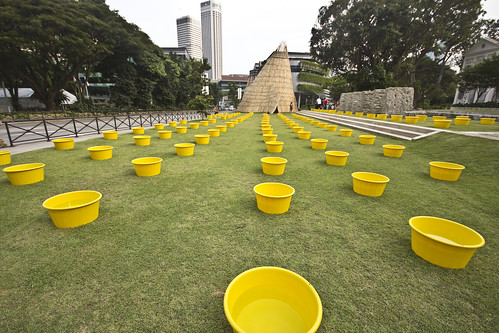
    Yellow tubs for the Singapore Biennale 2013 Mandi Bunga (Flower Bath).

    The mandi bunga or flower bath is a centuries’ old folk tradition that has transcended cultures and religions to become a truly Southeast Asian ritual, practiced by the Indians, Chinese and Malays. Its purpose is to rid oneself of bad luck and negative vibes in order to improve one’s aura and attract good luck and fortune. Hoping to accomplish this renewal collectively, Malaysian artist, Sharon Chin’s Mandi Bunga (Flower Bath) opened the Singapore Biennale 2013. The artist and one hundred volunteers came together to first design and paint their yellow sarongs and then to have a mandi bunga together on the front lawn of the National Museum Singapore. The act was performed here in Singapore by people of various backgrounds, age, gender and nationality.

    Singapore Biennale 2013. Preparing the bath water for Mandi Bunga, Courtesy of Helmie Kremers.
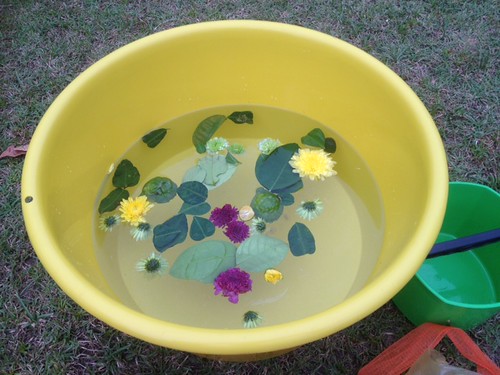
    Getting the bath water ready with kaffir lime and pomelo leaves, flowers and calamansi and lime fruit for the Singapore Biennale 2013 Mandi Bunga (Flower Bath). Courtesy of Helmie Kremers.

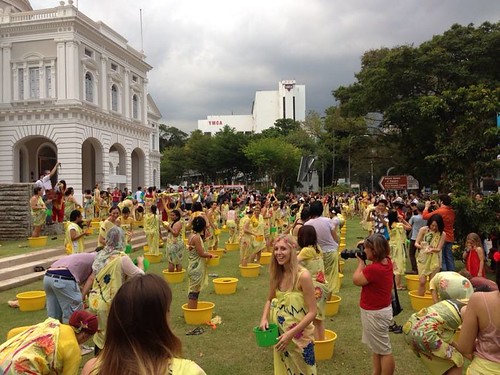
    Singapore Biennale 2013. Singapore Biennale 2013 Mandi Bunga (Flower Bath) in progress at the National Museum front lawn. Courtesy of Kate Horsburgh.
    Mandi Bunga in progress at the National Museum front lawn. Courtesy of Kate Horsburgh.

    On a personal level, the idea of throwing away the bad to attract the good appealed to me and was my reason for participating. Many other people, when asked, said they thought it would be fun and that is why they had joined in. The performance began with everyone walking from the Singapore Art Museum building to the National Museum lawn across the road where yellow tubs had been placed ready for use. Sharon signalled the start of the performance by waving a yellow flag. We began by infusing the bath water with a potpourri of kaffir lime and pomelo leaves, calamansi and lime fruit, colourful flowers and their petals – each element bringing its own energy and fragrance to the mix. Many then indulged in a full leisurely bath but others who were a bit reluctant to pour water over themselves publicly simply washed their arms, legs and face. In another corner the mandi bunga turned into a Songkran festival as some of us decided that they would help those a bit shy by lobbing bucketfuls of water at them which of course invited retaliation and eventually resulted in everyone getting a good soaking anyway! Whatever the method, the mandi bunga happened at the designated time and space with the participants all taking a ritual flower bath until Sharon signalled the end of the performance by taking off her sarong and flicking it, which was followed by the rest.

    A few thousand miles away in the Pakistani city of Karachi, another public performance began on the same day at midnight. A four minute composition on the flute titled Chayn ki Bansuri (the flute of peace) was broadcast across the city via local radio channels. People were requested to participate by either tuning in or downloading the track and playing it on their phones and computers at the selected time to create a collective interlude of peace in a city where people live amidst constant tension and fear. The decision to hold the performance at midnight was to create a period of harmony at a time when most people are back into the safety of their homes, hoping to unwind before facing the city again the next day. The event was a public art project created by the Pakistani artist Durriya Kazi and part of Pursukoon Karachi (Peaceful Karachi), an initiative by the city’s Koel Gallery to promote peace in the city via various art forms. Kazi called the performance a way of empowering people to create peace even if for a few minutes. The exact number of people who participated cannot be known as it was an open event staged via digital media. Volunteers had distributed leaflets across a wide cross section of the city to involve as many people as possible in the city of 20 million but how far the initiative reached is beyond measure. On the night of the event, volunteers drove around the city playing the track in their cars and with their windows down, to envelope the whole city in the melodious and peaceful sound of the flute. There were participants from other Pakistani cities and overseas as well, who joined in by playing the track at midnight Pakistan time. The responses to this performance were as varied as for the Mandi Bunga (Flower Bath). Some loved the idea while others thought it a frivolous act that achieves nothing. Some participated wholeheartedly, inviting others to join in while others threw away the leaflets before even reading them.

    The art in both cases happened at that moment. At 6 pm Singapore time for Mandi Bunga (Flower Bath) and at midnight Pakistan time for Chayn ki Bansuri. The performances cannot be replicated and only fragments of the responses and emotions it evoked can be documented. In Mandi Bunga’s case, the photos of the event as well as flowers and leaves remaining in the water tubs will be exhibited at the Singapore Art Museum at part of the Singapore Biennale 2013. Chayn ki Bansuri will live in the soundtrack, the tweets and posts on social media and in the collective memories of those who participated.